A
B
C
D
Text Solution
Verified by Experts
The correct Answer is:



Topper's Solved these Questions
Similar Questions
Explore conceptually related problems
CAREER POINT-MOCK TEST 2-PART ( C)- MATHS
- If z is a complex number, then the minimum value of |z|+|z-1| is -
Text Solution
|
- x+y+z=15 if 9, x, y, z, a are in A.P. while (1)/(X)+(1)/(Y)+(1)/(Z)=(5...
Text Solution
|
- lim(hto0)(1)/(h)int(x)^(x+h)(dz)/(z+sqrt(z^(2)+1)) is equal to -
Text Solution
|
- If the area bounded by the curve y=f(x), x-axis and the ordinates x=1 ...
Text Solution
|
- If f(x) = e^(x), then lim(xto0) (f(x))^((1)/({f(x)})) (where { } deno...
Text Solution
|
- Let f(x) = x[x], xinz, [.] is GIF then "f"^(')(x) =
Text Solution
|
- If f(x)={{:(,[x]+[-x],,,xne2 ),(," "lamda,,,x=2):} then f is continuo...
Text Solution
|
- Let f(x)={x^3-x^2+10 x-5,xlt=1-2x+(log)2(b^2-2),x >1 Find the values ...
Text Solution
|
- The equations of the perpendicular bisector of the sides AB and perpen...
Text Solution
|
- If (1,a), (2,b), (c^2,3) are vertices of a triangle then its centroid ...
Text Solution
|
- A polygon has 25 sides, the lengths of which starting from the smalles...
Text Solution
|
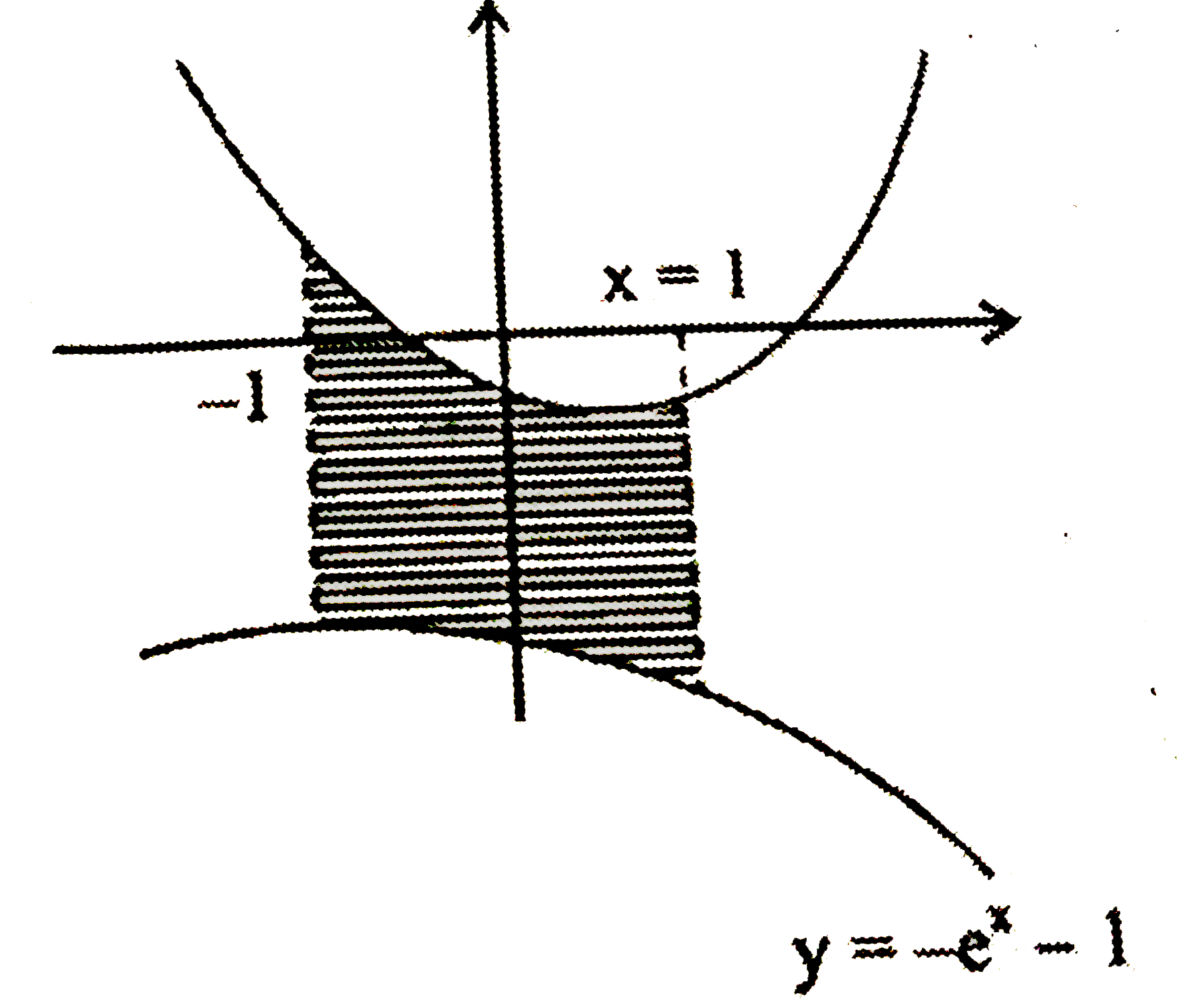
- The area bounded by the curves y= x^(2)-2x-1, e^(x)+y+1=0 and ordinate...
Text Solution
|
- Let S be the set of real values of parameter lamda for which the equat...
Text Solution
|
- If f(x)=x^(3)+ax^(2)+ax+x(tantheta+cottheta) is increasing for all x ...
Text Solution
|
- If f(x) = { 3 + |x-k|, x leq k; a^2 -2 + sin(x-k)/(x-k), xgtk} has min...
Text Solution
|
- int(x^(2)-1)/((x^(2)+1)sqrt(x^(4)+1)) dx is equal to -
Text Solution
|
- The void relation on a set A is
Text Solution
|
- If 0le[x]lt2,-1le[y]lt1and1le[z]lt3, where [*] denotes the greatest in...
Text Solution
|
- The system of equations 6x+5y+lamdaz= 0, 3z-y+4z= 0, x+2y-3z=0 has non...
Text Solution
|
- The median of following frequency distribution is {:(,"Class",,fi),(...
Text Solution
|