Home
Class 12
PHYSICS
A particle initially at rest on a fricti...

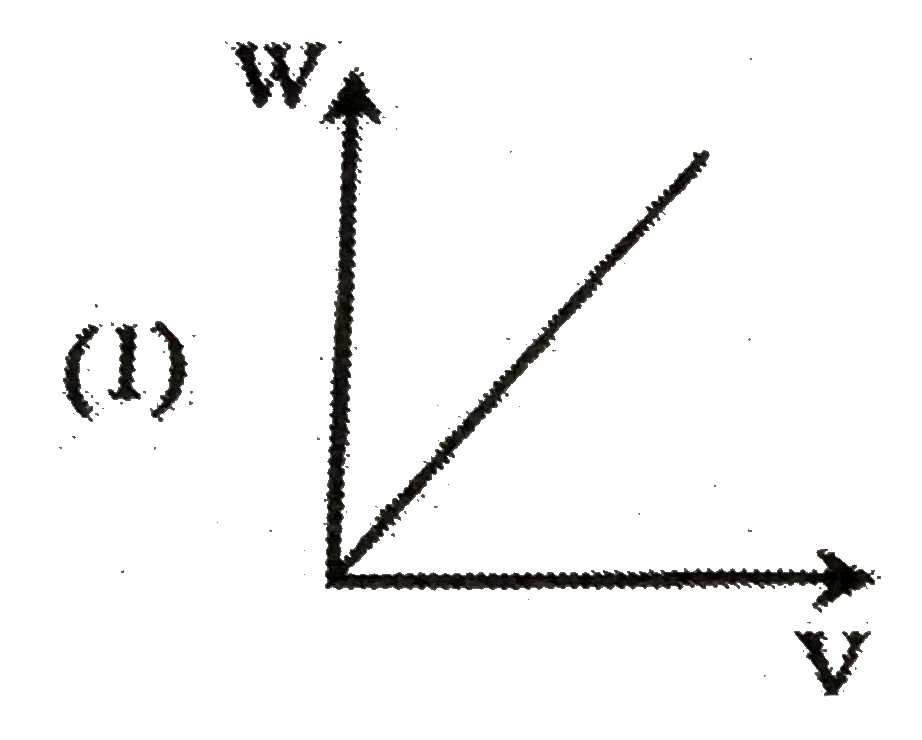
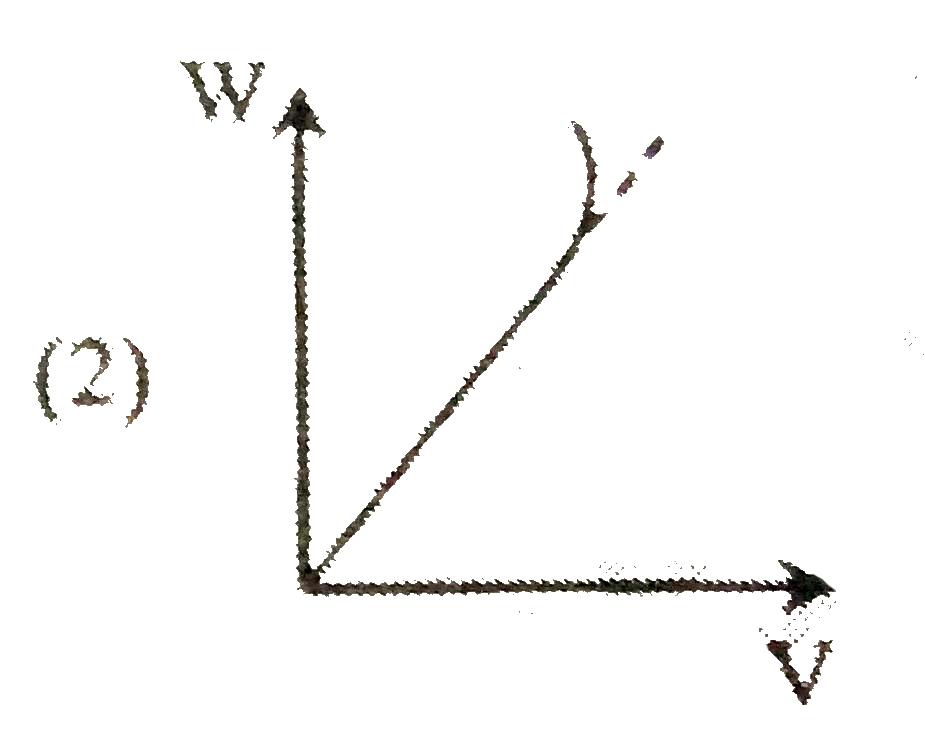
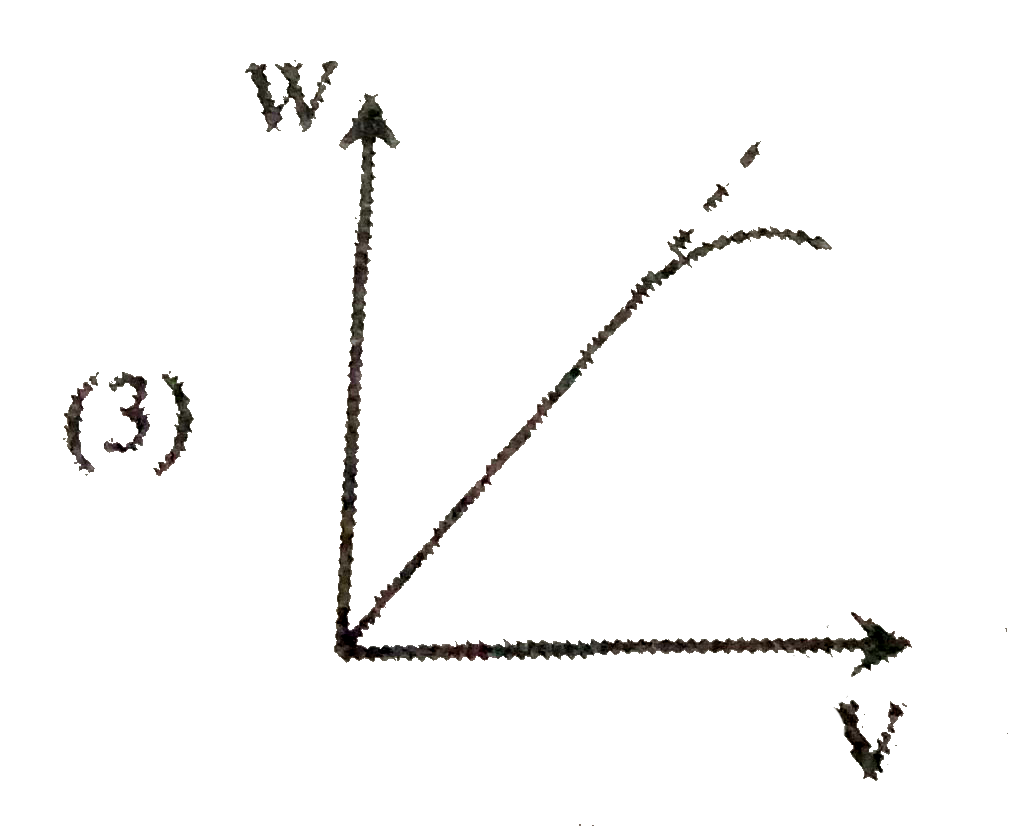
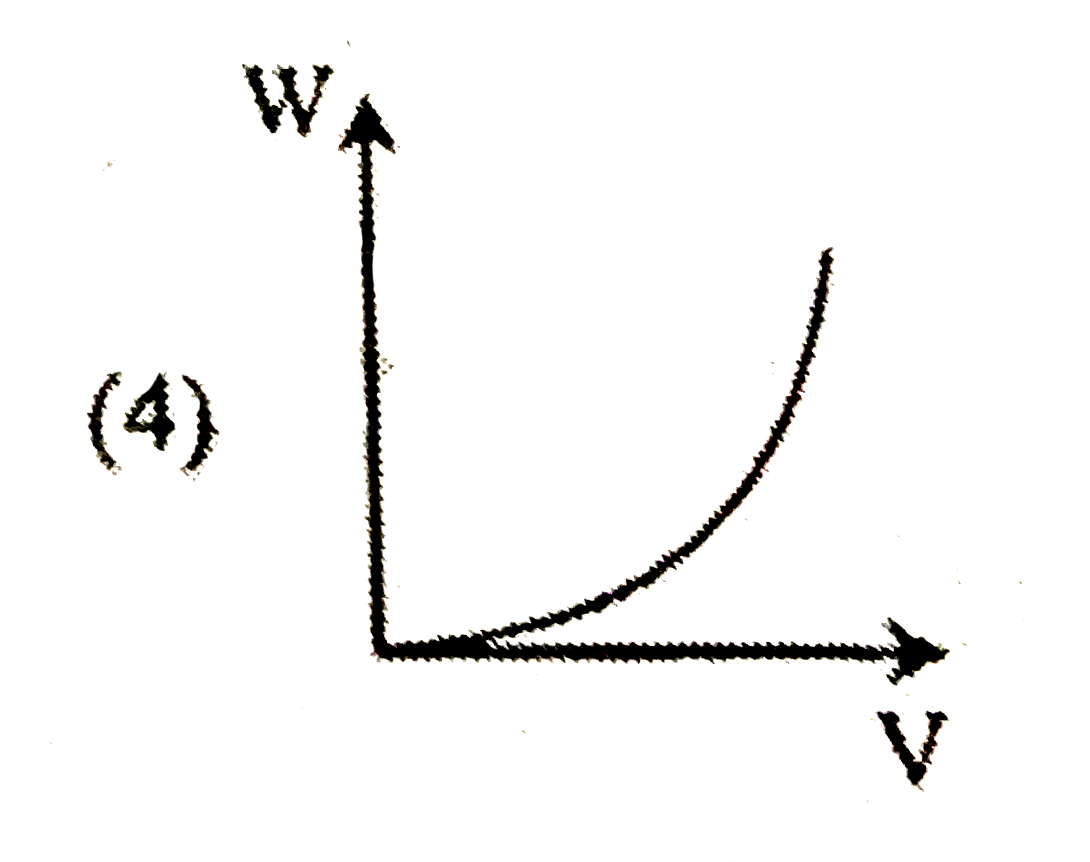
A particle initially at rest on a frictionless horizontal surface, is acted upon by a horizontal force which is constant is size and direction. A graph is plotted between the work done (W) on the particle, against the speed of the particle, (v). If there are no other horizontal forces acting on the particle the graph would look like

A

B

C

D

Text Solution

Verified by Experts

The correct Answer is:

D

Work done= change in kinetic energy `w=1/2 mV^(2)`
`:. Prop V^(2)`` graph will be parabolic in nature
Promotional Banner

Topper's Solved these Questions

  • MOCK TEST 4

    CAREER POINT|Exercise CHEMISTRY|30 Videos
  • MOCK TEST 3

    CAREER POINT|Exercise CHEMISTRY|30 Videos
  • MOCK TEST 5

    CAREER POINT|Exercise PART (B)-CHEMISTRY|29 Videos

Similar Questions

Explore conceptually related problems

A particle at rest on a frictionless table is acted upon by a horizontal force which is constant in magnitude and direction. A graph is plotted of the work done on the particle W, against the speed of the particle v. If there are no frictional forces acting on the particle, the graph will look like

A box of mass m=2 kg resting on a frictionless horizontal ground is acted upon by a horizontal force F, which varies as shown. Find speed of the particle when force ceases to act.

The figure showns the force versus time graph for a particle. Find the average force acting on the particle

A rigid body is acted upon by a horizontal force which is inversely proportional to the distance covered 's'. The work done by this force will be proportional to

The potential energy of a particle varies with distance x as shown in the graph. The force acting on the particle is zero at

A wedge of mass M resting on a horizontal frictionless surface is acted upon by a force F in the horizontal direction as shown in figure. Find the net horizontal force acting on the shaded portion of the wedge.

CAREER POINT-MOCK TEST 4-CHEMISTRY
  1. A particle initially at rest on a frictionless horizontal surface, is ...

    Text Solution

    |

  2. Which is in the decreasing order of boiling points of V group hydrid...

    Text Solution

    |

  3. The process used for the removal of hardness of water is

    Text Solution

    |

  4. The product of the reaction is -

    Text Solution

    |

  5. Which one of the following compounds undergoes predominantly SN^2 reac...

    Text Solution

    |

  6. Which of the compounds HCHO (I),CH(3)CH(2)CHO (II), CH(3)COCH(3) (III)...

    Text Solution

    |

  7. The oxidation state of S-atoms in Caro's and Marshall's acids are:

    Text Solution

    |

  8. 25mL of 2N HCl, 50 mL "of" 4N HNO(3) and xmL H(2)SO(4) are mixed toget...

    Text Solution

    |

  9. An aqueous solution containing 1M each of Au^(3+),Cu^(2+),Ag^(+),Li^(...

    Text Solution

    |

  10. Which of the following statement is not correct?

    Text Solution

    |

  11. In which transformation the change of hydridization and shape about un...

    Text Solution

    |

  12. The correct order of second ionization energy of C,N,O and F are in th...

    Text Solution

    |

  13. The ionization energy of the electron in the lowest orbit of hydrogen ...

    Text Solution

    |

  14. A binary solid(A^(+) B^(-)) has a zinc blende stracture with B ions co...

    Text Solution

    |

  15. Given: (i) Cu^(2+)+2e^(-) rarr Cu, E^(@) = 0.337 V (ii) Cu^(2+)+e^...

    Text Solution

    |

  16. When heated , ammonium carbamate decomate decompoes as follows : NH(...

    Text Solution

    |

  17. Calculate elevation in boiling point for 2 molal aqueous solution of g...

    Text Solution

    |

  18. Given that for a reaction of order n. the intergrated form of the rate...

    Text Solution

    |

  19. Solubility of calcium phosphate (molecular mass, M) in water is W g pe...

    Text Solution

    |

  20. When 1 L of CO2 is heated with graphite , the volume of the gases coll...

    Text Solution

    |

  21. Periodic acid splits glucose and fructose into formaldehyde and formic...

    Text Solution

    |
