Home
Class 12
PHYSICS
A ball 'A' is projected from origin with...

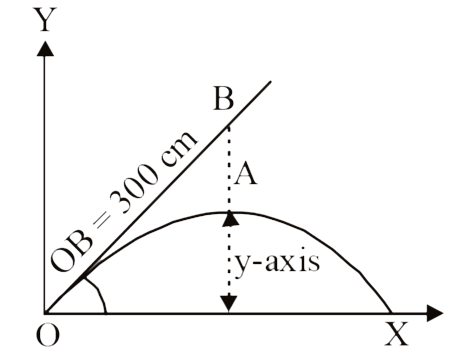
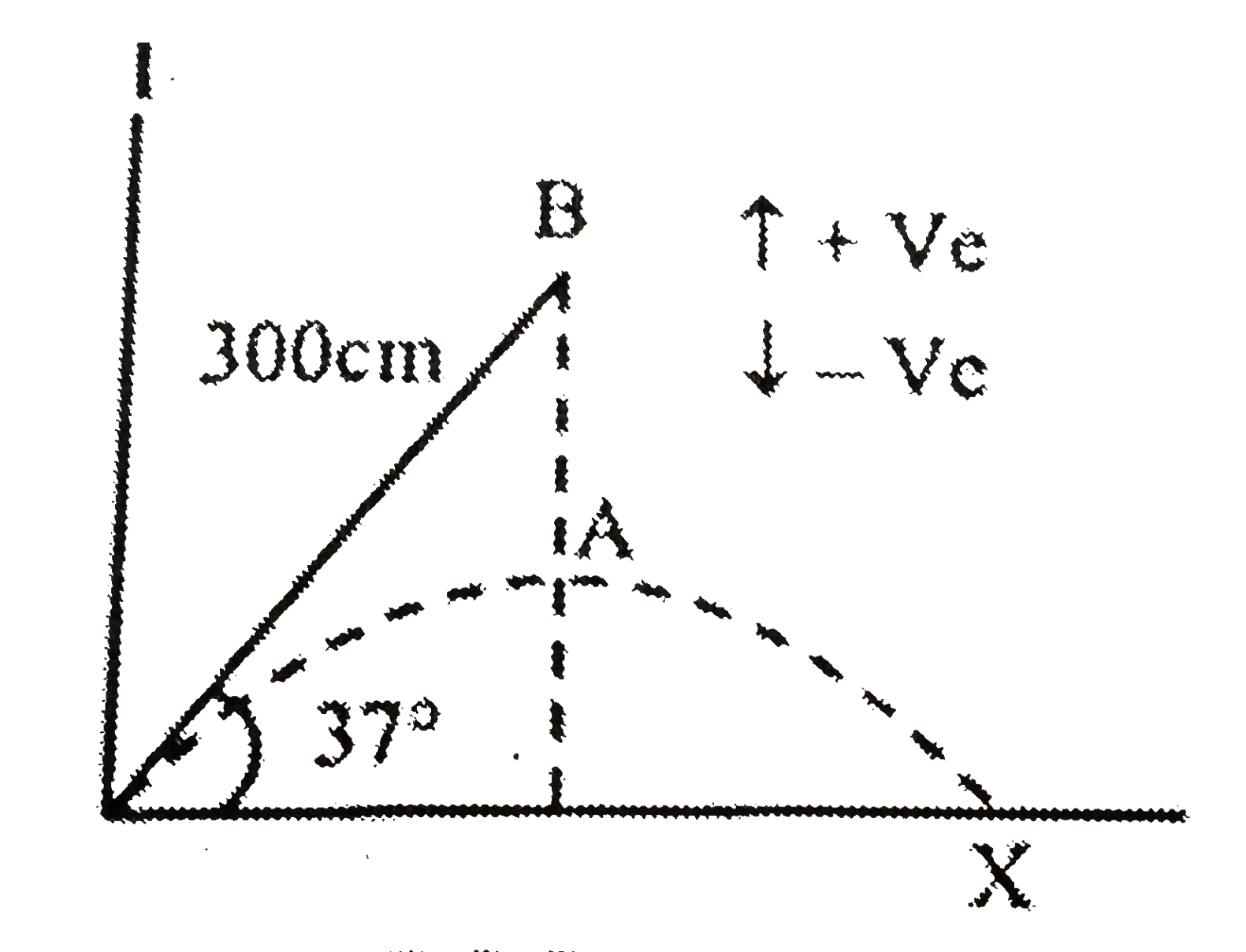
A ball 'A' is projected from origin with an initial velocity `v_(0)` = 700 cm/sec in a direction `37^(@)` above the horizontal as shown in fig .Another ball 'B' 300 cm from origin on a line `37^(@)` above the horizontal is released from rest at the instant A starts. How far will B have fallen when it is hit by A ?

A

90 cm

B

80 cm

C

70 cm

D

60 cm

Text Solution

Verified by Experts

The correct Answer is:
A


From `DeltaBOC,"sin" 37^(@) = (BC)/(OB)`
`BC=300 "sin" 37^(@) =300 xx 3/5 =180 cm`
Let bal A and ball B collide after a time t `:.` for ball A, along vertical
`s_(y) =u_(y) +1/2 a_(y) t^(2)`
`= 700 "sin" 37^(@) t+1/2(-g) r^(2)`
`AC =420 t- ("gt"^(2))/(2)`
For ball B height fallen along vertical
`s="ut"+1/2 a t^(2) rArr -BA =(0) t+1/2(-g) r^(2)`
`BA =("gt"^(2))/(2)`
`BA+AC =BC =180`
`("gt"^(2))/(2) +420t - ("gt"^(2))/(2) =180`
`420 t=180`
`t =(180)/(420) =3/7 "sec"`
`:. BA =("gt"^(2))/(2) =(980)/(2)xx(9)/(49)=90 "cm"`
Promotional Banner

Topper's Solved these Questions

  • MOCK TEST 4

    CAREER POINT|Exercise CHEMISTRY|30 Videos
  • MOCK TEST 3

    CAREER POINT|Exercise CHEMISTRY|30 Videos
  • MOCK TEST 5

    CAREER POINT|Exercise PART (B)-CHEMISTRY|29 Videos

Similar Questions

Explore conceptually related problems

A ball is projeced from O with an initial velocity 700 cm/ s in a direction 37^(@) above the horizontal. A ball B, 500 cm away from O on the line of the initial velocity of A, is released from rest at the instant A is projected. The height through which B falls, before it is hit by A and the direction of the velocity A at the time of impact will respectively be [Given g=10m//s^(2), sin 37^(@)=0.6 and cos 37^(@)=0.8 ]

A cannon ball is thrown with an initial velocity of 40m/s at an angle of 53^(@) above the horizontal from ground.After some time,the ball is seen to travel at an angle of 37^(@) below horizontal.Find the time elapsed (in second) till then.

A footballer throws a ball from a height of 2.00m above the ground with an initial velocity of 20.0m//s at an angle of 30^(@) above the horizontal (a) How long does the ball take to cross the goal line 32.0m from the point of release?(b) What is the ball's height above the ground as it crosses the goal line?

A ball is thrown from the top of a tower with an intial velocity of 10 m//s at an angle 37^(@) above the horizontal, hits the ground at a distance 16 m from the base of tower. Calculate height of tower. [g=10 m//s^(2)]

A ball is projected from a point A with some velocity at an angle 30^@ with the horizontal as shown in (Fig. 5.204). Consider a target at point B . The ball will hit the target if it thrown with a velocity v_0 equal to. .

A ball is thrown from the top of 36m high tower with velocity 5m//ss at an angle 37^(@) above the horizontal as shown. Its horizontal distance on the ground is closest to [ g=10m//s^(2) :

A paricle is projected from a point with initial speed of 10 m//sec at an angle of 37^(@) with the horizontal. At the same instant a fly starts on the same path of particle with constant speed of 10 m//s Then :

A ball A is projected with speed 20 m//s at an angle of 30^(@) with the horizontal from the ground. Another ball B is released simultaneously from a point on the vertical line along the maximum height of the projectile. Both the balls collide at the maximum height of the first ball. The initial height of ball B is

A ball is projected directly upward with an initial speed v_(0) . Bounces elastically from a roof inclined at an angle 45^(@) as shown in figure and then it strikes a table at a horizontal distance 2D from its starting point. Find v_(0) .

A cricketer hits a ball with a velocity 25m//s at 60^(@) above the horizontal. How far above the ground it passes over a fielder 50 m from the bat (assume the ball is struck very close to the ground)

CAREER POINT-MOCK TEST 4-CHEMISTRY
  1. A ball 'A' is projected from origin with an initial velocity v(0) = 70...

    Text Solution

    |

  2. Which is in the decreasing order of boiling points of V group hydrid...

    Text Solution

    |

  3. The process used for the removal of hardness of water is

    Text Solution

    |

  4. The product of the reaction is -

    Text Solution

    |

  5. Which one of the following compounds undergoes predominantly SN^2 reac...

    Text Solution

    |

  6. Which of the compounds HCHO (I),CH(3)CH(2)CHO (II), CH(3)COCH(3) (III)...

    Text Solution

    |

  7. The oxidation state of S-atoms in Caro's and Marshall's acids are:

    Text Solution

    |

  8. 25mL of 2N HCl, 50 mL "of" 4N HNO(3) and xmL H(2)SO(4) are mixed toget...

    Text Solution

    |

  9. An aqueous solution containing 1M each of Au^(3+),Cu^(2+),Ag^(+),Li^(...

    Text Solution

    |

  10. Which of the following statement is not correct?

    Text Solution

    |

  11. In which transformation the change of hydridization and shape about un...

    Text Solution

    |

  12. The correct order of second ionization energy of C,N,O and F are in th...

    Text Solution

    |

  13. The ionization energy of the electron in the lowest orbit of hydrogen ...

    Text Solution

    |

  14. A binary solid(A^(+) B^(-)) has a zinc blende stracture with B ions co...

    Text Solution

    |

  15. Given: (i) Cu^(2+)+2e^(-) rarr Cu, E^(@) = 0.337 V (ii) Cu^(2+)+e^...

    Text Solution

    |

  16. When heated , ammonium carbamate decomate decompoes as follows : NH(...

    Text Solution

    |

  17. Calculate elevation in boiling point for 2 molal aqueous solution of g...

    Text Solution

    |

  18. Given that for a reaction of order n. the intergrated form of the rate...

    Text Solution

    |

  19. Solubility of calcium phosphate (molecular mass, M) in water is W g pe...

    Text Solution

    |

  20. When 1 L of CO2 is heated with graphite , the volume of the gases coll...

    Text Solution

    |

  21. Periodic acid splits glucose and fructose into formaldehyde and formic...

    Text Solution

    |

