Home
Class 12
PHYSICS
Which of the compounds HCHO (I),CH(3)CH(...

Which of the compounds HCHO (I),`CH_(3)CH_(2)CHO` (II), `CH_(3)COCH_(3)` (III) and `HCOOC_(2)H_(5)` (IV) will give a secondary alcohol on reaction with excess Grignard reagent, followed by hydrolysis ? Select the correct answer using the codes given below:

A

II only

B

III only

C

I and IV

D

II and IV

Text Solution

Verified by Experts

The correct Answer is:
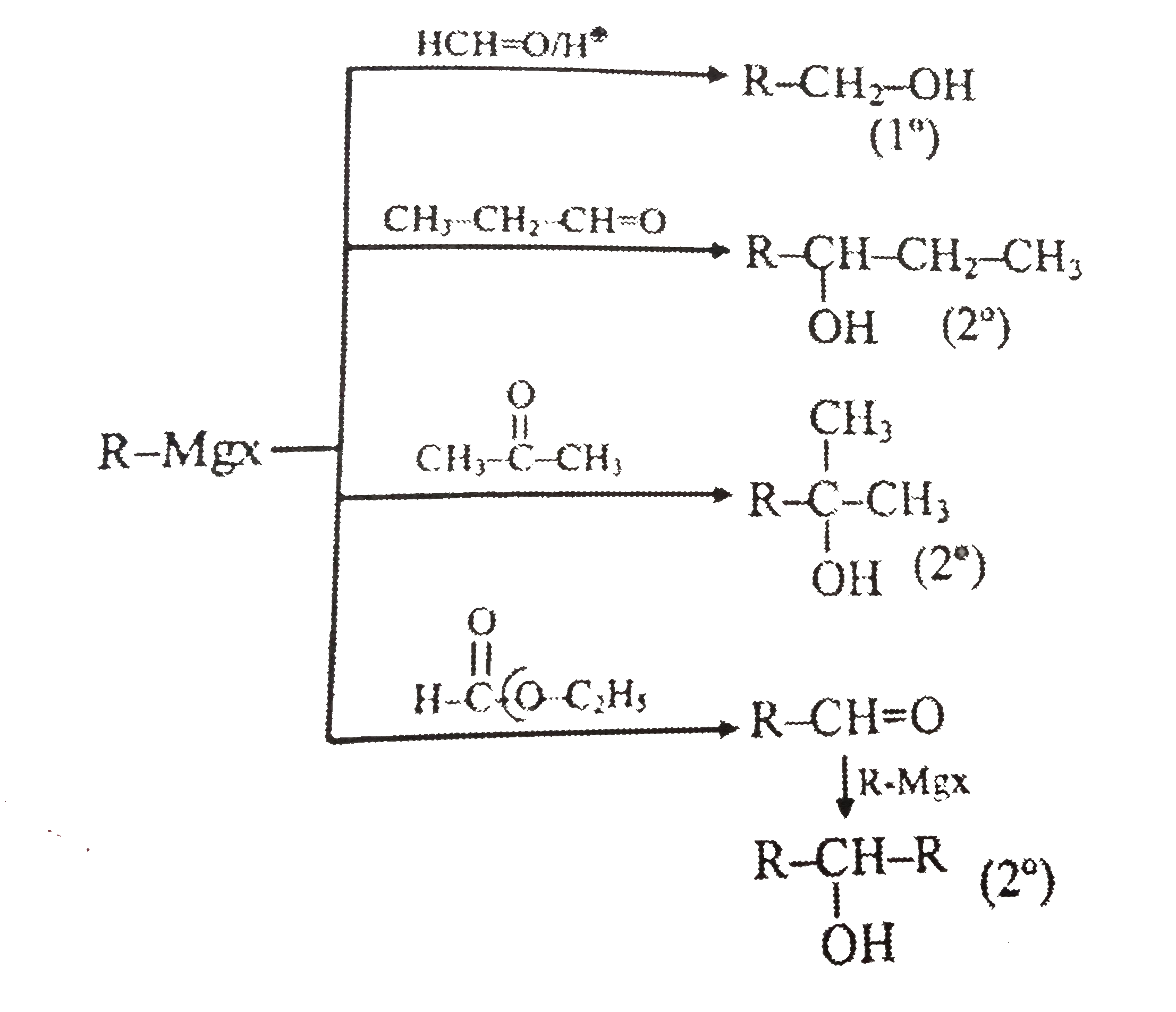
D

Promotional Banner

Topper's Solved these Questions

  • MOCK TEST 4

    CAREER POINT|Exercise CHEMISTRY|30 Videos
  • MOCK TEST 3

    CAREER POINT|Exercise CHEMISTRY|30 Videos
  • MOCK TEST 5

    CAREER POINT|Exercise PART (B)-CHEMISTRY|29 Videos

Similar Questions

Explore conceptually related problems

Which of the compounds HCHO(I),CH_3CH_2CHO(II),CH_3COCH_3(III) and HCOOC_2H_5 (IV) will give a secondary alcohol on reaction with excess Grignard reagent , followed by hydrolysis ? Select the correct answer using the codes given below

Which among the following compounds will give a secondary alcohol on reacting with Grignard reagent followed by acid hydrolysis ? (i) HCHO (ii) C_(2)H_(5)CHO (iii) CH_(3)COCH_(3) (iv) HCOOC_(2)H_(5) Select the correct anwer using the codes given below :

Which among the following compounds will give a secondary alcohol on reacting with Grignard reagent followed by acid hydrolysis? I. HCHO II. C_(2)H_(5)CHO III. CH_(3)COCH_(3) IV. C_(2)H_(5)COOH Select the correct answer using the codes given below.

Observe the following compounds (A) CH_3CH_2CHO (B) CH_3COCH_3 (C) Ph-CHO (D) CH_3CH(CH_3)CHO (E) HCHO

The order of reactivity of CH_(3)CHO, CH_(3)COC_(2)H_(5) and CH_(3)COCH_(3) is

Which of the following compounds can form carbanion easily ? I. CH_(3)CH_(2) II. CH_(3)CHO III. CH_(3)CH_(2)Cl IV. The correct choice is :

Write the IUPAC names of the following : (i)CH_(3)COCH_(3), (ii) CH_(3)COCH_(2)CH_(3)

CAREER POINT-MOCK TEST 4-CHEMISTRY
  1. The product of the reaction is -

    Text Solution

    |

  2. Which one of the following compounds undergoes predominantly SN^2 reac...

    Text Solution

    |

  3. Which of the compounds HCHO (I),CH(3)CH(2)CHO (II), CH(3)COCH(3) (III)...

    Text Solution

    |

  4. The oxidation state of S-atoms in Caro's and Marshall's acids are:

    Text Solution

    |

  5. 25mL of 2N HCl, 50 mL "of" 4N HNO(3) and xmL H(2)SO(4) are mixed toget...

    Text Solution

    |

  6. An aqueous solution containing 1M each of Au^(3+),Cu^(2+),Ag^(+),Li^(...

    Text Solution

    |

  7. Which of the following statement is not correct?

    Text Solution

    |

  8. In which transformation the change of hydridization and shape about un...

    Text Solution

    |

  9. The correct order of second ionization energy of C,N,O and F are in th...

    Text Solution

    |

  10. The ionization energy of the electron in the lowest orbit of hydrogen ...

    Text Solution

    |

  11. A binary solid(A^(+) B^(-)) has a zinc blende stracture with B ions co...

    Text Solution

    |

  12. Given: (i) Cu^(2+)+2e^(-) rarr Cu, E^(@) = 0.337 V (ii) Cu^(2+)+e^...

    Text Solution

    |

  13. When heated , ammonium carbamate decomate decompoes as follows : NH(...

    Text Solution

    |

  14. Calculate elevation in boiling point for 2 molal aqueous solution of g...

    Text Solution

    |

  15. Given that for a reaction of order n. the intergrated form of the rate...

    Text Solution

    |

  16. Solubility of calcium phosphate (molecular mass, M) in water is W g pe...

    Text Solution

    |

  17. When 1 L of CO2 is heated with graphite , the volume of the gases coll...

    Text Solution

    |

  18. Periodic acid splits glucose and fructose into formaldehyde and formic...

    Text Solution

    |

  19. Which of the following in not correctly matched ?

    Text Solution

    |

  20. The intermediate product 'X' of following synthesis is identified as:

    Text Solution

    |

