Home
Class 12
PHYSICS
A ray of light is incident on a prism as...

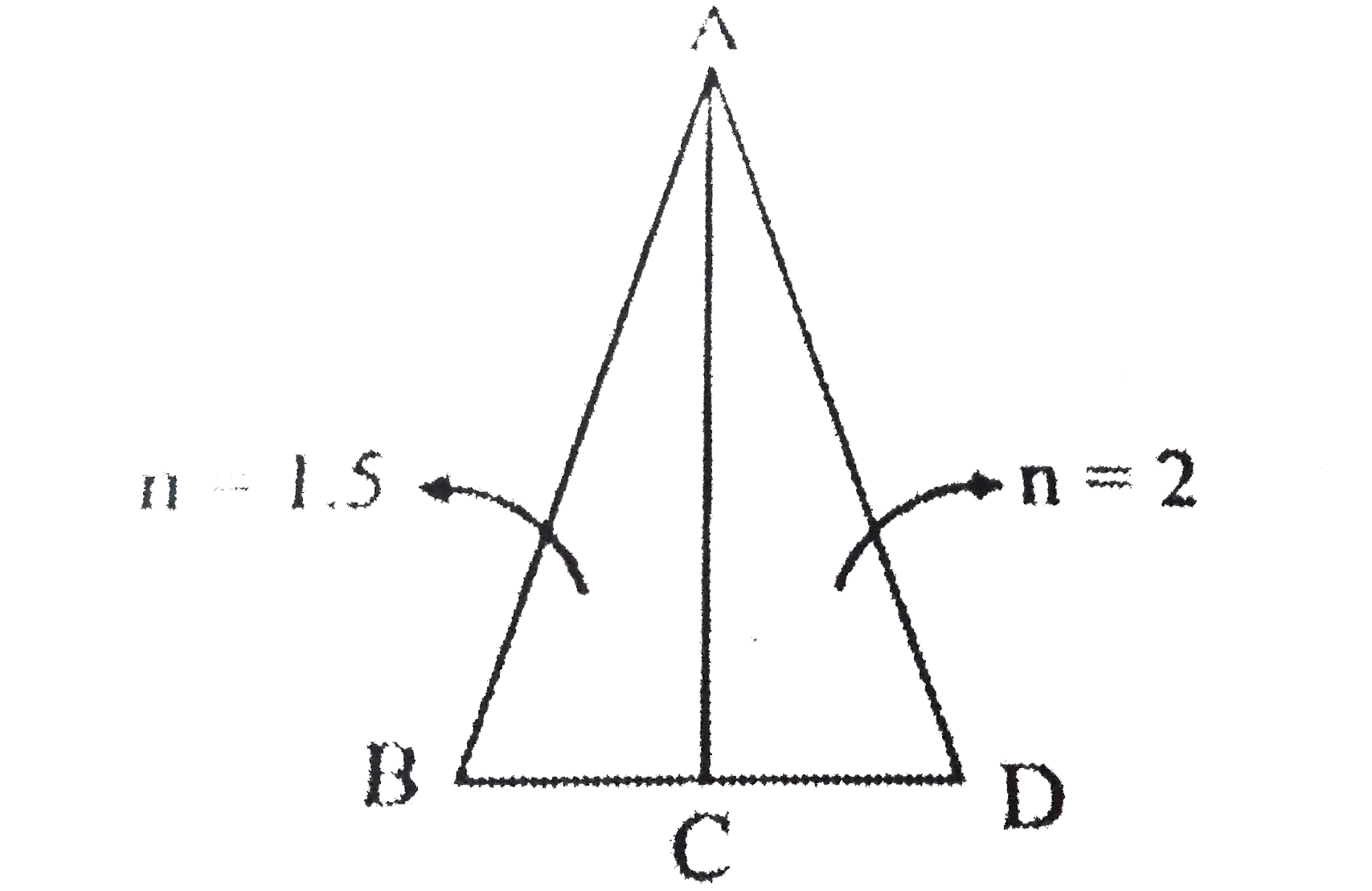
A ray of light is incident on a prism as shown in fig. Find the total deviation suffered by the ray if `/_BAC = 1^(@)` and `/_CAD = 2^(@)`.

A

`1^(@)`

B

`1.5^(@)`

C

`2.5^(@)`

D

`2^(@)`

Text Solution

Verified by Experts

The correct Answer is:

C

`delta_(ul("net")) =delta_(1) +delta_(2)`
`= (mu -1)A_(1) +(mu_(2)-1) A_(2)`
`= (1.5-1)1^(@) +(2-1) xx 2^(@)`
`= 2.5^(@)`
Promotional Banner

Topper's Solved these Questions

Similar Questions

Explore conceptually related problems

A ray of light is incident on a prism ABC of mu = sqrt(3) as shown in Fig. Find the angle of incidence for which the deviation of light by the prism ABC is minimum. By what angle should the second prism be rotated so that final ray suffers net minimum deviation ?

In the diagram shown, a light ray is incident on the lower medium boundary at an angle 45° with the normal. Find the deviation suffered by the light ray if– (a) mu_(2) gt sqrt(2) (b) mu_(2) lt sqrt(2)

A ray of light is incident on one face of a prism at an angle of 50^(@) with the normal . The ray is deviated by the prism through 42^(@) . What is the angle of the prism , if the angle of emergence is 51^(@) ?

A ray is incident on a sphere of refractive index sqrt(2) as shown in figure. Angle of refraction of the ray inside sphere is 30^(@) if total deviation suffered by the ray is 30x^(0) , then find x.

A right-angled prism of apex angle 4^(@) and refractive index 1.5 is located in front of a vertical plane mirror as shown in figure. A horizontal ray of light is falling on the prism. Find the total deviation produced in the light ray as it emerges 2nd time from the prism.

There is a equilateral prism of refractive index 3 on which a light ray is incident normally on one face as shown in the figure. Find the length of the path traveled by the light ray inside the prism.

General method of finding deviation by prism. In the ray diagram shown in figure, find total deviation by prism.

If two prisms are combined , as shown in figure, find the total angular dispersion and angle of deviation suffered by a white ray of light incident on the combination.

Light passes symmetrically through a 60^(@) prism of refractive index 1.54. After emergence out from the prism the light ray is incident on a plane mirror fixed to the base of the prism extending beyond it. Find the total deviation of the light ray after reflection from the mirror.

Figure shows a small angles prism angle 4^(@) and mu = (3)/(2) . A light ray almost normally incident on the prism is refracted and falls on a vertical mirror as shown. Find the total deviation of the ray after reflection from the mirror.

CAREER POINT-UNIT TEST 9-PHYSICS
  1. A man looks down on a fish of length 20 cm. His eye is 2m above the su...

    Text Solution

    |

  2. A prism having an apex angle 4^(@) and refractive index 1.5 is located...

    Text Solution

    |

  3. A ray of light is incident on a prism as shown in fig. Find the total ...

    Text Solution

    |

  4. An optical fibre consists of core of mu(1) surrounded by a cladding of...

    Text Solution

    |

  5. Two identical glass (mu(g)=3//2) equiconvex lenses of focal length f a...

    Text Solution

    |

  6. A uniform, horizontal parallel beam of light is incident upon a prism ...

    Text Solution

    |

  7. Two thin lens have a combined power of 10D in contact. When separated ...

    Text Solution

    |

  8. A beam of plane polarized light falls normally on a polarizer of cross...

    Text Solution

    |

  9. A screen is placed 50cm from a single slit, which is illuminated with ...

    Text Solution

    |

  10. A slit of width is illuminated by white light. For red light (lambda=6...

    Text Solution

    |

  11. A beam of light AO is incident a glass slab (mu=1.54) in the direction...

    Text Solution

    |

  12. Magnification produced by astronominal telescope for normal adjustment...

    Text Solution

    |

  13. In a compound microscope, the focal lengths of two lenses are 1.5 cm a...

    Text Solution

    |

  14. A telescope of diameter 2m uses light of wavelength 5000 Å for viewing...

    Text Solution

    |

  15. In a Young's double-slit experiment, let S(1) and S(2) be the two slit...

    Text Solution

    |

  16. In Young's double-slit experiment, the intensity of light in front of ...

    Text Solution

    |

  17. In Young's double slit experiment, the intensity of light at a point o...

    Text Solution

    |

  18. In the ideal double-slit experiment, when a glass-plate(refractive ind...

    Text Solution

    |

  19. If ratio of maximum to minimum intensity in an interference experiment...

    Text Solution

    |

  20. An observer can see through a pin-hole the top end of a thin rod of he...

    Text Solution

    |
