

Home
Class 9
MATHS
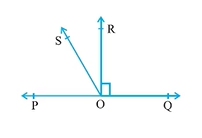
In Fig. 6.17, POQ is a line. Ray OR is ...

In Fig. 6.17, POQ is a line. Ray OR is perpendicular to line PQ. OS is another ray lying between rays OP and OR. Prove that `/_R O S=1/2(/_Q O S-/_P O S)dot`

Promotional Banner

Topper's Solved these Questions

  • LINEAR EQUATIONS IN TWO VARIABLES

    RD SHARMA|Exercise All Questions|104 Videos
  • MEASURES OF CENTRAL TENDENCY

    RD SHARMA|Exercise All Questions|141 Videos

Similar Questions

Explore conceptually related problems

In Figure,POQ is a line.Ray OR is perpendicular to lien PQdot OS is another ray lying between rays OP and OR. Prove that /_ROS=(1)/(2)(/_QOS-/_POS)

In figure POQ is a line. Raw Oris perpendicular to line PQ .OS is another ray lying between rays OP and OR. Prove that angleROS(1)/(2) (angleQOS-anglePOS)i.e., angle1=(1)/(2)(angle2-angle3)

In Fig. 6.44, the side QR of PQR is produced to a point S. If the bisectors of /_P Q R and /_P R S meet at point T, then prove that /_Q T R=1/2/_Q P R .

POQ is a straight line RO bot PQ , SO is a ray from O then prove that angleROS=1/2(angleQOS-anglePOS)

In Fig 7.51, P R\ >\ P Q and PS bisects /_Q P R . Prove that /_P S R\ >/_P S Q .

If P + Q = R and P - Q = S, prove that R^2 + S^2 = 2(P^2 + Q^2)

In Fig. 4.90, if P S Q R , prove that P O S ~ R O Q . (FIGURE)

In arrangement shown in figure, plane wavefront of monochromatic light of wavelength lamda is incident on identical slits S_(1) and S_(2) . There is another pair of indentical slits S_(3) and S_(4) which are having separation Z = (lamda D)/(2d) Point O is on the screen at the common perpendicular bisector of S_(1)S_(2) and S_(3) S_(4).I_(1) is the intensity at point O Now the board having slits S_(3)S_(4) is moved upward parallel to itself and perpendicular to line AO till slit S_(4) is on line AO and it is observed that now intensity at point O is I_(2) then (I_(2))/(I_(1)) is :

In Fig. 6.15, /_P Q R=/_P R Q , then prove that /_P Q S=/_P R T .

RD SHARMA-LINES AND ANGLES -All Questions
  1. An angle is 14^@ more than its complementary angle. What is its measur...

    Text Solution

    |

  2. If an angle differs from its supplement by 10^@ , find the angle.

    Text Solution

    |

  3. In Fig. 6.17, POQ is a line. Ray OR is perpendicular to line PQ. OS ...

    Text Solution

    |

  4. Find the angle which is equal to its complement

    Text Solution

    |

  5. Find the measure of an angle which forms a pair of supplementary ang...

    Text Solution

    |

  6. Two supplementary angles differ by 34^0 . Find the angles.

    Text Solution

    |

  7. An angle is equal to five times its complement. Determine its measu...

    Text Solution

    |

  8. An angle is equal to one-third of its supplement. Find its measure.

    Text Solution

    |

  9. Two supplementary angles are in the ratio 2:3. Find the angles.

    Text Solution

    |

  10. The supplement of an angle is one-third of itself. Determine the an...

    Text Solution

    |

  11. Write the complement of each of the following angles: (i) 20^0 (ii) ...

    Text Solution

    |

  12. Write the supplement of each of the following angles: (i) 54^0 (ii) ...

    Text Solution

    |

  13. If an angle is 28^0 less than its complement, find its measure.

    Text Solution

    |

  14. If an angle is 30^0 more than one half of its complement, find the ...

    Text Solution

    |

  15. Two supplementary angles are in the ratio 4:5 . Find the angles.

    Text Solution

    |

  16. Two supplementary angles differ by 48^0 . Find the angles.

    Text Solution

    |

  17. An angle is equal to 8 times its complement. Determine its measure.

    Text Solution

    |

  18. If the angles (2x-10)^0 and (x-5)^0 are complementary angles, find xdo...

    Text Solution

    |

  19. If the complement of an angle is equal to the supplement of the thr...

    Text Solution

    |

  20. If an angle differs from its complement by 10^0 , find the angle.

    Text Solution

    |