Home
Class 12
CHEMISTRY
Using the data given below: E(Cr(2)O(7...

Using the data given below:
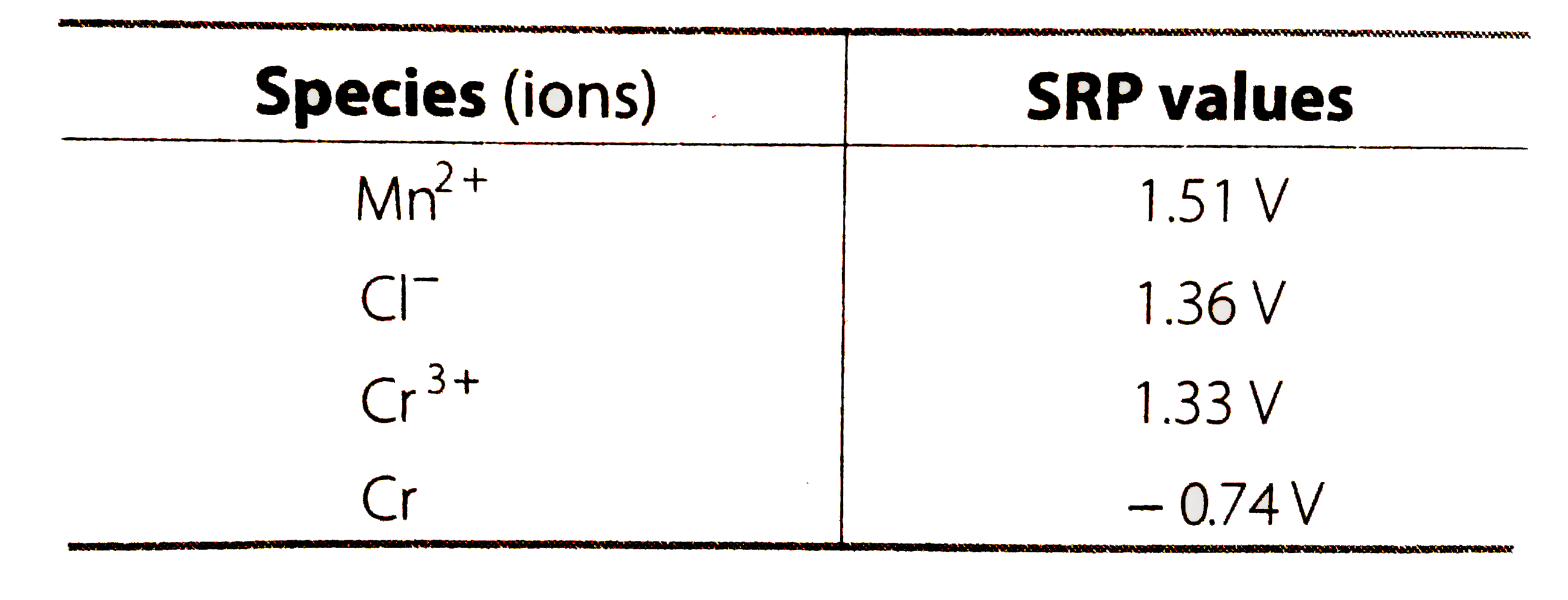
`E_(Cr_(2)O_(7)^(2-)|Cr^(3+))^(@)=1.33V E_(Cl_(2)|Cl^(-))^(@)=1.36V`
`E_(MnO_(4)^(-)|Mn^(2+))^(@)=1.51V E_(Cr^(3+)|Cr)=-0.74V`
In which option the order of reducing power is correct?

A

`Cr^(3+)ltCl^(-)ltMn^(2+)ltCr`

B

`Mn^(2+)ltCl^(-)ltCr^(3+)ltCr`

C

`Cr^(3+)ltCl^(-)ltCr_(2)O_(7)^(2-)ltMnO_(4)^(-)`

D

`Mn^(2+)ltCr^(3+)ltCl^(-)ltCr`

Text Solution

Verified by Experts


On moving top to bottom SRP value decreases from positive to negative value which will increase the reducing capacity, so, the correct option is b
Promotional Banner

Topper's Solved these Questions

  • D AND F-BLOCK ELEMENTS

    NCERT EXEMPLAR|Exercise D And F-Block Elements|71 Videos
  • GENERAL PRINCIPLE AND PROCESSES OF ISOLATION OF ELEMENTS

    NCERT EXEMPLAR|Exercise General Principle And Processes Of Isolation Of Elements|55 Videos

Similar Questions

Explore conceptually related problems

Using the data given below: E_(Cr_(2)O_(7)^(2-)|Cr^(3+))^(@)=1.33V E_(Cl_(2)|Cl^(-))^(@)=1.36V E_(MnO_(4)^(-)|Mn^(2+))^(@)=1.51V E_(Cr^(3+)|Cr)=-0.74V Mark the strongest reducing agent.

Using the data given below: E_(Cr_(2)O_(7)^(2-)|Cr^(3+))^(@)=1.33V E_(Cl_(2)|Cl^(-))^(@)=1.36V E_(MnO_(4)^(-)|Mn^(2+))^(@)=1.51V E_(Cr^(3+)|Cr)=-0.74V Find the most stable oxidised species.

Using the data given below: E_(Cr_(2)O_(7)^(2-)|Cr^(3+))^(@)=1.33V E_(Cl_(2)|Cl^(-))^(@)=1.36V E_(MnO_(4)^(-)|Mn^(2+))^(@)=1.51V E_(Cr^(3+)|Cr)=-0.74V Find the most stable ion in its reduced forms

Using the data given below: E_(Cr_(2)O_(7)^(2-)|Cr^(3+))^(@)=1.33V E_(Cl_(2)|Cl^(-))^(@)=1.36V E_(MnO_(4)^(-)|Mn^(2+))^(@)=1.51V E_(Cr^(3+)|Cr)=-0.74V Mark the strongest oxidising agent.

Using tha data given below is reducing potenial. E_(Cr_2O_7^(2-)//Cr^(3+))^@ =1.33 V , E_(Cl_2//Cl^-)^@ =1.36 V E_(MnO_4^(-)//Mn^(2+))^@ =1.51 V , E_(Cr^(3+) // Cr)^@ =- 0.74 V find out which of the following is the strongest oxidising agent.

NCERT EXEMPLAR-ELECTROCHEMISTRY-Electrochemistry
  1. Using the data given below: E(Cr(2)O(7)^(2-)|Cr^(3+))^(@)=1.33V E(Cl...

    Text Solution

    |

  2. Given E("Cr(2)O(7)^(2-)//Cr^(3+))^(@)=1.33V,E(MnO(4)^(-)//Mn^(2+))^(@)...

    Text Solution

    |

  3. Using the data given below: E(Cr(2)O(7)^(2-)|Cr^(3+))^(@)=1.33V E(Cl...

    Text Solution

    |

  4. Use the data given in Q.8 and find out the most stable ion in its redu...

    Text Solution

    |

  5. Using the data given below: E(Cr(2)O(7)^(2-)|Cr^(3+))^(@)=1.33V E(Cl...

    Text Solution

    |

  6. The quantity of charge required to obtain one mole of aluminium from A...

    Text Solution

    |

  7. The cell constant of a conductivity cell

    Text Solution

    |

  8. While charging the lead storage battery:

    Text Solution

    |

  9. ^^(m((NH(4)OH)))^(o) is equal to

    Text Solution

    |

  10. In the electrolysis of aqueous sodium chloride solution which of the h...

    Text Solution

    |

  11. The positive value of the standard electrode potential of Cu^(2+)//Cu ...

    Text Solution

    |

  12. Potential for some half cell reactions are given below. On the basis o...

    Text Solution

    |

  13. E("cell")^(@)=1.1V for Daniel cell. Which of the following expressions...

    Text Solution

    |

  14. Conductivity of an electrolytic solution depends on:

    Text Solution

    |

  15. A(m)^(@)H(2)O is equal to:

    Text Solution

    |

  16. What will happen during the electrolysis of aqueous solution of CuSO(4...

    Text Solution

    |

  17. What will happen during the electrolysis of aqu eous solution of CuSO(...

    Text Solution

    |

  18. Conductivity k, is equal to ......

    Text Solution

    |

  19. Molar conductivity of inic solution depends on ........

    Text Solution

    |

  20. For the given cell, Mg|Mg^(2+)||Cu^(2+)|Cu

    Text Solution

    |