Home
Class 12
CHEMISTRY
For the given cell, Mg|Mg^(2+)||Cu^(2+)|...

For the given cell, `Mg|Mg^(2+)||Cu^(2+)|Cu`

A

Mg is cathode

B

Cu is cathode

C

The cell reation is `Mg+Cu^(2+)rarrMg^(2+)+Cu`

D

`Cu is the oxidisng agent

Text Solution

Verified by Experts

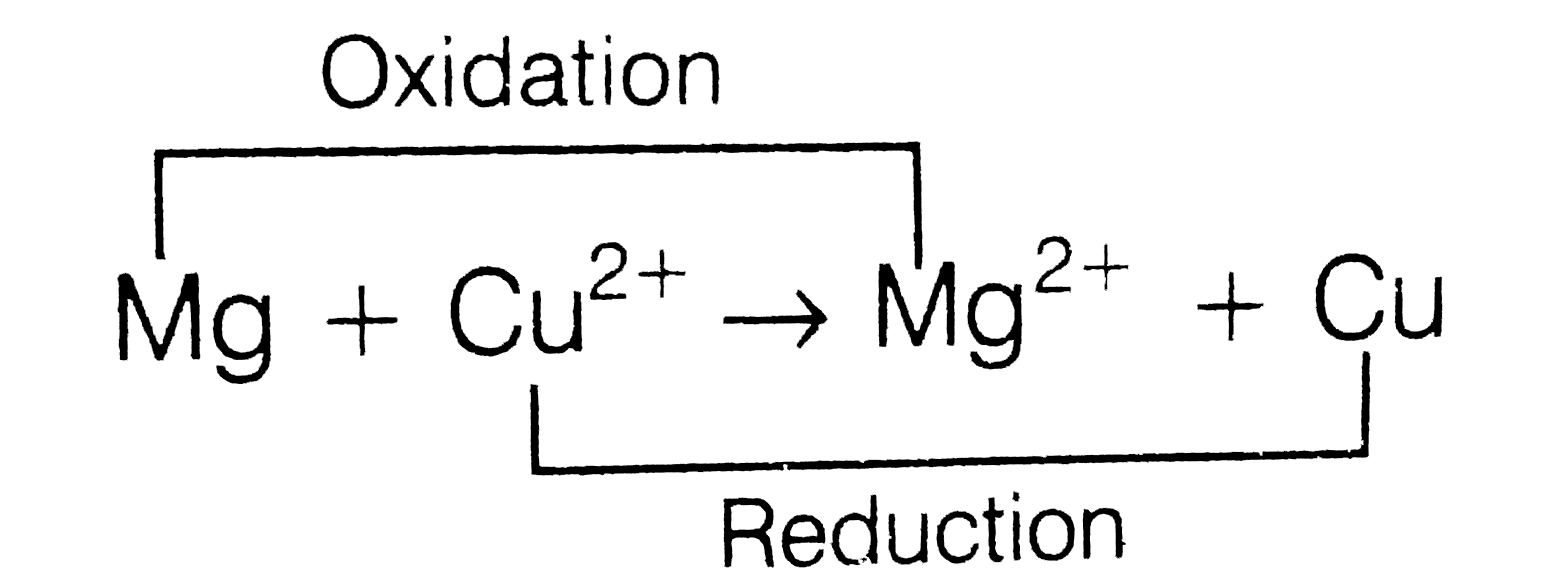
Left side of cell reaction represents oxidation half cell i.e., oxidation of Mg and right side of cell represents reduction half cell reactions i.e., reduction of copper.
(ii) Cu is reduced and reduction occurs at cathode.
(iii)Mg is oxidised and oxidation occurs at anode
(iv) Whole cell reaction can be written as

Hence, option (b) and (c) both are correct choices.
Promotional Banner

Topper's Solved these Questions

  • D AND F-BLOCK ELEMENTS

    NCERT EXEMPLAR|Exercise D And F-Block Elements|71 Videos
  • GENERAL PRINCIPLE AND PROCESSES OF ISOLATION OF ELEMENTS

    NCERT EXEMPLAR|Exercise General Principle And Processes Of Isolation Of Elements|55 Videos

Similar Questions

Explore conceptually related problems

For the given cell, Mg | Mg^(2+) || Cu^(2+) | Cu 1) Mg is cathode 2) Cu is cathode 3) The cell reaction is Mg + Cu^(2+) to Mg^(2+) + Cu 4) Cu is the oxidising agent.

For a cell given below Ag|Ag^(+)||Cu^(2+)|Cu Ag^(+)+e^(-)toAg,E^(@)=x Cu^(2+)+2e^(-)toCu,E^(@)=y then E_(cell)^(@) is

For the cell given, below Zn|Zn^(2)||Cu^(2+)|Cu,(E_(cell)-E_(cell)^(@)) is -0.12 V. it will be when

If E_((Mg)/(Mg^2+))^0 = +2.37 and E_((Cu)/(Cu^2+))^0 = -0.34 V then standard EMF of the cell, (Mg)/(Mg^(2+))/(Cu^(2+))/(Cu) is

Consider the cell Zn|Zn^(2+) || Cu^(2+)|Cu. If the concentration of Zn and Cu ions are doubled, the emf of the cell.

Calculate the e.m.f of the cell Mg(s)//Mg^(2+)(0.1 M)||Cu^(2+)(1.0xx10^(-3) M)//Cu(s) Given E_(Cu^(2+)//Cu)^(@)=+0.34 V and E_(Mg^(2+)//Mg)^(@)=-2.37 V

NCERT EXEMPLAR-ELECTROCHEMISTRY-Electrochemistry
  1. Conductivity k, is equal to ......

    Text Solution

    |

  2. Molar conductivity of inic solution depends on ........

    Text Solution

    |

  3. For the given cell, Mg|Mg^(2+)||Cu^(2+)|Cu

    Text Solution

    |

  4. Can absolute electrode potential of an electrode be measured?

    Text Solution

    |

  5. Can E("cell")^(@) or Delta(r)G^(@) for cell reaction ever be equal to ...

    Text Solution

    |

  6. Under what condition is E("cell")^(@)=0 or Delta(r)G=0?

    Text Solution

    |

  7. What does the negative sign in the expression E(Zn^(2+)//Zn)^(@)=-0.76...

    Text Solution

    |

  8. Aqueous copper sulphate solution and aqueous silver nitrate solution a...

    Text Solution

    |

  9. Depict the galvanic cell in which the cell reaction is Cu+2Ag^(+)rar...

    Text Solution

    |

  10. Value of standard electrode potential for the oxidation of Cl^(-) ions...

    Text Solution

    |

  11. What is electrode potential?

    Text Solution

    |

  12. Consider the following diagram in which an electrochemical cell is cou...

    Text Solution

    |

  13. Why is alternating current used for measuring resistance of an electro...

    Text Solution

    |

  14. A galvanic cell has electrical potential of 1.1 V . If an opposing pot...

    Text Solution

    |

  15. How will the pH of brine (aq NaCl solution) be affected when it is ele...

    Text Solution

    |

  16. Unlike dry cell, the mercury cell has a constant cell has a constant c...

    Text Solution

    |

  17. Solutions of two electrolytes A and B are diluted. The Lambda(m) of 'B...

    Text Solution

    |

  18. When acidulated water (dil. H(2)SO(4) solution) is electrolysed, with ...

    Text Solution

    |

  19. In an aqueous solution how does specific conductivity of electrolytes ...

    Text Solution

    |

  20. Which reference electrode is used to measure the electrode potnetial o...

    Text Solution

    |