Home
Class 12
CHEMISTRY
Match the items of Column I and Column I...

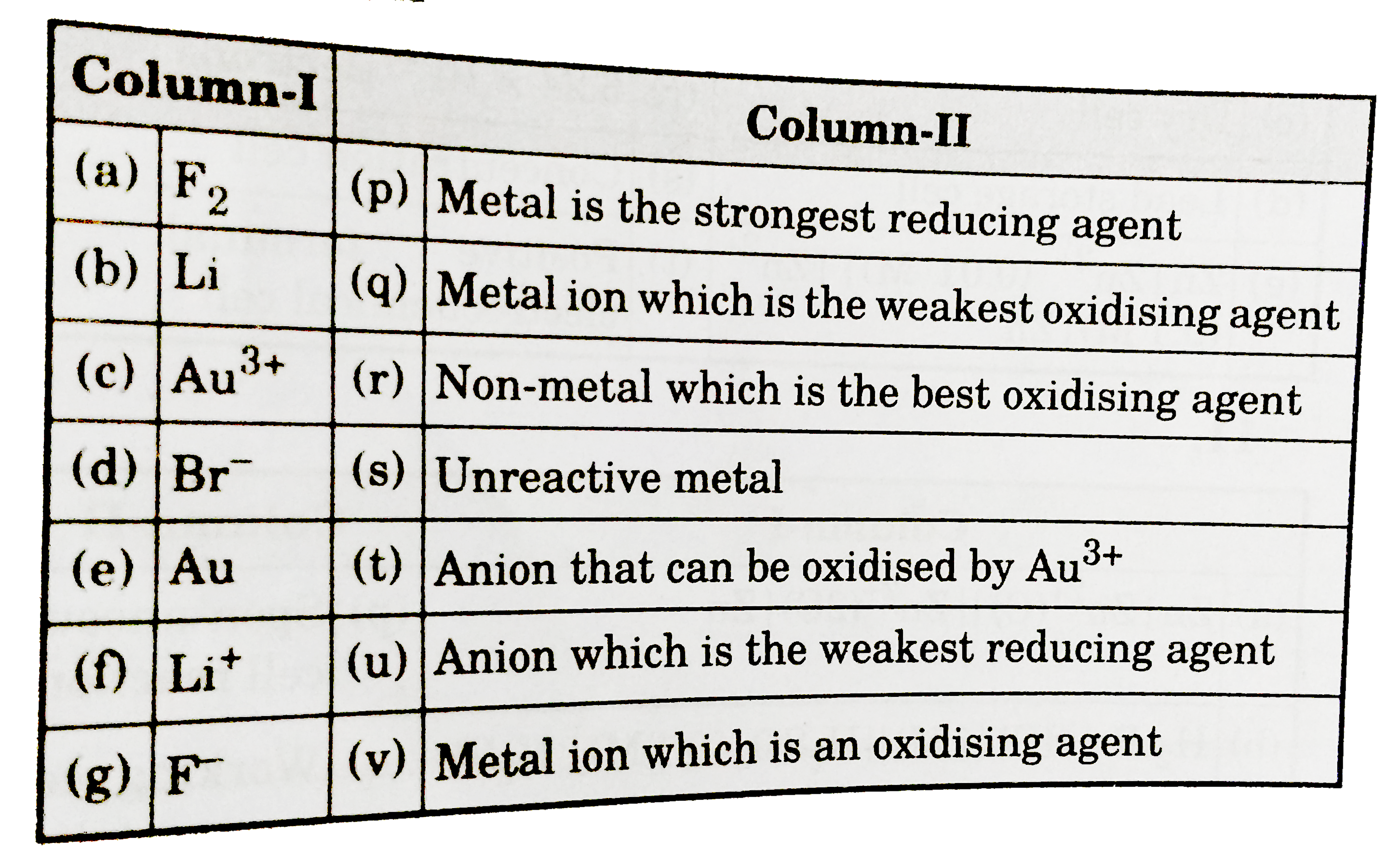
Match the items of Column I and Column II on the basis of data given below:
(One to one match only)
`E_(F_(2)|F^(-))^(@)` = 2.87 V, `E_(Li^(+)|(Li)` = -3.5 V,
`E_(Au^(3+)|Au)^(@)` = 1.4 V, `E_(Br_(2)|Br^(-))^(@)` = 1.09V

Text Solution

Verified by Experts

A. `F_(2)` is a non-metal and best oxidising agent because SRP of `F_(2)` is +2.87V
B. Li is a metal and strongest reducing agen t because SRP of `Li` is -3.05V
`Au^(3+)` is a metal in which is an oxidisng agent as SRP of `Au^(3+)` is +1.40V
D. `Br^(-)` is an anion that can be oxidised by
`Au^(3+)` and `Au^(3+)(E^(@)=1.40)` is greater than
`Br^(-)(E^(@)=1.09V)`.
E. Au is an unreactive metal .
F. `Li^(+)` is a metal ion having least value of SRP(-3.05V), hence it is the weakest oxidising agent.
G. `F^(-)` is an anion which is the weakest reducing agent as `F^(-)//F_(2)` has low oxidation potential `(-2.87V)`.
Promotional Banner

Topper's Solved these Questions

  • D AND F-BLOCK ELEMENTS

    NCERT EXEMPLAR|Exercise D And F-Block Elements|71 Videos
  • GENERAL PRINCIPLE AND PROCESSES OF ISOLATION OF ELEMENTS

    NCERT EXEMPLAR|Exercise General Principle And Processes Of Isolation Of Elements|55 Videos

Similar Questions

Explore conceptually related problems

If E_(Au^(+)//Au)^(@) is 1.69 V and E_(Au^(3+)//Au)^(@) is 1.40 V, then E_(Au^(+)//Au^(3+))^(@) will be :

Select the correct statement if- E_(Mg^(2+)//Mg)^(@)=-2.4V, E_(Sn^(4+)//Sn^(2+))^(@)=0.1V, E_(MnO_(4)^(-),H^+//Mn^(2+))^(@)=1.5V, E_(I_(2)//I^(-))^(@)=0.5V

Arrange the following metals in increasing order of their reducing power. [ Given : E_(K^(+)//K)^(@)=-2.93V, E_(Ag^(+)//Ag)^(@)=+0.80V, E_(Al^(3)//Al)^(@)=-1.66V, E_(Au^(3+)//Au)^(@)=+1.40 V, E_(Li^(+)//Li)^(@)=-3.05 V ]

Four different solution containing 1M each of Au^(+3), Cu^(+2), Ag^(+), Li^(+) are being electrolysed by using inert electrodes. In how many samples, metal ions would be deposited at cathode? ["Given :" E_(Ag^+//Ag)^(0) = 0.8, E_(Au^(+3)//Au)^(0) = 1.00 V E_(Cu^(+2)//Cu)^(0) = 0.34 V, E_(Li^(+)//Li)^(0)= -3.03 V ]

The E^(@) values of redox complex of halogens are given. Based on these values mark the correct statement. E_(I_(2)//CI^(-))^(@)=+0.54V, E_(Br_(2)//Br^(-))^(@)=+1.08V , E_(Cl_(2)//Cl^(-))^(@)=+1.36V ,

NCERT EXEMPLAR-ELECTROCHEMISTRY-Electrochemistry
  1. Why on dilution the Lambda(m) of CH(3)COOH increases drastically, whil...

    Text Solution

    |

  2. Match the terms given in column I with the units given in column II.

    Text Solution

    |

  3. Match the terms given in Column I with the items given in Column II. (...

    Text Solution

    |

  4. Match the items of Column I and Column II.

    Text Solution

    |

  5. Match the items of Column I and Column II.

    Text Solution

    |

  6. Match the items of Column I and Column II.

    Text Solution

    |

  7. Match the items of Column I and Column II on the basis of data given b...

    Text Solution

    |

  8. Assertion(A) Cu is less reactive than hydrogen. Reason(R) E(Cu^(2+)/...

    Text Solution

    |

  9. Assertion (A) E("cell") should have a positive value for the cell to f...

    Text Solution

    |

  10. Assertion (A) Conductivity of all electrolytes decreases on dilution. ...

    Text Solution

    |

  11. Assertion(A) Lambda(m) for weak electrolytes shows a sharp increase wh...

    Text Solution

    |

  12. STATEMENT-1: The voltage of mercury cell remains constant for longer p...

    Text Solution

    |

  13. Assertion (A): Electrolysis of NaCl solution gives chlorine at anode i...

    Text Solution

    |

  14. Assertion : For measuring resistance of an ionic solution an AC so...

    Text Solution

    |

  15. Assertion : Current stops flowing when E(cell)=0. Reason : ...

    Text Solution

    |

  16. Assertion (A): E(Ag^(+)//Ag) increases with increase in concentration ...

    Text Solution

    |

  17. Assertion (A) Copper sulphate can be stored in zinc vessel. Reason(R...

    Text Solution

    |

  18. Consider the figure and answer the following question. (i) Cell '...

    Text Solution

    |

  19. Consider figure from the above question and answer the questions (i) t...

    Text Solution

    |

  20. What is the relationship between Gibbs free energy of the cell reactio...

    Text Solution

    |
