

Home
Class 12
CHEMISTRY
Assertion (A) beta-glycosidic linkage is...

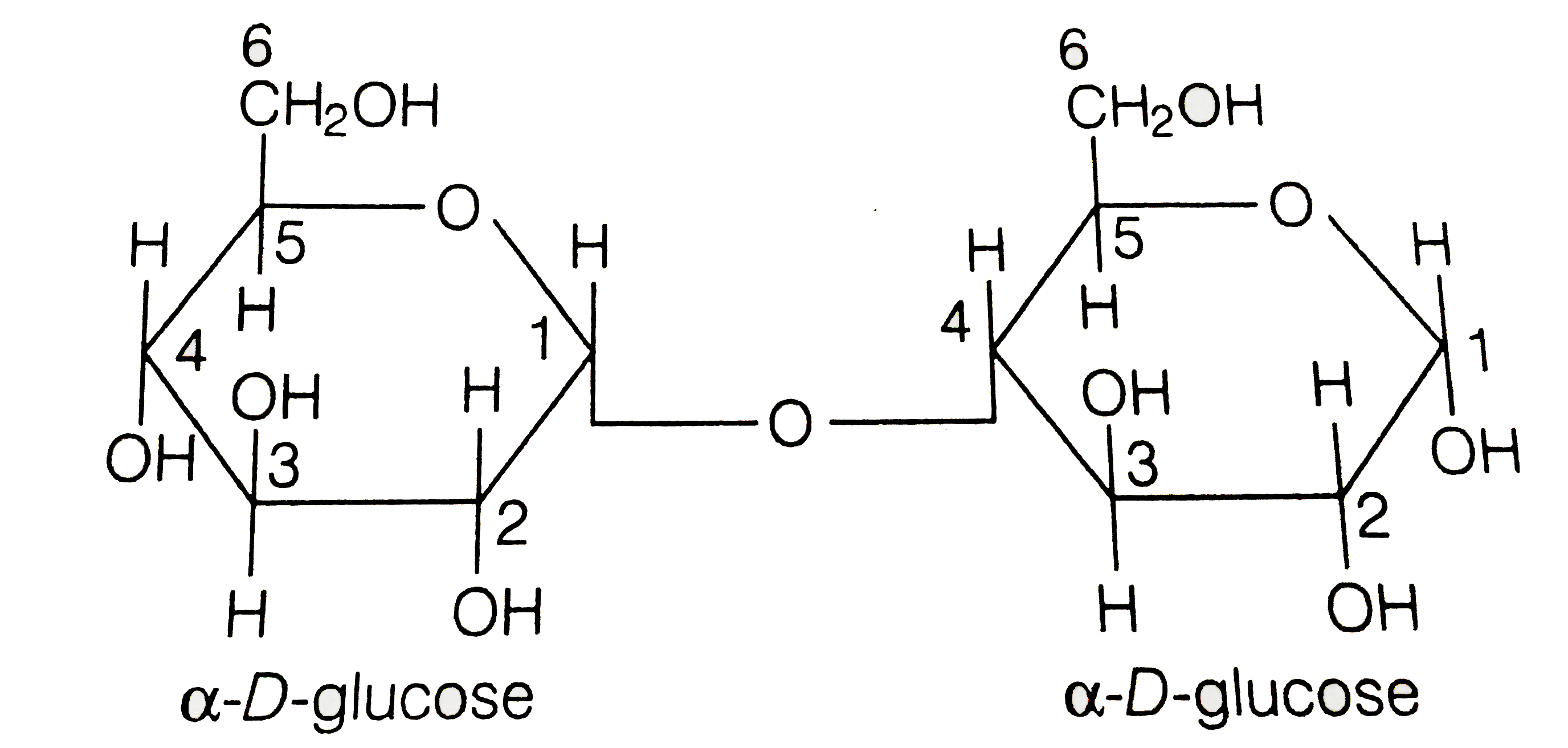
Assertion (A) `beta`-glycosidic linkage is present in maltose.
Reason (R) Maltose is composed of two glucose units in which C-1 of one glucose unit is linked to C-4 of another glucose unit.

A

Assertion and reason both are correct statements and reason explains the assertion.

B

Both assertion and reason are wrong statements

C

Assertion is correct statement and reason is wrong statement.

D

Assertion is wrong statement and reason is correct statement.

Text Solution

Verified by Experts

The correct Answer is:
D

Assertion is wrong statement and reason is correct statement `alpha`-glucosidic linkage is present in maltose

Because maltose is composed of two glucose unti in which C-1 of one glucose unit is linked to C-4 of another glucose unit.
Promotional Banner

Topper's Solved these Questions

  • AMINES

    NCERT EXEMPLAR|Exercise Amines|77 Videos
  • CHEMICAL KINETICS

    NCERT EXEMPLAR|Exercise Chemical Kinetics|66 Videos

Similar Questions

Explore conceptually related problems

Write the name of the unit to which glucose unit is linked to form sucrose.

The disaccharide that is constituted of two glucose units is

In maltose, glycosidic linkage is present between the two glucose units at positions

Which of the glycosidic linkage between galactose and glucose is present in lactose?

A polysaccharide is composed only of beta -D-glucose units which are joined by glycosidic linkage between C-1 of one glucose unit and C-4 of the next glucose unit. Name the polysaccharide.

Which one of the following has two alpha-D- glucose units ?

Assertion : Two sugar units joined by 1,2-glycosidic bond in sucralose. Reason : It contains C_(1) -glucose and C_(2) -fructose glycosidic bon

NCERT EXEMPLAR-BIOMOLECULES -Biomolecules
  1. What are glucosidic linkages? In which type of biomolecules are they p...

    Text Solution

    |

  2. Which monosaccharide units are present in strach, cellulose and glucos...

    Text Solution

    |

  3. How do enzymes help a substrate to be attacked by the reagent effectiv...

    Text Solution

    |

  4. Descrive the term D- and L-configuration used for amino acids with exm...

    Text Solution

    |

  5. How will you distinguish 1^(@) and 2^(@) hydroxyl groups present in gl...

    Text Solution

    |

  6. Coagulation of egg white on boiling is an example of denaturation of p...

    Text Solution

    |

  7. Match the vitamins given in Column I with the deficiency disease they ...

    Text Solution

    |

  8. Match the following enzymes given in Column I with the reactions they ...

    Text Solution

    |

  9. Assertion (A) D(+)- Glucose is dextrorotatory in nature. Reason (R) ...

    Text Solution

    |

  10. Assertion (A) Vitamin D can be stored in our body. Reason (R) Vitami...

    Text Solution

    |

  11. Assertion (A) beta-glycosidic linkage is present in maltose. Reason ...

    Text Solution

    |

  12. Assertion (A) All naturally occurring alpha-aminoacids except glycine ...

    Text Solution

    |

  13. Assertion (A) Deoxyribose, C(5)H(10)O(4) is not a carbohydrate. Reas...

    Text Solution

    |

  14. Assertion (A) Glycine must be taken through diet. Reason (R) It is a...

    Text Solution

    |

  15. Assertion (A) In presence of enzyme, substrate molecule can be attacke...

    Text Solution

    |

  16. Write the reactions of D-glucose which can't be explained by its open ...

    Text Solution

    |

  17. On the basis of which evidences D-glucose was assigned the following s...

    Text Solution

    |

  18. Carbohydrates are essential for life in both plants and animals. Name ...

    Text Solution

    |

  19. Explain the terms primary and secondary structures of proteins. What i...

    Text Solution

    |

  20. Write the structures of fragments produced on complete hydrolysis of D...

    Text Solution

    |