Home
Class 12
CHEMISTRY
Assertion (A) [Fe(CN)(6)]^(3-) ion shows...

Assertion (A) `[Fe(CN)_(6)]^(3-)` ion shows magnetic moment corresponding to two unpaired electrons.
Reason (R) Because it has `d^(2)sp^(3)` type hybridisation.

A

Assertion and reason both are true, reason is correct explanation of assertion.

B

Assertion and reason both are true but reason is not the correct explanation of assertion.

C

Assertion is true, reason is false.

D

Assertion is false, reason is true.

Text Solution

Verified by Experts

The correct Answer is:
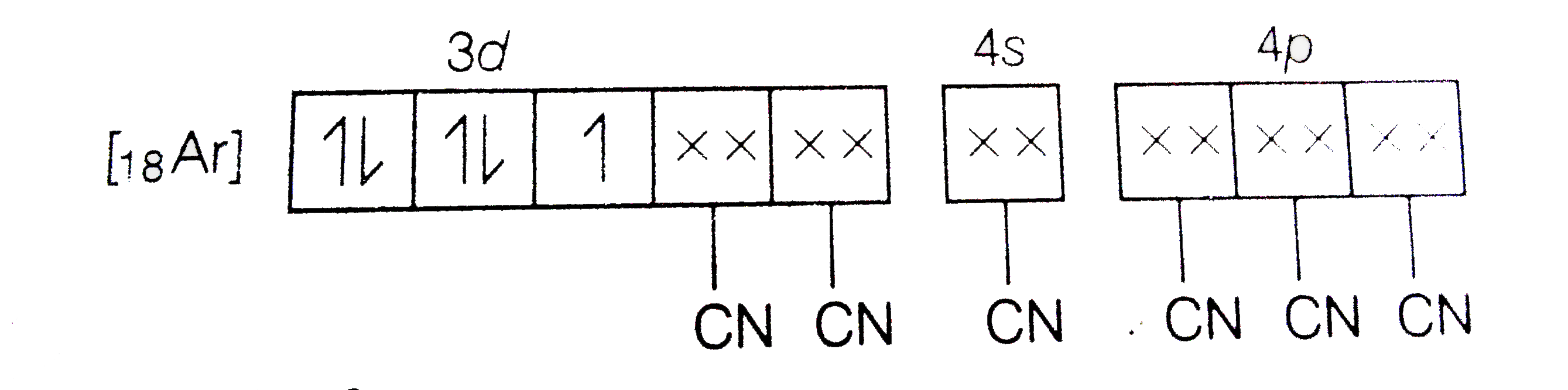
D

Assertion is false but reason is true.
According to VBT, MOEC of `Fe^(3+)` in `[Fe(CN)_(6)]^(3-)` is

Hybridisation `= d^(2) sp^(3)`
`n=1`
Hence, correct assertion is
`[Fe(CN)_(6)]^(3-)` ion shows magnetic moment corresponding to one unpaired electron.
t.e., `mu=sqrt(n(n+2))`
`=sqrt(1(1+2))`
`=sqrt(3)=1.73 BM`
Promotional Banner

Topper's Solved these Questions

  • CHEMISTRY IN EVERYDAY LIFE

    NCERT EXEMPLAR|Exercise Chemistry In Everyday Life|101 Videos
  • D AND F-BLOCK ELEMENTS

    NCERT EXEMPLAR|Exercise D And F-Block Elements|71 Videos

Similar Questions

Explore conceptually related problems

The questions given below consist of Assertion (A) and Reason (R ) . Use the following key to select the correct answer. Assertion : [Fe(CN)_6]^(3-) has d^(2)sp(3) hybridisation . Reason : [Fe(CN)_6]^(3-) shows magnetic moment corresponding to two unpaired electrons . Reason : [Fe(CN)_6]^(3-) shows magnetic moment corresponding to two unpaired electrons .

Assertion (A) : Mercurous ion is paramagnetic. Reason (R ): It contains one unpaired electron.

These questions consist of two statements each, printed as Assertion and Reason. While answering these questions you are required to choose any one of the following four responses: Assertion: [Fe(CN)_6]^(3-) has d^2sp^3 type hybridisation. Reason: [Fe(CN)_6]^(3-) ion shows magnetic moment corresponding to two unpaired electrons.

Assertion: Transition metal ion forming octahedral complexes undergo sp^(3)d^(2) or d^(2) sp^(3) hybridisation. Reason: Strong field ligands force the unpaired electrons of central metal ion to pair up causingg d^(2)sp^(3) hybridisation whereas weak field ligands do not affect electronic configuration of the metal ion undergoes in sp^(3)d^(2) hybridisation.

NCERT EXEMPLAR-COORDINATION COMPOUNDS-Coordination Compounds
  1. Explain why [Fe(H(2)O)(6)]^(3+) has magnetic moment value of 5.92 BM w...

    Text Solution

    |

  2. Arrange following complex ions in increasing order of crystal field sp...

    Text Solution

    |

  3. Why do compounds having similar geometry have different magnetic momen...

    Text Solution

    |

  4. CuSO(4).5H(2)O is blue in colour while CuSO(4) is colourless. Why ?

    Text Solution

    |

  5. Name the type of isomerism when ambidentate ligands are attched to cen...

    Text Solution

    |

  6. Match the complex ions given in column I with the colours given in col...

    Text Solution

    |

  7. Match the coordination compounds given in column I with the central me...

    Text Solution

    |

  8. Match the complex ions given in column I with the hybridisation and nu...

    Text Solution

    |

  9. Match the complex species given in column I with the possible isomeris...

    Text Solution

    |

  10. Match the compounds given In column I with oxidation state of cabalt p...

    Text Solution

    |

  11. Assertion (A) Toxic metal ions are removed by the chelating ligands. ...

    Text Solution

    |

  12. Assertion (A) [Cr(H(2)O(6))]Cl(2) and [Fe(H(2)O)(6)]Cl(2) are reducing...

    Text Solution

    |

  13. Assertion (A) Linkage isomerism arises in coordination compounds conta...

    Text Solution

    |

  14. Assertion (A) Complexes of MX(6) and MX(5)L type (X and L are unidenta...

    Text Solution

    |

  15. Assertion (A) [Fe(CN)(6)]^(3-) ion shows magnetic moment corresponding...

    Text Solution

    |

  16. Using crystal field theory, draw energy level diagram, write electroni...

    Text Solution

    |

  17. Using valence bond theory, explain the following in relation to the co...

    Text Solution

    |

  18. CoSO(4)Cl.5 NH(3) exists in two isomeric forms 'A' and 'B'. Isomer 'A'...

    Text Solution

    |

  19. what is the relationsphip between observed colour of the complex and t...

    Text Solution

    |

  20. Why are different colours observed in octahedral and tetrahedral compl...

    Text Solution

    |

