

Home
Class 12
CHEMISTRY
Using crystal field theory, draw energy ...

Using crystal field theory, draw energy level diagram, write electronic configuration of the central metal atom/ion and determine the magnetic moment value in the following
(a) `[CoF_(6)]^(3-), [Co(H_(2)O)_(6)]^(2+), [Co(CN)_(6)]^(3-)`
(b) `FeF_(6)^(3-), [Fe(H_(2)O)_(6)]^(2+), [Fe(CN)_(6)]^(4-)`

Text Solution

Verified by Experts

`[CoF_(6)]^(3-)`.
`F^(-)` is a weak field ligand.

Configuration of `Co^(3+)=3 d^(6) ("or "t_(2g)^(4)e_(g)^(2))`
Number of unpaired electrons `(n)=4`
Magnetic moment `(mu) =sqrt(n(n+2))=sqrt(4(4+2))=sqrt(24)=4.9 BM`
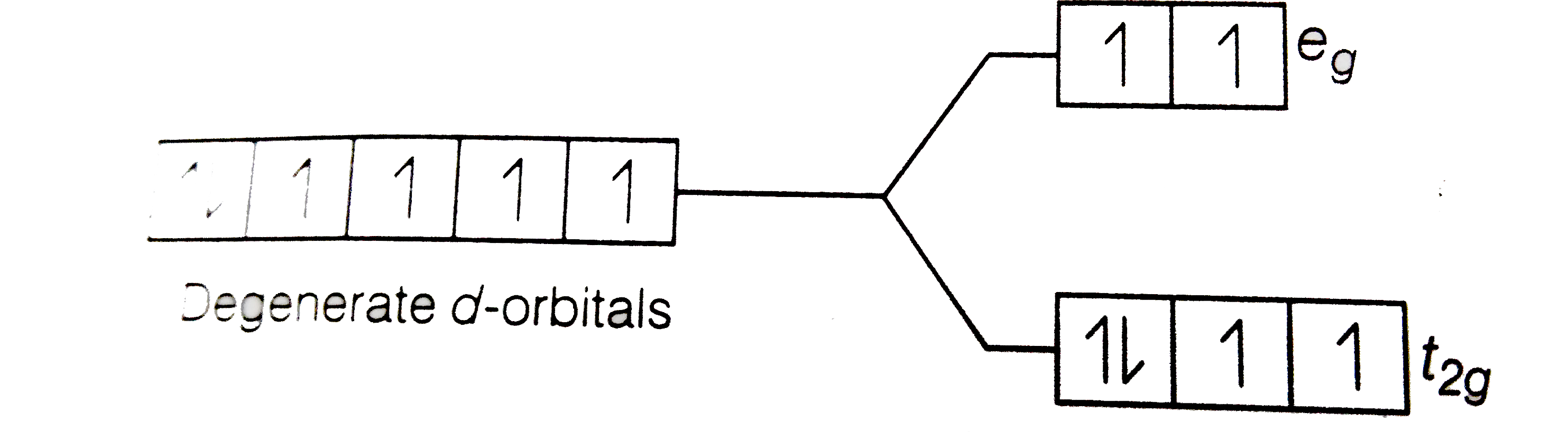
`[Co(H_(2)O)_(6)]^(2+)`,
`H_(2)O` is a weak field ligand.

Configuration of `Co^(2+)=3d^(7) ("or "t_(2g)^(5) e_(g)^(2))`
Number of unpaired electrons `(n)=3`
`mu=sqrt(3(3+2))=sqrt(15)=3.87 BM`
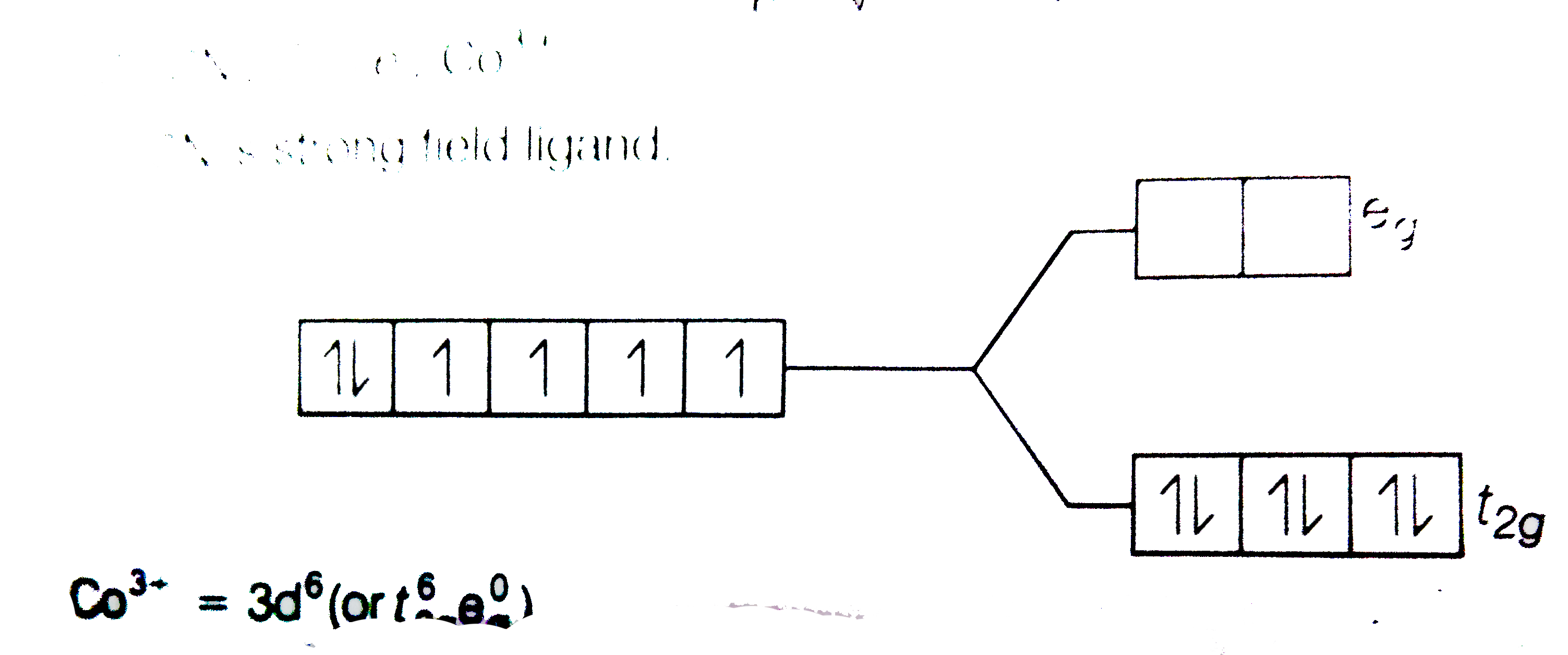
`[Co(CN)_(6)]^(3-)` i.e., `Co^(3+)`
`:.` CN is strong field ligand.

`Co^(3+)=3d^(6) ("or "t_(2g)^(6) e_(g)^(0))`
there is no unpaired electron, so it is diamagnetic.
`mu=0`
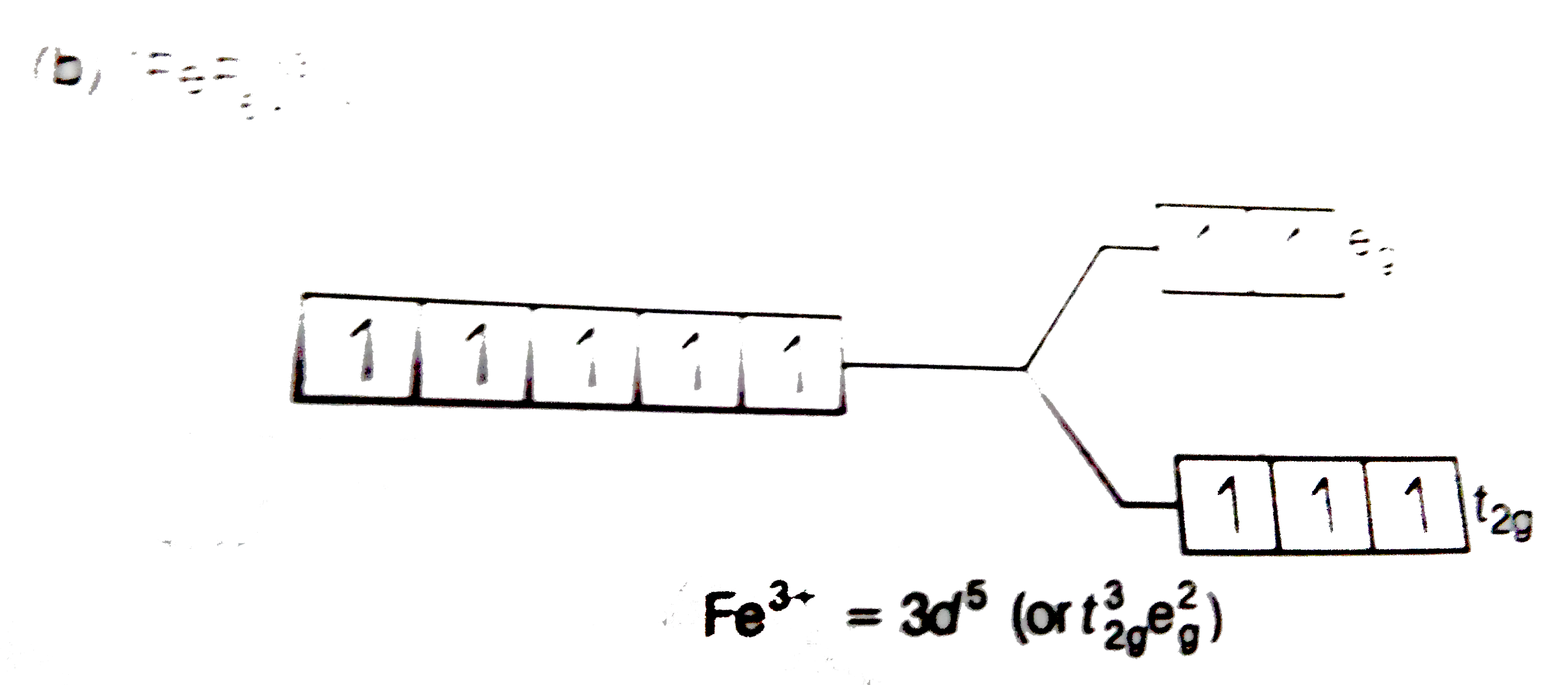
(b) `[FeF_(6)]^(3-)`,

`Fe^(3+)=3d^(5) ("or "t_(2g)^(3)e_(g)^(2))`
Number of unpaired electrons, `n=5`
`mu = sqrt(5(5+2))`
`=sqrt(35)=5.92 BM`
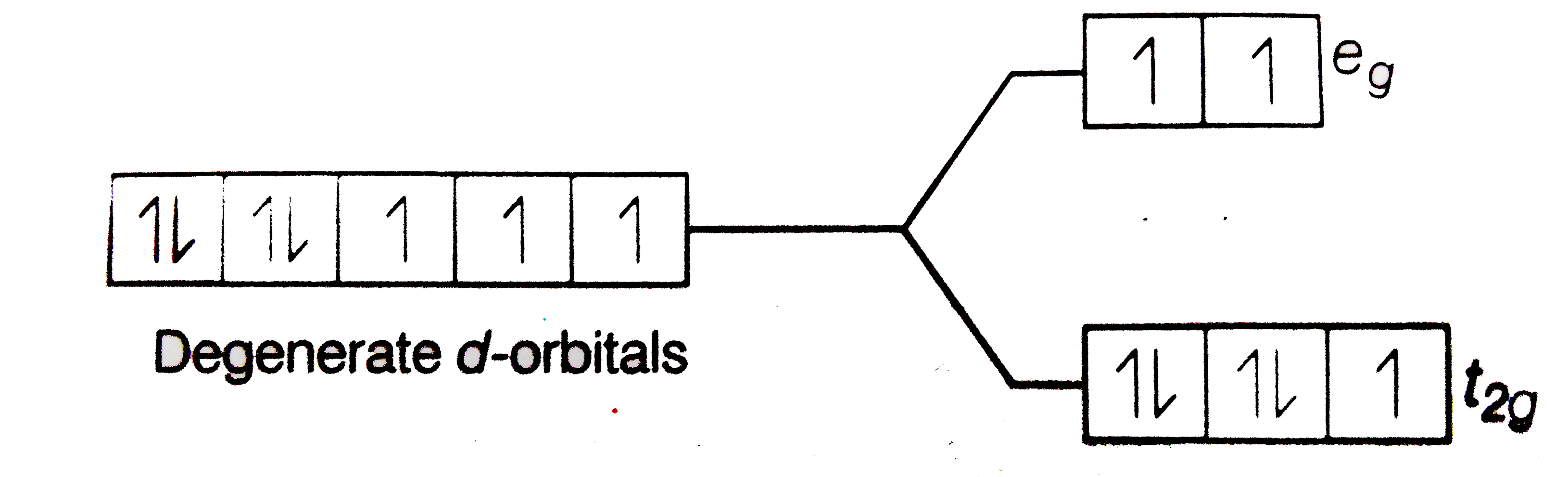
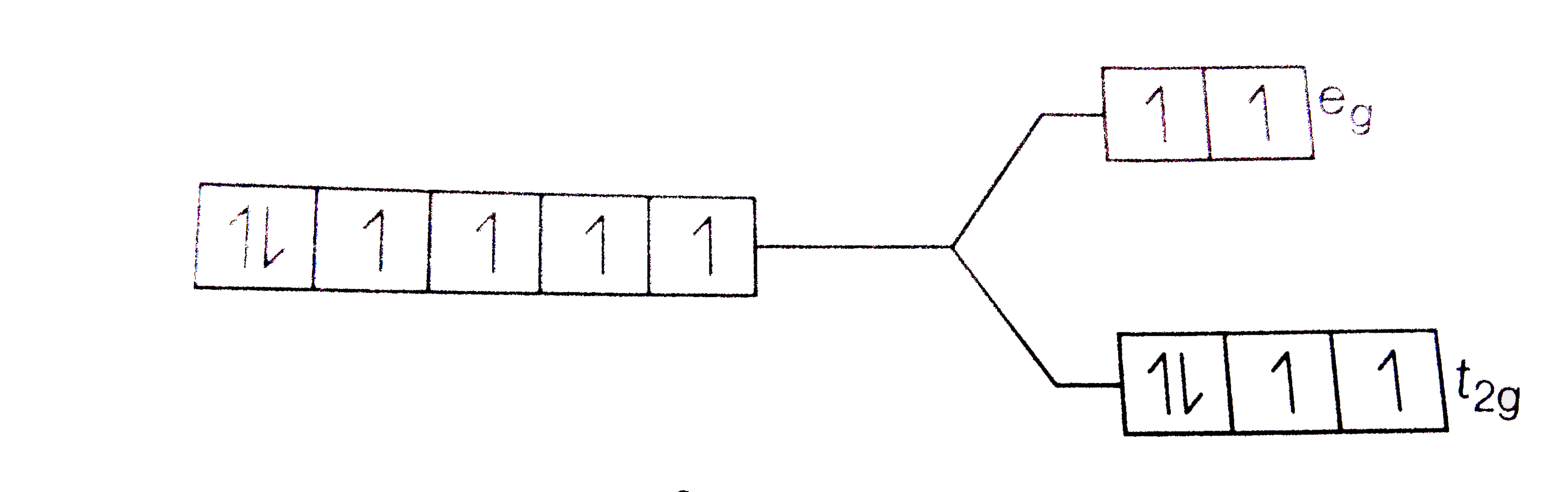
`[Fe(H_(2)O)_(6)]^(2+)`

`Fe^(2+)=3d^(6) ("or "t_(2g)^(4)e_(g)^(2))`
Number of unpaired electrons, `n=4`
`mu = sqrt(4(4+2))`
`Z=sqrt(24)`
`= 4.98 BM`
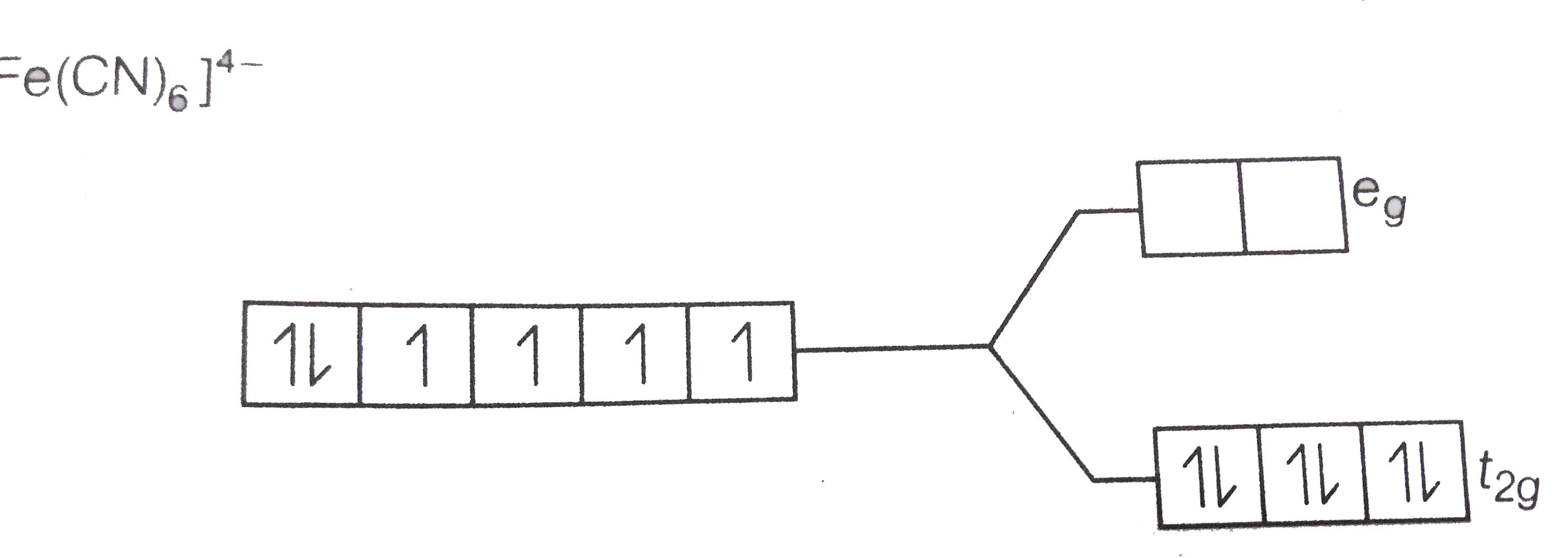
`[Fe(CN)_(6)]^(4-)`

since, `CN^(-)` is a strong field ligand, all the electrons get paired.
`Fe^(2+)=3d^(6) ("or "t_(2g)^(6) e_(g)^(0))`
Because there is no unpaired electron, so it is diamagnetic in nature.
Promotional Banner

Topper's Solved these Questions

  • CHEMISTRY IN EVERYDAY LIFE

    NCERT EXEMPLAR|Exercise Chemistry In Everyday Life|101 Videos
  • D AND F-BLOCK ELEMENTS

    NCERT EXEMPLAR|Exercise D And F-Block Elements|71 Videos

Similar Questions

Explore conceptually related problems

[Fe(H_(2)O)_(6)]^(2+) and [Fe(CN)_(6)]^(4-) differ in

[Fe(H_(2)O)_(6)]^(2+) and [Fe(CN)_(6)]^(4-) differ in :

[Fe(H_(2)O)_(6)]^(3+) and [Fe(CN)_(6)]^(3-) differ in

[Fe(H_2O)_6]^(2+)and [Fe(CN)_6]^(4-) differ in :

What is the correct electronic configuration of the central atom in K_(4)[Fe(CN)_(6)] based on crystal field theory

NCERT EXEMPLAR-COORDINATION COMPOUNDS-Coordination Compounds
  1. Explain why [Fe(H(2)O)(6)]^(3+) has magnetic moment value of 5.92 BM w...

    Text Solution

    |

  2. Arrange following complex ions in increasing order of crystal field sp...

    Text Solution

    |

  3. Why do compounds having similar geometry have different magnetic momen...

    Text Solution

    |

  4. CuSO(4).5H(2)O is blue in colour while CuSO(4) is colourless. Why ?

    Text Solution

    |

  5. Name the type of isomerism when ambidentate ligands are attched to cen...

    Text Solution

    |

  6. Match the complex ions given in column I with the colours given in col...

    Text Solution

    |

  7. Match the coordination compounds given in column I with the central me...

    Text Solution

    |

  8. Match the complex ions given in column I with the hybridisation and nu...

    Text Solution

    |

  9. Match the complex species given in column I with the possible isomeris...

    Text Solution

    |

  10. Match the compounds given In column I with oxidation state of cabalt p...

    Text Solution

    |

  11. Assertion (A) Toxic metal ions are removed by the chelating ligands. ...

    Text Solution

    |

  12. Assertion (A) [Cr(H(2)O(6))]Cl(2) and [Fe(H(2)O)(6)]Cl(2) are reducing...

    Text Solution

    |

  13. Assertion (A) Linkage isomerism arises in coordination compounds conta...

    Text Solution

    |

  14. Assertion (A) Complexes of MX(6) and MX(5)L type (X and L are unidenta...

    Text Solution

    |

  15. Assertion (A) [Fe(CN)(6)]^(3-) ion shows magnetic moment corresponding...

    Text Solution

    |

  16. Using crystal field theory, draw energy level diagram, write electroni...

    Text Solution

    |

  17. Using valence bond theory, explain the following in relation to the co...

    Text Solution

    |

  18. CoSO(4)Cl.5 NH(3) exists in two isomeric forms 'A' and 'B'. Isomer 'A'...

    Text Solution

    |

  19. what is the relationsphip between observed colour of the complex and t...

    Text Solution

    |

  20. Why are different colours observed in octahedral and tetrahedral compl...

    Text Solution

    |