

Home
Class 12
PHYSICS
A light in extensible thread passes over...

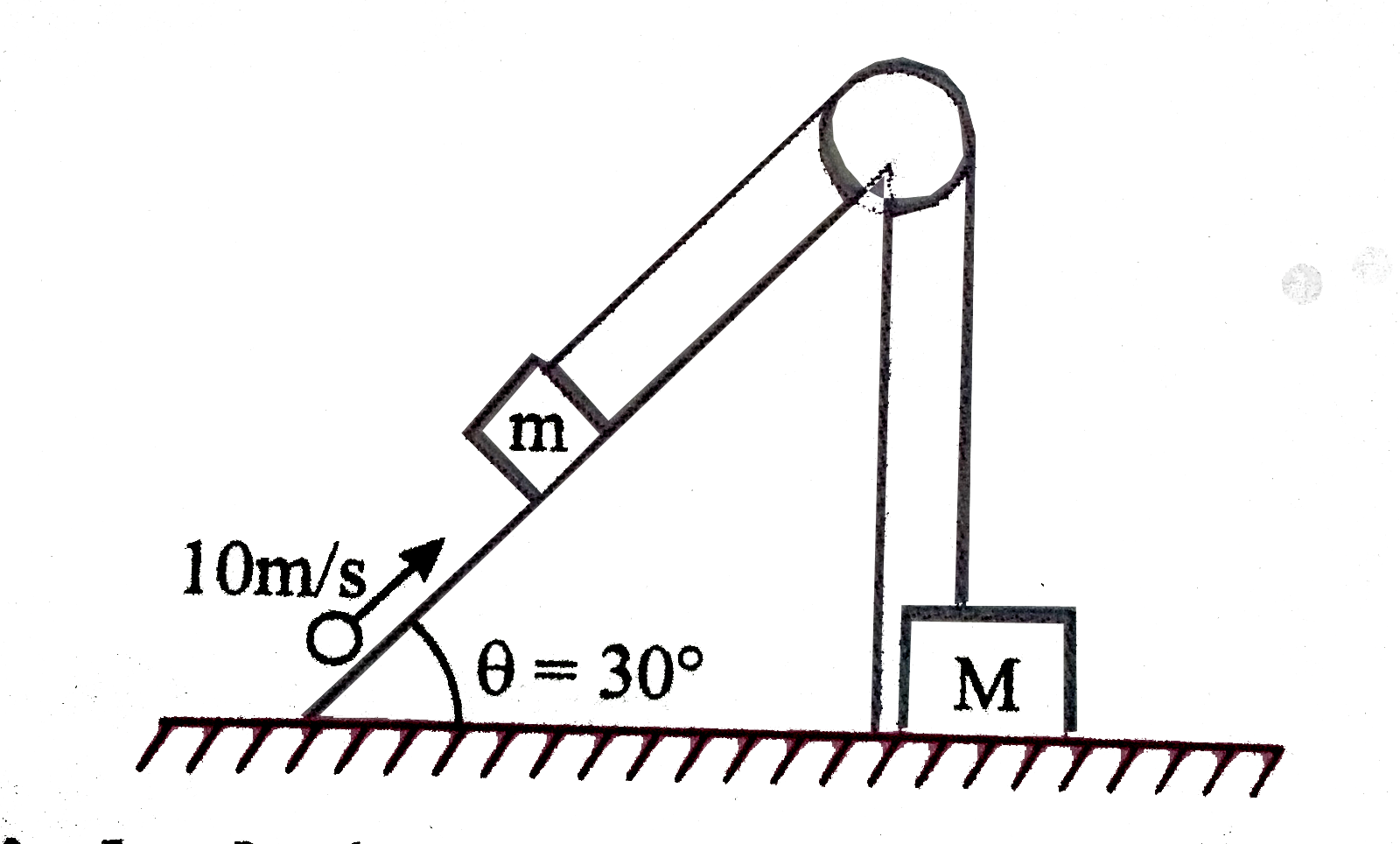
A light in extensible thread passes over a small frictionless pully. Two blocks of masses `m = kg` and `M = 3kg` respectively are attached with the thread as shown in the fig. The heavier block rests on a horizontal surface. A shell of mass `1 kg` moving upward with a velocity `10m//s` collides and sticks with the block of mass `'m'` as shown in the fig at `t = 0`. If the long inclined plane is smooth.

Find velocity of `(m+"shell")` just after collision.

Promotional Banner

Similar Questions

Explore conceptually related problems

A light in extensible thread passes over a small frictionless pully. Two blocks of masses m = kg and M = 3kg respectively are attached with the thread as shown in the fig. The heavier block rests on a horizontal surface. A shell of mass 1 kg moving upward with a velocity 10m//s collides and sticks with the block of mass 'm' as shown in the fig at t = 0 . If the long inclined plane is smooth. Find the maximum height ascended by 'M'

A light in extensible thread passes over a small frictionless pully. Two blocks of masses m = kg and M = 3kg respectively are attached with the thread as shown in the fig. The heavier block rests on a horizontal surface. A shell of mass 1 kg moving upward with a velocity 10m//s collides and sticks with the block of mass 'm' as shown in the fig at t = 0 . If the long inclined plane is smooth. Find the total time T at that instant of maximum height ascended by M

A light inelastic thread passes over a small frictionless pulley. Two blocks of masses m = 1 kg and M = 3 kg, respectively, are attached with the thread and heavy block rests on a surface. A particle P of mass 1 kg moving upward with a velocity of 10 ms^(-1) collides with the lighter block and sticks to it. The speed of the bigger block just after the string is taut will be [g = 10 ms^(-2)]

Two blocks of masses of 40 kg and 30 kg are connected by a weightless string passing over a frictionless pulley as shown in the figure.

A block of mass m slides down along the surface of the bowl from the rim to the bottom as shown in fig. The velocity of the block at the bottom will be-

A block of mass m moving with a velocity v_(0) collides with a stationary block of mass M to which a spring of stiffness k is attached, as shown in Fig. Choose the correct alternative(s)

Two blocks of masses 1 kg and 2 kg are placed in contact on a smooth horizontal surface as shown in fig. A horizontal force of 6N is applied d(a) on a 1-kg block. Find the force of interaction of the blocks. .

A block of mass sqrt(3) kg rests on a horizontal frictionless surface. What will be the acceleration of the block if it is subjected to two forces as shown in the figure.

In the shown figure both blocks are in equilibrium m=1 kg. a bullet of mass m moves with velocity 10 m//s and get embedded into the block A, then just after collision :

Two block of masses 10 kg and 4 kg are connected by a spring of negligible mass and placed on a frictionless horizontal surface. An impluse given a velocity of 14 m/s to the heavier block in the direction of the leghter block. The velocity of centre of mass is :