Home
Class 12
PHYSICS
Two students X and Y perform an experime...

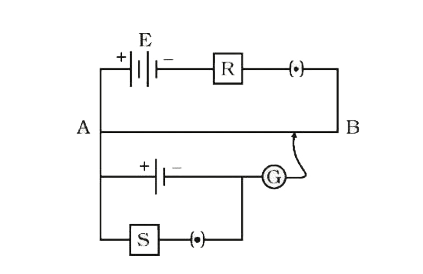
Two students X and Y perform an experiment on potentiometer separating using the circuit diagram shown here. Keeping other things unchanged
(i) X increases the value of resistance R.
(ii) Y decreases the value of resistance S in the set up. How would these changes affect the position of the null point in each case and why?

Text Solution

Verified by Experts

(i) By increasing resistance R, the current in main circuit decreases, so potential gradient decreases. Hence a greater length of wire would be needed for balancing the same potential difference. So, the null point would shift towards right (i.e., towards B).
(ii) By decreasing resistance S, the terminal potential difference `V=E/(1+r/S)`across cell decreases, so balance is obtained at small length i.e., point will be obtained at smaller length. So, the null point would shift towards left (i.e., towards A).
Promotional Banner

Similar Questions

Explore conceptually related problems

Two students ‘X’ and ‘Y’ perform an experiment on potentiometer separately using the circuit given: Keeping other parameters unchanged, how will the position of the null point be affected it (i) X’ increases the value of resistance R in the set-up by keeping the key K_1 closed and the key K_2 open? (ii) Y’ decreases the value of resistance S in the set-up, while the key K_2 remain open and the key K_1 closed? Justify.

Consider the MB shown in the diagram, let the resistance X have temperature coefficient alpha_(1) and the resistance from the RB have the temperature coefficient alpha_(2) . Let the reading of the meter scale be 10 cm from the LHS. if the temperature of the two resistance increase by small temperature DeltaT then what is the shift in the position of the null point ? Neglect all the other changes in the bridge due to temperature rise.

Two students X and Y have to do their experiment on plotting the temperature-time graph for a hot body as it cools to room temperature. They do their experiments in the same lab, using completely identical apparatus, take equal amounts of tap water heated up to the same temperature, start their observations simultaneously and note the temperature values at identically spaced intervals of time. Their temperature-time graphs, plotted on a given graph paper, with the same given choices of scales along the axis, are however, as shown: The following could be the reason for this difference: (A) Use of an overhead fan by student X. (B) Use of an overhead fan by student Y. (C) Less frequent stirring of water by student X. (D) Less frequent stirring of water by student Y. The most likely reason is:

The figure Shows the experimental set up of a meter bridge. The null point is found to be 60 cm away from the end A with X and Y in positions as shown. When a resistance of 15 Omega is connected in series with Y, the null points is found to shift by 10 cm towards the end A of the wire. Find the position of the null point if resistance of 30 Omega were connected in parallel with Y.

The circuit diagram of a potentiometer for determining the emf epsilon of a cell of negligible internal reistance. (i) What is the purpose of using high resistance R_(2) ? (ii) How does the position of balance point (J) change when the resistance R_(1) is increased ? (iii) Why cannot the point be obtained, (a) When the emf epsilon is greater than 2V, and (b) When the key K is closed.

The figure shows experimental set up of a meter bridge. When the two unknown resistances X and Y are inserted, the null point D is obtained 40 cm from the end A. When a resistance of 10 Omega is connected in series with X, the null point shifts by 10 cm. Find the position of the null point when the 10 Omega resistance is instead connected in series with resistance 'Y'. Determine the value of the resistance X and Y

In the given circuit diagram, a voltmeter 'V' is connected across a lamp 'L'. How would (i) the brightness of the lamp and (ii) voltmeter reading 'V' be affected, if the value of resistance 'R' is decreased ? Justify your answer.
