Home
Class 12
PHYSICS
Two bars of equal resistivity rho and ra...

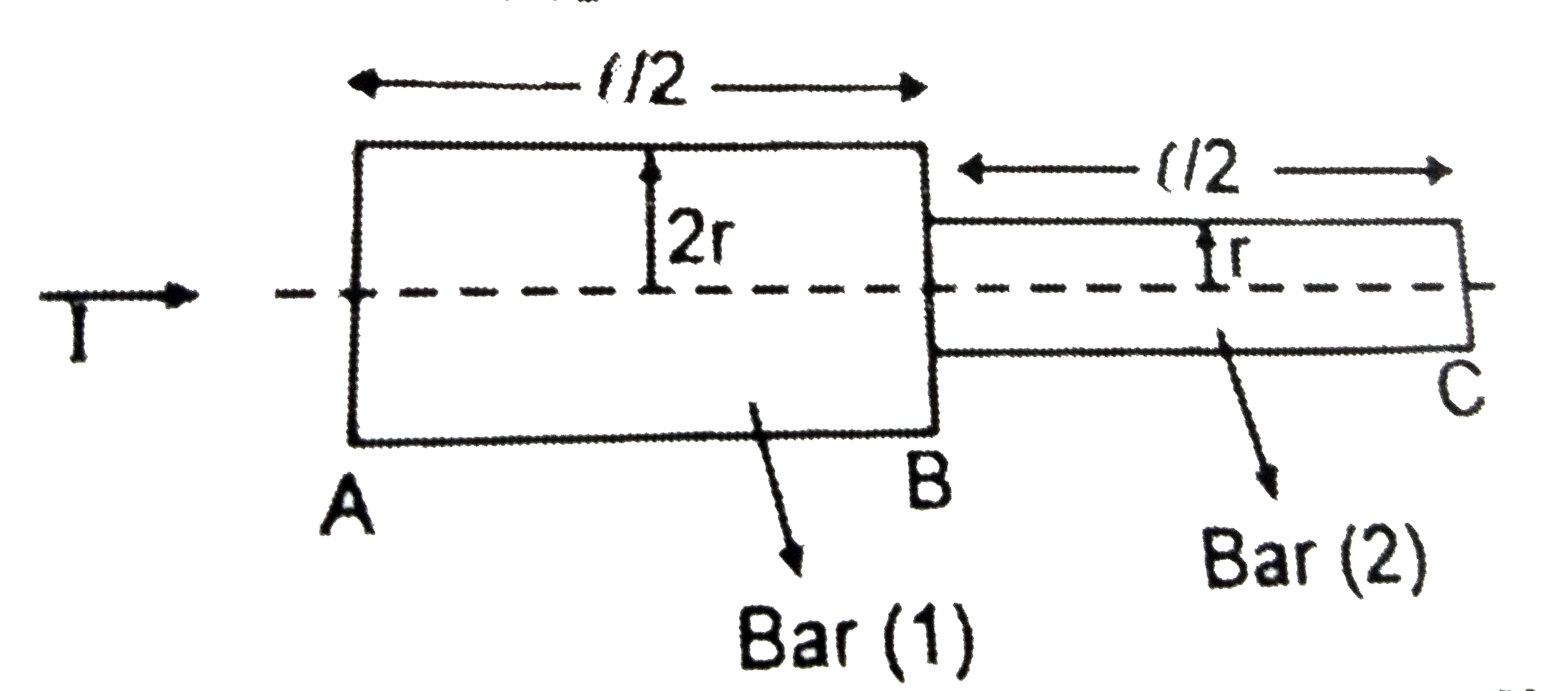
Two bars of equal resistivity `rho` and radius 'r' and '2r' are kept in contact as show. An electric current is passed through the bars. Which one of the following is correct ?

A

Heat produced in bar BC is 4 times the heat produced in bar AB

B

Electric field in both halves is equal

C

Current density across AB is double that of across BC

D

Potential difference across AB is 4 times that of across BC

Text Solution

Verified by Experts

Current flowing through both the bars is equal. Now the heat produced is given by `H=I^2Rt or H prop R`
or `H_(AB)/H_(BC)=R_(AB)/R_(BC)=(1//2r)^2/(1//r)^2 (as R prop 1/2 prop 1/r^2)=1//4 or H_(BC)=4H_(AB)`
Promotional Banner

Similar Questions

Explore conceptually related problems

Two bars of equal resisttivity rho and radil 'r' and '2r' are kept in contact as show. An electric currtn is passed through the bars. Which one of the following is correct ?

The graphs between current (1) and voltage (v) for three linear resistors 1,2 and 3 are given below: If R_(1),R_(2) and R_(3) are the resistances of these resistors, then which one of the following is correct?

A:Current density is a very is a vector quantity . R : Electric current , passing through a given unit area is current density.

A hemispherical bowl of radius r is placed in uniform electric field E . The electric flux passing through the bowl is

A coil of n turns and radius R carries a current I it is unwound and rewound to make a new coil of radius (R )/(2) and the same current is passed through it what is the ratio of the magnetic moment of the new coil and the original coil ?

A circle is passing through the points [5,-8], (-2,9) and (2,1) If r is the radius of the circle, then which of the following is correct?

Find the moment of inertia of a pair of spheres, each having a mass m and radius r kept in contact about the tangent passing through the point of contact.

The M.I. of the solid sphere of density 'rho' and radius 'R' about an axis passing through its centre is given by

