Home
Class 12
PHYSICS
A cord is wrapped on a pulley (disk) of ...

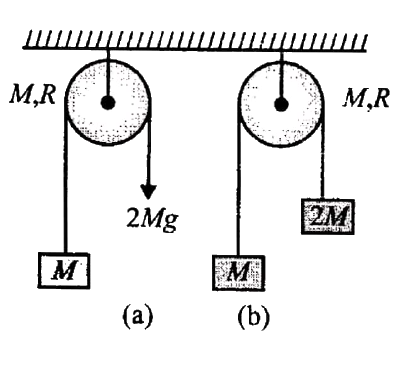
A cord is wrapped on a pulley (disk) of mass M and radius R as shown in figure. To one end of the cord, a block of mass M is connected as shown and to other end in (a) a force of 2 Mg and in (b) a block of mass 2 M. Let angular acceleration of the disk in A and B is `alpha_(A) and alpha_(beta)` respectively, then (cord is not slipping on the pulley)

A

`alpha_(A) = alpha_(B)`

B

`alpha_(A) gt alpha_(B)`

C

`alpha_(A) lt alpha_(B)`

D

None of these

Text Solution

Verified by Experts

The correct Answer is:
B

In (A)
`(T_(2)-T_(1)R) = (MR^(2))/2 alpha_(A)`, `T_(1) - Mg = Ma_(A)`, `T_(2) = 2Mg`
`a_(A) = R alpha_(A)`

Solve to get `alpha_(A) =(2g)/(3R)`
For (a)
`(T_(2)-T_(1)) xx R = (MR^(2))/2 alpha_(B)`

`(T_(2)-T_(1)) xx R =(MR^(2))/2 alpha_(B)`
`T_(1)-Mg = Ma_(s)`
`2Mg -T_(2)= 2Ma_(s)`
`a_(B) = R alpha_(B)`
Solve to get `alpha_(B) = (2g)/(7R) `, So, `alpha_(A) gt alpha_(B)`.
Promotional Banner

Similar Questions

Explore conceptually related problems

A cord is wrapped on a pulley (disk) of mass M and radius R as shown in figure. To one end of the cord, a block of mass M is connected as shown and to other end in (a) a force of 2 Mg and in (b) a block of mass 2 M. Let angular acceleration of the disk in (a) and (b) is alpha_(A) and alpha_(B) respectively, then (cord is not slipping on the pulley)

Two blocks of masses m_1 and m_2 are connected as shown in the figure. The acceleration of the block m_2 is :

Two block of masses m_(1) and m_(2) are connected as shown in the figure. The acceleration of the block m_(2) is:

In the figure shown, all surfaces are smooth and the pulley is massless. A constant force of magnitude F = (mg)/(2) is acting on the block of mass M. The acceleration of the block M is :

A block of mass m_(1) rests on a horizontal table. A string tied to the block is passed on a frictionless pulley fixed at the end of the table and to the other end of string is hung another block of mass m_(2) . The acceleration of the system is

A uniform disc of mass M and radius R is mounted on an axle supported in frictionless bearings. A light cord is wrapped around the rim of the disc and a steady downward pull T is exerted on the cord. The angular acceleration of the disc is

A block of mass m is released from a wedge of mass m as shown in figure . Find the time taken by the block to reach the end of the wedge.

Figure shows a uniform disk, with mass M = 2.5 kg and radius R = 20 cm, mounted on a fixed horizontal axle. A block with mass m = 1.2 kg hangs from a massless cord that is wrapped around the rim of the disk. Find the acceleration of the falling block, the angular acceleration of the disk, and the tension in the cord. The cord does not slip, and there is no friction at the axle.

In the figure, the blocks have masses M_(1) and M_(2) (M_(1) gt M_(2)) and acceleration a. The pulley P has a radius r and some mass the string not slip on the pulley

