Home
Class 12
PHYSICS
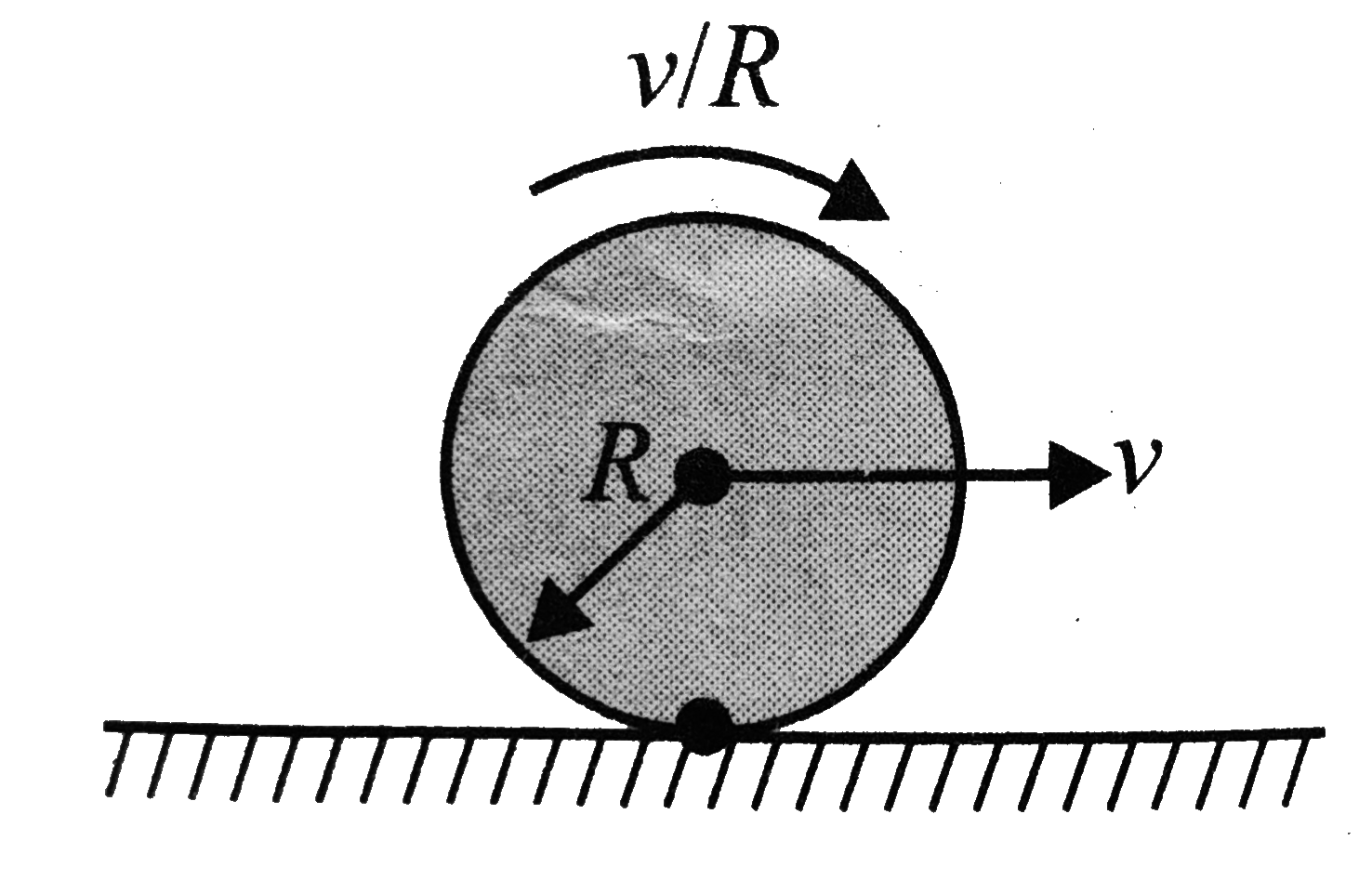
A disc is performing pure rolling on a s...

A disc is performing pure rolling on a smooth stationary surface with constant angular velocity as shown in Fig,. At any instant, for the lower most point of the disc,

A

velocity is v, acceleration is zero

B

velocity is zero, acceleration is zero

C

velocity is v, acceleration is `v^(2)/R`

D

velocity is zero, acceleration is `v^(2)/R`

Text Solution

Verified by Experts

The correct Answer is:
D

`a=R omega^(2) = R(v/R)^(2) = v^(2)/R`
Promotional Banner

Similar Questions

Explore conceptually related problems

A sphere is performing pure rolling on a rough horizontal surface with constant angular velocity. Frictional force acting on the sphere is zero. Velocity of contact point is zero.

A disc of radius R is rolling purely on a flat horizontal surface, with a constant angular velocity. The angle between the velocity and acceleration vectors of point P is .

An object of mass M and radius R is performing pure rolling motion on a smooth horizontal surface under the action of a constant force F as shown in Fig. The object may be

A disc of radius R is rolling purely on a flat horizontal surface, with a constant angular velocity the angle between the velocity ad acceleration vectors of point P is

A disc is undergoing rolling on a horizontal surface. Which of the statement about angular momentum of the disc is incorrect ?

A disc of mass 4.8 kg and radius 1 m is rolling on a horizontal surface without sliding with angular velocity of 600 rotations/min. What is the total kinetic energy of the disc ?

A disc shaped body (having a hole shown in the figure) of mass m=10kg and radius R=10/9m is performing pure rolling motion on a rough horizontal surface. In the figure point O is geometrical center of the disc and at this instant the centre of mass C of the disc is at same horizontal level with O . The radius of gyration of the disc about an axis pasing through C and perpendicular to the plane of the disc is R/2 and at the insant shown the angular velocity of the disc is omega=sqrt(g/R) rad/sec in clockwise sence. g is gravitation acceleration =10m//s^(2) . Find angular acceleation alpha ( in rad//s^(2) ) of the disc at this instant.

