Home
Class 12
PHYSICS
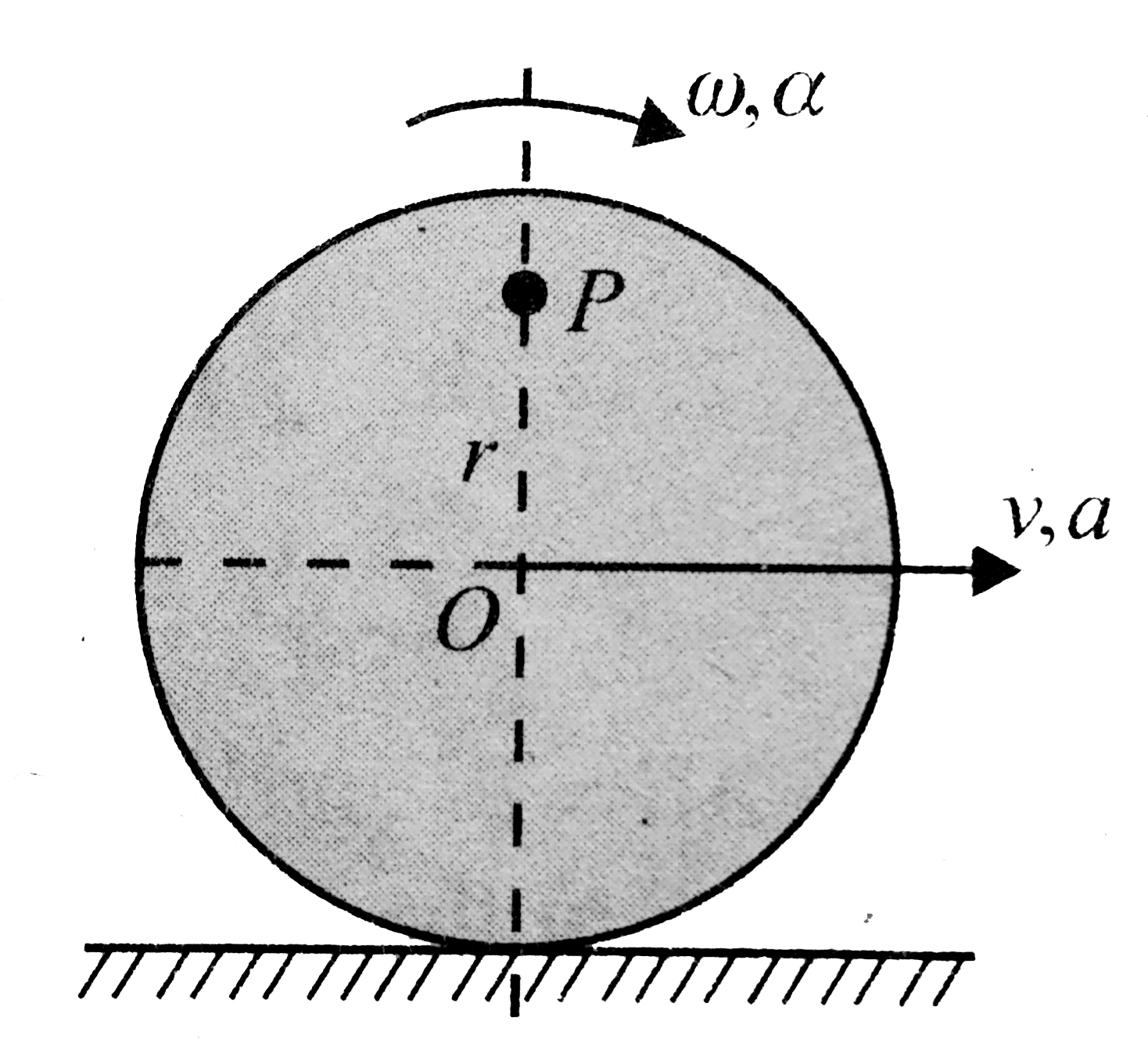
A disc of radius R rolls on a horizontal...

A disc of radius `R` rolls on a horizontal ground with linear acceleration `a` and angular acceleration `alpha` as shown in Fig. The magnitude of acceleration of point `P` as shown in the figure at an instant when its linear velocity is `v` and angular velocity is `omega` will be a

A

`sqrt((a + ralpha)^(2) + (r omega^(2))^(2))`

B

`(ar)/R`

C

`sqrt(r^(2)alpha^(2) + r^(2) omega^(4))`

D

`r alpha`

Text Solution

Verified by Experts

The correct Answer is:

A

Linear velocity of p is `v + r omega rArr` Linear acceleration `=d/(dt) (v+ romega) = a + romega`
Angular velocity `=omega rArr` radial acceleration `=omega^(2)r`
`rArr` total acceleration of `p propto sqrt((a+r alpha)^(2)+(omega^(2)r^(2))`
Promotional Banner

Similar Questions

Explore conceptually related problems

A wheel is rolling on a horizontal plane. At a certain instant it has a velocity v and acceleration a of CM as shown in figure . Acceleration of

A disc of radius R is rolling purely on a flat horizontal surface, with a constant angular velocity the angle between the velocity ad acceleration vectors of point P is

A disc of radius R is rolling purely on a flat horizontal surface, with a constant angular velocity. The angle between the velocity and acceleration vectors of point P is .

Consider a uniform disc of mass m , radius r rolling without slipping on a rough surface with linear acceleration a and angular acceleration alpha due to an external force F as shown in the figure coefficient of friction is mu . Q. Angular momentum of the disc will be conserved about

A ring of radius R rolls on a horizontal ground with linear speed v and angular speed omega . For what value of theta the velocity of point P is in vertical direction (vltRomega) .

A disc of radius R is moving on a rough horizontal surface with velocity v and angular speed omega at an instant as shown in figure. Choose the correct statement.

A wheel is rolling without slipping on a horizontal plane with velocity v and acceleration a of centre of mass as shown in figure. Acceleration at

Calculate the magnitude of linear acceleration of a particle moving in a circle of radius 0.5 m at the instant when its angular velocity is 2.5 rad s–1 and its angular acceleration is 6 rad s^(-2) .
