Home
Class 12
PHYSICS
A disc is rotated about its axis with a ...

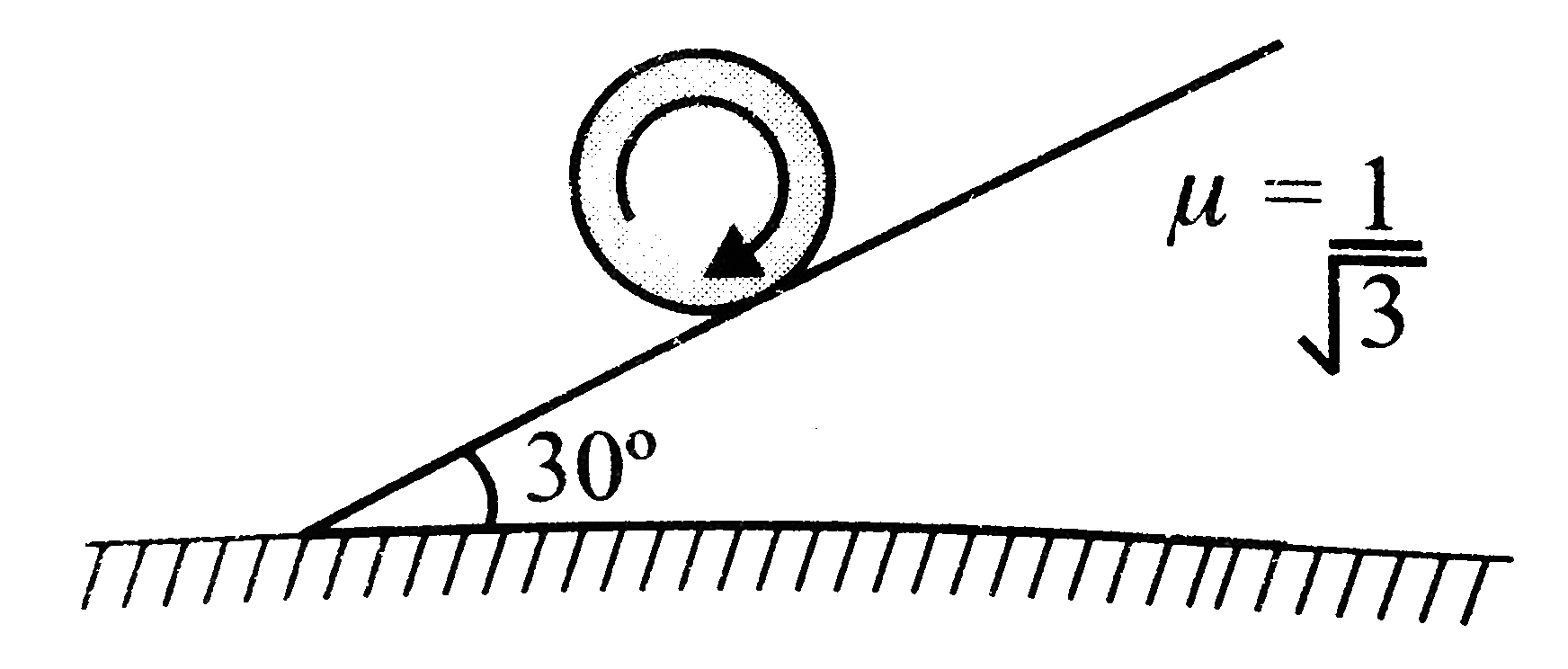
A disc is rotated about its axis with a certain angular velocity and lowered gently on a rough inclined plane as shown in Fig., then

A

It will rotate at the position where it was placed and then will move downward

B

It will go downward just after it is lowered

C

It will go downward first and then climb up

D

It will climb upwards and then move downwards

Text Solution

Verified by Experts

The correct Answer is:
A

Here kinetic friction force will balance the force of gravity along the incline. So it will rotate at its initial position and will not move up or down. As its angular velocity becomes zero (friction also becomes zero), it will move downwards.
Promotional Banner

Similar Questions

Explore conceptually related problems

An cylinder of mass m is rotated about its axis by an angular velocity omega and lowered gently on an inclined plane as shown in figure. Then : .

A sphere of mass m is rotated about its axis by an angular velocity omega and lowered gently on an inclined plane as shown in figure. Then initally

A circular disc of radius R is rotating about its axis O with a uniform angular velocity omega"rad s"^(-1) as shown in the figure. The magnitude of the relative velocity of point A relative to point B on the disc is

A homogeneous disc of mass 2 kg and radius 15 cm is rotating about its axis with an angular velocity of 4 rad/s. the linear momentum of the disc is

A uniform circular disc of radius R is rotating about its own axis with moment of inertia I at an angular velocity omega if a denser particle of mass m is gently attached to the rim of disc than its angular velocity is

A thin circular ring of mass M and radius R is rotating about its axis with constant angular velocity omega . The objects each of mass m are attached gently to the ring. The wheel now rotates with an angular velocity.

A circular disc rotates about an axis passing through its centre with a certain angular velocity. Suddenly a small piece of the disc is broken from the edge and falls down. Then

A disc is given an initial angular velocity omega_(0) and placed on a rough horizontal surface as shown Fig. The quantities which will not depend on the coefficient of friction is/are

A non-conducting disc having unifrom positive charge Q , is rotating about its axis with unifrom angular velocity omega .The magnetic field at the centre of the disc is.

A brass disc is rotating about its axis. If temperature of disc is increased then its

