Home
Class 12
PHYSICS
A stick of length L and mass M lies on a...

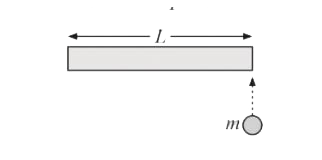
A stick of length L and mass M lies on a frictionless horizontal surface on which it is free to move in any way. A ball of mass m moving with speed v collides elastically with the stick as shown in the figure. If after the collision the ball comes to rest, then what would be the mass of the ball?

A

m=2M

B

m=M

C

`m= M//2`

D

`m = M//4`

Text Solution

Verified by Experts

The correct Answer is:

D

Applying the law of conservation of momentum
mv=MV
By conservation of angular momentum
`mv(L//2) = (ML^(2))/(12) omega`…………..(ii)
As the collision is elastic, we have
`1/2 mv^(2) = 1/2MV^(2) + 1/2I omega^(2)`……….(iii) or (`Lomega + V = evw` here e=1)
Substituting the valu,e we get: `m=M//4`
Promotional Banner

Similar Questions

Explore conceptually related problems

A Stick of length L and mass M lies on a fnctionless horizontal surface on which it is free to move in any way. A ball of mass m moving with speed v collides elastically with the stick as shownin figure-5.115. If after the collision ball comes to rest, then what should be the mass of the ball ?

A ball of mass m moving with velocity v collides head on elastically with another identical ball moving with velocity - V. After collision

A ball of mass m moving with velocity v , collide with the wall elastically as shown in the figure. After impact the change in angular momentum about P is : .

A ball of mass 'm', moving with uniform speed, collides elastically with another stationary ball. The incident ball will lose maximum kinetic energy when the mass of the stationary ball is

A meter stick of length l and mass M lies on a frictionlesss table. The stick is free to move in any way on the table. A hockey ball of mass m moving perpendicuarly to the mass of the ball so that it remains at rest immediately after the collision? [Hint: Elastic collision means that kinetic energy is conserved in the process. Consider conservation of kinetic energy, conservation of angualr momentum and linear momentum, i.e., 1/2mv^(2) = (1/2Mv^(2') + 1/2Iepsilon^(2) , mv1/2 = Iepsilon , mv = Mv^(') . Eliminate v^(2') and w^(2) from the first with the help of the other two. Use the expression I = 1/12 MI^(2)]

A ball of mass M moving with speed v collides perfectly inelastically with another ball of mass m at rest. The magnitude of impulse imparted to the first ball is

A body of a mass m moving with speed v collides elastically head on with another body of mass m, initially at rest. Show that the moving body will come to a stop after collision.

A stick of length l lies on horizontal table. It has a mass M and is free to move in any way on the table. A bal of mass m moving perpendicularly to the stick at a distance d from its centre with speed v collides elastically with it as shown in figure. what quantities are conserved in the collision ? what must be the mass of the ball, so that it remains at rest immediately after collision?
