Home
Class 12
PHYSICS
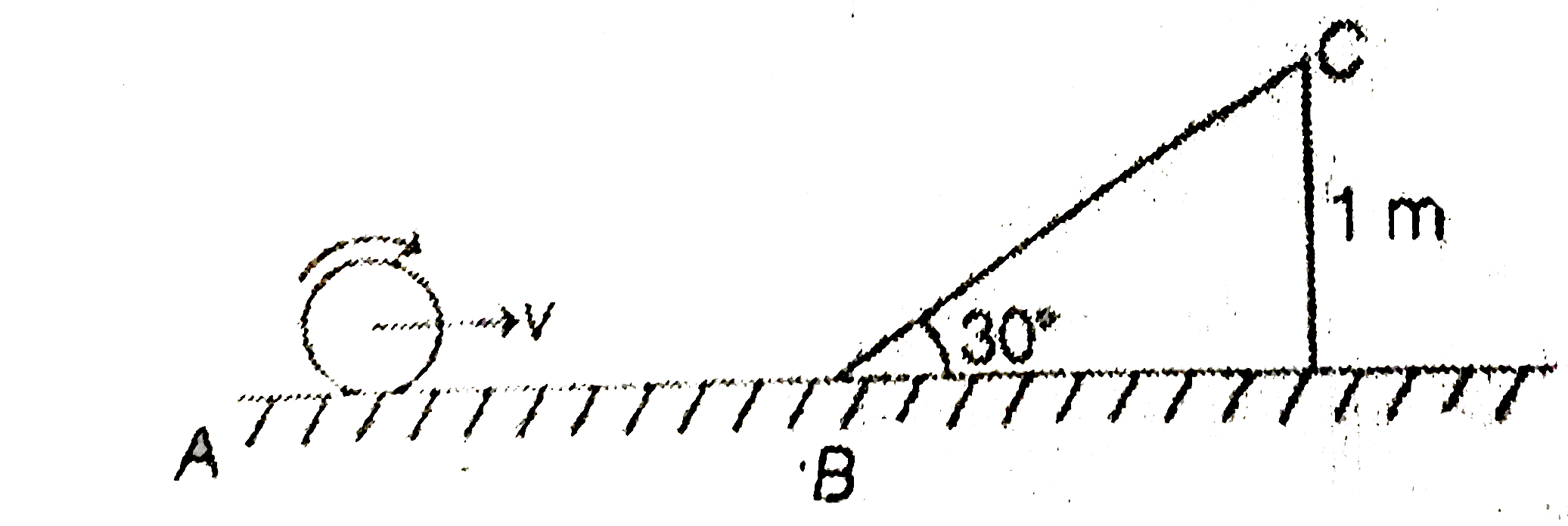
A small sphere of mass 1 kg is rolling w...

A small sphere of mass 1 kg is rolling without slipping with linear speed
`v=sqrt((200)/(7) m//s`

It leaves the inclined plane at point C.
Find the linear speed at point C.

A

`2//5`

B

`2//3`

C

`1//6`

D

`1//2`

Text Solution

Verified by Experts

The correct Answer is:

C

At point C total kinetic energy is 10 J. Ratio of `K_(R)/K_(T) ` is `2/3` .Therefore,
`K_(R) = 2/7 xx 10 = 20/7` J
this `K_(R)` will now remain constant because only weight act on the sphere in air which will pass through centre. Net torque will be zero. So, `K_(R)` can neither increases nor decreases. So, at the time striking with ground.
`K_(R) = 20/7 J `, while, `K_(T) =(20-20/7)_ = 120/7 J therefore K_(R)/K_(T) = 1/6`
Promotional Banner

Similar Questions

Explore conceptually related problems

A small sphere of mass 1 kg is rolling without slipping with linear speed v=sqrt((200)/(7) m//s It leaves the inclined plane at point C. Find ratio of rotational and translational kinetic energy of the sphere when it strikes the ground after leaving from point C.

A solid sphere of mass 1 kg rolls on a table with linear speed 2 m/s, find its total kinetic energy.

A ring of mass m is rolling without slipping with linear speed v as shown in figure. Four particles each of mass m are also attached at points A, B , C and D find total kinetic energy of the system.

A solid sphere of mass 1 kg rolls on a table with linear speed 1 m/s. Its total kinetic energy is

A circular disc of mass 2 kg and radius 10 cm rolls without slipping with a speed 2 m/s. The total kinetic energy of disc is

A solid sphere of mas 2kg rolls on a table with linear speed of 1 m//s . Its total kinetic energy is

A solid sphere of mass m and radius R rolls without slipping on a horizontal surface such that v_(c.m.)=v_(0) .

A uniform sphere of mass m and radius R starts rolling without slipping down an inclined plane at an angle alpha to the horizontal. Find the time dependence of the angular momentum of the sphere relative to the point of contact at the initial moment. How will the obtained result change in the case of a perfectly smooth inclined plane?
