Home
Class 12
PHYSICS
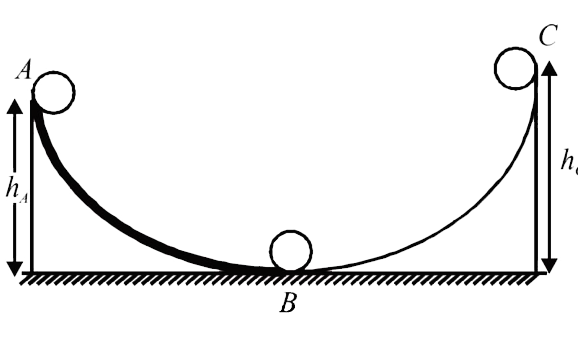
A small bell starts moving from A over a...

A small bell starts moving from `A` over `a` fixed track as shown in the figure . Surface `AB` is friction from `A` to `B` the bell roll ralis without sipping `BC` is friction , `K_(A)K_(B)` and` K_(C)` are kinetic energy of the bell at `A, B` and `C` respacecvely.Then

A

`h_(A) gt h_(c), K_(B) gt K_(C)`

B

`h_(A) gt h_(c ), K_(C) gt K_(A)`

C

`h_(A)= h_(c ), K_(B) = K_(C)`

D

`h_(A) lt h_( c), K_(B) gt K_(C)`

Text Solution

Verified by Experts

The correct Answer is:

A, B

Since work is being done in the process, the sum of kinetic energy, translational kinetic energy, rotational kinetic energy and potential energy will be constant.
`KE_(A) + mah_(A) = KE_(B) = KE_(C) + mgh_(C)`
`KE_(B) gt KE_(A)` and `KE_(B) gt KE_(C)`
Now, if `h_(C) gt h_(A)`, then `KE_(A) lt KE_(C)`.
Promotional Banner

Similar Questions

Explore conceptually related problems

A ball moves over a fixed track as shown in the figure. From A and B the ball rolls without slipping. If surface B is frictionless and K_(A),K_(B) and K_(C) are kinetic energies of the ball at A,B and C respectively then:

A ball moves over a fixed track as shown in the figure. From A to B ball rolls without slipping. Surface BC is frictionless. K_(A), K_(B) and K_(C) are kinetix energies of the ball at A, B and C , respectively. Then .

A ball moves over a fixed track as shown in thre figure. From A to B the ball rolls without slipping. If surface BC is frictionless and K_(A),K_(B) and K_(C) are kinetic energies of the ball at A, B and C respectively then (a). h_(A)gth_(C),K_(B)gtK_(C) (b). h_(A)gth_(C),K_(C)gtK_(A) (c). h_(A)=h_(C),K_(B)=K_(C) (d). h_(A)lth_(C),K_(B)gtK_(C)

A small block of mass m slides along a smooth frictional track as shown in the figure. If it starts from rest at P, what is the resultant force acting on it at Q?

Portion AB of the wedge shown in figure is rough and BC is smooth. A solid cylinder rolld without slipping from A to B . Find the ratio of translational kinetic energy to rotationa linetic energy, when the cylinder reaches point C . .

If a car is moving rightward with acceleration a = gsqrt(k) m//s rightward as shown in the figure. Find the value of k so that, rod maintains its orientation as shown in the figure. Neglect the friction and mass of the small roller at A and B.

A wire, which passes through the hole in a small bead, is bent in the form of quarter of a circle. The wire is fixed vertically on ground as shown in the figure. The bead is released from near the top of the wire and it slides along the wire without friction. As the bead moves from A to B, the force it applies on the wire is
