Home
Class 12
PHYSICS
A thin ring of mass 2kg and radius 0.5 m...

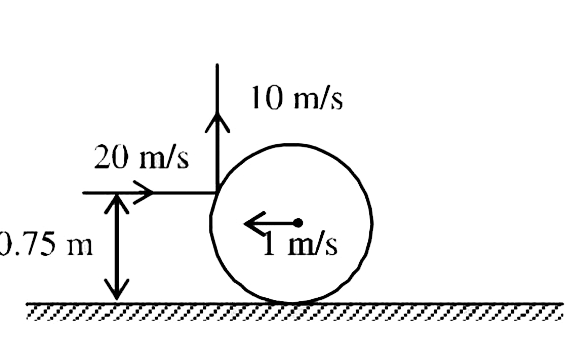
A thin ring of mass 2kg and radius 0.5 m is rolling without on a horizontal plane with velocity 1m/s. A small ball of mass 0.1kg, moving with velocity 20 m/s in the opposite direction hits the ring at a height of 0.75m and goes vertically up with velocity 10m/s. Immediately after the collision

A

the ring has pure rotation about its stationary CM

B

the ring comes to a complete stop

C

friction between the ring and the ground is to the left

D

there is no friction between the ring and the ground

Text Solution

Verified by Experts

The correct Answer is:
A, C

The data is incomplte. Let us asumethat friction from ground on ring is not impulsive during impact.
From linear momentum conservation in horizontal direction, we have
`(-2 xx 1) + (0.1 xx 20) = (0.1 xx 0) + (2 xx v)`

Here,v is the velocity of CM of ring after impact.
Solving, the above equation, we have v=0
Thus, CM becomes stationary, `therefore` Correct option is (A).
Linear impulse during impact
(i) In horizontal direction, `J_(1) = Deltap =0.1 xx 20 =2N-s`
(ii) In vertical direction `J_(2) =Delta_(p)=0.1 xx 10 =1N-s`

Angular impulse = Change in angular momentum
We have, `1 xx (sqrt(3)/2 xx 1/2) -2 xx 0.5 xx 1/2 =2 xx (0.5)^(2) [omega -1/(0.5)]`
Solving this equation `omega` comes out to the positive or `omega` anticlockwise. So just after collision rightwards slipping is taking place.
Hence, friction is leftwards. Therefore, option ( C) is also correct.
Promotional Banner

Similar Questions

Explore conceptually related problems

A thin ring of mass 2kg and radius 0.5 m is rolling without slipping on a horizontal plane with velocity 1m/s. A small ball of mass 0.1kg, moving with velocity 20 m/s in the opposite direction hits the ring at a height of 0.75m and goes vertically up with velocity 10m/s. Immediately after the collision

what will be the wavelength of a ball of mass 0.1 kg moving with a velocity of 10 m s^(-1) ?

A solid cylinder of mass 1 kg and radius 0.02 m, is rolling on a smooth horizontal surface with a uniform velocity of 0.1 m/s. Its total energy is

A ball of mass 0.2 kg moves with a velocity of 20m//sec and it stops in 0.1 sec , then the force on the ball is

A body of mass 2 kg moving with a velocity 3 m//s collides with a body of mass 1 kg moving with a velocity of 4 m//s in opposite direction. If the collision is head on and completely inelastic, then

A body of mass 2 kg moving with a velocity 3 m//sec collides with a body of mass 1 kg moving with a velocity of 4 m//sec in opposite direction. If the collision is head-on perfect inelastic, then

A body of mass 1 kg moving with velocity 5 m/s collides with another body of mass 2 kg moving with velocity 1.5 m/s in opposite direction. If the coefficient of restitution is 0.8, their velocities aftter collision respectively are

A circular disc of mass 0.41 kg and radius 10 m rolls without slipping with a velocity of 2 m/s. The total kinetic energy of disc is

