Home
Class 12
PHYSICS
In the List-I below, four different path...

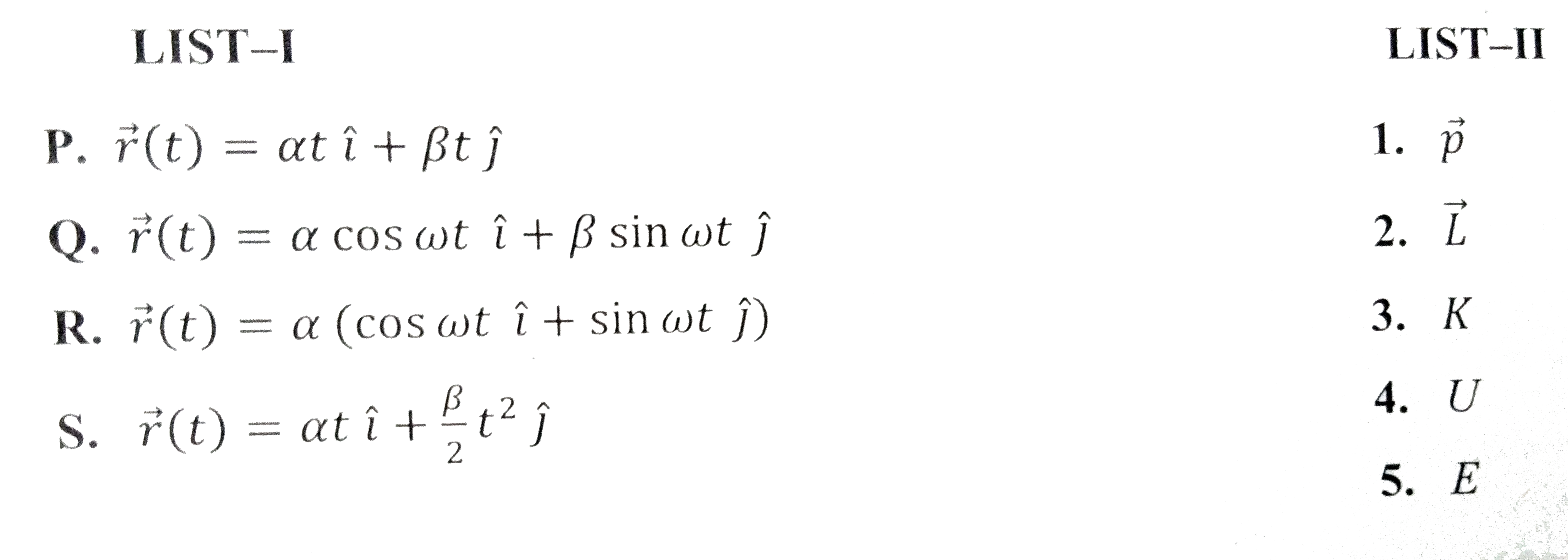
In the List-I below, four different paths of a particle are given as functions of time. In these functions, and are positive constants of appropriate dimensions and . In each case, the force acting on the particle is either zero or conservative. In List-II, five physical quantities of the particle are mentioned: is the linear momentum, is the angular momentum about the origin, is the kinetic energy, is the potential energy and is the total energy. Match each path in List-I with those quantities in List-II, which are conserved for that path.

A

A-PQRST, B-Q,T, C-Q,R,S,T, D-T

B

A=P,Q,R,S,T, B=R,T, C=C,Q,R,S,T, D=Q,T

C

A=Q,R,S, B=T, C=P,Q,S, D=Q,T

D

A=P,Q,R,T, B=Q,T, C=Q,R,S,T, D=Q,T

Text Solution

Verified by Experts

The correct Answer is:

A

A. `vecr = alphathati + betathatj`
`vecv = alpha hati + betahatj`
`veca = 0 rArr vecF = 0`
`therefore A-P, Q-R, S,T`
B. `vecr = alpha cos omegathetai + betasin omegat hatj`, `vecv=-alpha omegasin omegat hati + beta omega cos omega t hatj`
`veca =-alpha omega^(2) cos omegat hai - beta omega^(2) sin omega t hatj, veca = -omega^(2)vecr rArr` Force is towards centre
`veca.vecv=(alpha^(2) - beta^(2))omega^(3) sin omegat cos omegat ne 0`
`rArr` Work is done by the force and kinetic energy of particle will not be conserved.
`therefore B-Q, T`
C. `vecr = alpha cos omega t hati + alpha sin omega t hatj`
`rArr` Uniform circular motion, `therefore` C,Q,R,S,T
D. `vecr = alphat hati + beta/2t^(2) hatj`, `vecv = alpha hati + beta t hatj`
`veca = betahatj rArr` force is not passing through origin `therefore` D-T
Promotional Banner

Similar Questions

Explore conceptually related problems

The angular momentum of a particle is

The linear momentum p of a particle is given as a function of time t as p=At^2+Bt+C .The dimensions of constant B are

A particle has a linear momentum p and position vector r. the angular momentum of this particle about the origin will not be zero under the conditions

in a circular motion the angle between a particle's linear momentum and its angular moment is

A particle moves on a straight line with a uniform velocity. The angular momentum of the particles is

Name the physical quantity whose dimensions are same as that of angular momentum ?
