Home
Class 12
PHYSICS
A thin uniform bar lies on a frictionles...

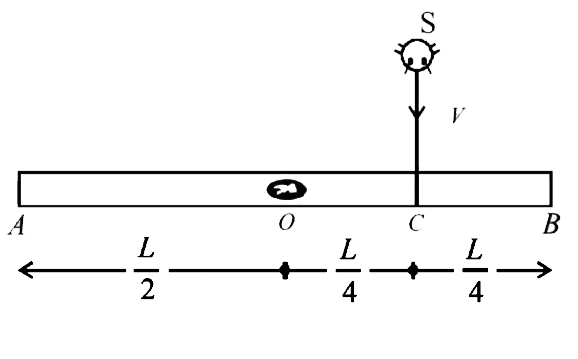
A thin uniform bar lies on a frictionless horizonta surface and is free to move in any way on th surface. Its mass is 0.16 kg and length `sqrt3`meters. Two particless, each of mass 0.08 kg, are moving on the same surface and towards the bar in a direction perpendicular to the bar, one with a velocity of 10 m/s, and other with 6m/s as shown in fig. The first particle strikes the bar at point A and the other at point B. Points A and B are at a distane of 0.5m from the centre of the bar. The particles strike the bar at the same instant of time and stick to the bar on collision. Calculate the loss of the kinetic energy of the system in the above collision process.

Text Solution

Verified by Experts

The correct Answer is:
B

Considering bar + particle as system and applying conservation of linear momentum just before and just after collision.
`m_(1) xx v_(1) + m_(2) xx v_(2) = (M+m_(1) + m_(2))v_(C)`
Where, `V_(C)` is the velocity of centre of mass of the bar and particles stick on it after collision.
`0.08 xx 10 + 0.08 xx 6 = (0.16 + 0.08 + 0.08)v_(C)`

`rArr v_(C) = 4m//s`
Initial kinetic energy of system will be only translation nature.
`K_("initial") = 1/2m+_(1)v_(1)^(2) + 1/2m_(2)v_(2)^(2)`
`=1/2 xx 0.08 xx 10^(2) +1/2 xx 0.088 xx 6^(2) = 5.44` J...........(i)
`therefore` Translational kinetic enrgy after collision
`K_("translatory") = 1/2(M+m_(1) + m_(2))v_(C)^(2) =2.56` J............(ii)
Now applying conservation of angular momentum of the bar and two particle system about the centre of the bar. Since external torque is zero, the initial angular momentum should be equal to final angular momentum
Initial angular momentum `L_("initial") = m_(1)v_(1)x - m_(2)v_(2)x`
`=0.08 xx 10 xx 0.5 - 0.08 xx 6 xx 0.5`
`=0.4 - 0.24 = 0.16 kg m^(2) s^(-1)` (in clockwise direction)
Final angular momentum `L_("final") = I omega`
`=-0.08 xx 10 xx 0.5 - 0.08 xx 6 xx 0.5`
`=0.4 -0.24 = 0.16 kg m^(2) s^(-1)` (in clockwise direction)
Final angular momentum `L_("final") = I omega`
`L_("final") =[(MI^(2))/12 +m_(1)x^(2) + m_(2)x_(2)^(2)]omega =[((0.16) (sqrt(3))^(2))/12 + 2 xx 0.08 xx (0.5)^(2)]omega = 0.08 omega`
`therefore 0.08 omega = 0.16 rArr omega = 2 rad//s`..............(iii)
The rotational kinetic energy
`K_("rotation") = 1/2Iomega^(2) =1/2 = 0.08 xx 2^(2) = 0.16`J...........(iv)
The final kinetic energy
`K_("final") = K_("translational") + K_("irrational")`
`=2.56 + 0.16 = 2.72` J.............(v)
The change is K.E. = Initial K.E. - Final K.E.
=5.44 - 2.72 = 2.72 J
Promotional Banner

