Home
Class 12
PHYSICS
A wedge of mass m and triangular cross- ...

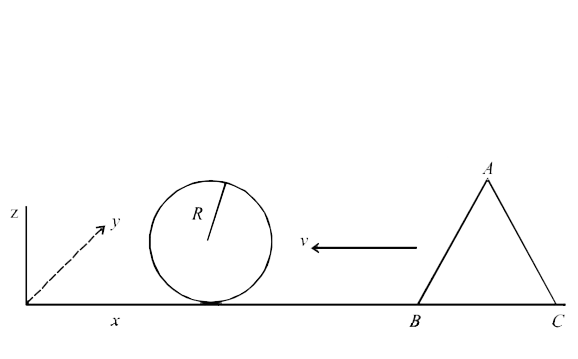
A wedge of mass m and triangular cross- section (AB = BC = CA = 2R) is moving with a constant velocity `-v hat`I towards a sphere of radius R fixed on a smooth horizontal table as shown in figure. The wadge makes an elastic collision with the fixed sphere and returns along the same path without any rotaion. Neglect all friction and suppose that the wedge remains in contact with the sphere for a very shot time. `Deltat,` during which the sphere exerts a constant force F on the wedge.

(a) Find the force F and also the normal force N exerted by the table on the wedge during the time `Deltat.`
(b) Ler h denote the perpendicular distance between the centre of mass of the wedge and the line of action of F. Find the magnitude of the torque due to the normal force N about the centre of the wedge, during the interval `Deltat.`

Text Solution

Verified by Experts

(i) `vecF =(2mv)/(Deltat)hati -(2mv)/(sqrt(3)Deltat)hatk, vecN =(mg + (2mv)/(sqrt(3)Deltat))hatk`, (ii) `(4mv)/(sqrt(3)Deltat)h`.
(i) The collision between sphere and wedge is elastic. As the sphere is fixed, hence the wedge will return with velocity `vhati`.
Now, linear impulse in x-direction = change in momentum in x-direction.
`therefore (F cos 30^(@))Deltat =mv-(-mv) = 2mv`
`therefore F=(2mv)/(Deltat cos 30^(@)) = (4mv)/(sqrt(Deltat))`

`vecF =((2mv)/(Deltat))hati -(2mv)/(sqrt(3)Deltat)hatk`
Now consider the equilibrium of wedge in vertical direction. During collision.
`N=mg + (2mv)/(sqrt(3)Deltat)`

or in vector form `vecN =mg + (2mv)/(sqrt(3)Deltat)hatk`
(ii) For rotational equilibrium of wedge about
its (CM), anticlockwise torque of F= Clockwise torque due to N
`therefore` Magnitude of torque of N about centre of mass = magnitude of torque of F about centre of mass =F.h.
`|vectau_(N)| =((4mv)/(sqrt(3)Deltat))h`
Promotional Banner

Similar Questions

Explore conceptually related problems

A solid sphere rolls without slipping on a rough horizontal floor, moving with a speed v . It makes an elastic collision with a smooth vertical wall. After impact

All the surfaces are smooth as shown in figure. The acceleration of mass m relative to wedge is :

A block of mass m is placed on a smooth inclined wedge ABC of inclination theta as shown in the figure. The wedge is given an acceleration a towards the right. The relation between a and theta for the block to remain stationary on the wedge is.

A hemispherical cavity of radius R is created in a solid sphere of radius 2R as shown in the figure . Then y -coordinate of the centre of mass of the remaining sphere is

A ball mass 2 kg moving horizontally with velocity 10 m/s hits a wedge of mass 5 kg placed on a horizontal surface as shown in the figure. Just after collision klvelocity of wedge is 3.2 m/s. There is no friction at any contact surface. Then (take sin 30^(@)=3//5 )

A sphere of mass m slides with velocity v on as frictionless surface towards a smooth inclined wall as shown in figure. If the collision with the wall is perfectly elastic find a. the impulse imparted by the wall on the sphere b the impulse imparted by the floor on the sphere.

