

Home
Class 11
PHYSICS
On a frictionless horizontal surface , ...

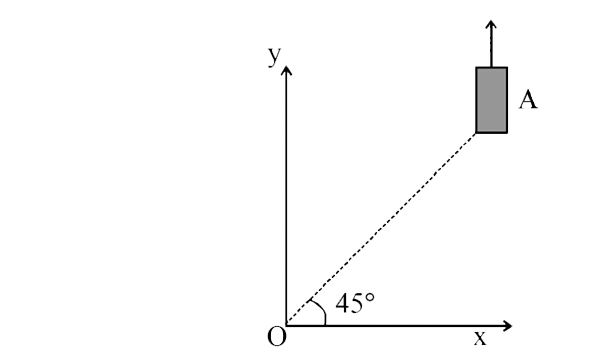
On a frictionless horizontal surface , assumed to be the ` x-y` plane , a small trolley `A` is moving along a straight line parallel to the `y-axis `( see figure) with a constant velocity of `(sqrt(3)-1) m//s ` . At a particular instant , when the line `OA` makes an angle of `45(@)` with the `x - axis ` , a ball is thrown along the surface from the origin `O`. Its velocity makes an angle `phi` with the `x -axis and it hits the trolley .
(a) The motion of the ball is observed from the frame of the trolley . Calculate the angle `theta` made by the velocity vector of the ball with the ` x-axis in this frame .
(b) Find the speed of the ball with respect to the surface , if ` phi = (4 theta )//(4)`.

Promotional Banner

Similar Questions

Explore conceptually related problems

A straight line makes an angle of 135^(@) with the X-axis and cuts Y-axis at a distance -5 from the origin. The equation of the line is

A particle is moving along a straight line parallel to x-axis with constant velocity. Find angular momentum about the origin in vector form :

A particle is moving along a straight line parallel to x-axis with constant velocity. Find angular momentum about the origin in vector form :

A small cart A starts moving on a horizontal surface, assumed to be x-y plane along a straight line parallel to x-axis (see figure) with a constant acceleration of 4 m//s^(2) . Initially it is located on the positive y-axis at a distance 9 m from origin. At the instant the cart starts moving, a ball is rolled along the surface from the origin in a direction making an angle 45° with the x-axis. The ball moves without friction at a constant velocity and hits the cart. (a) Describe the path of the ball in a reference frame attached to the cart. (b) Find the speed of the ball.

A straight line which makes an angle of 60^@ with each of Y and Z-axis, the angle this lines makes with X-axis is

A particle moves along a straight line parallel to x-axis at a distancce d = 3 m from it, with constant speed of v = 3 m//s . Another particle stats from the origin with constant acceleration a = 4 m//s^(2) at an angle theta with y-axis along a straight line at the instant the first particle crosses y-axis. Find 'theta' such that the two particle collide.

The distance of the line 3x-y=0 from the point (4,1) measured along a line making an angle 135^(@) wih the x-axis is