Home
Class 12
BIOLOGY
Enumerate the differences between asexua...

Enumerate the differences between asexual and sexual reproduction. Describe the types of asexual reproduction exhibited by unicellular organisms.

Text Solution

Verified by Experts
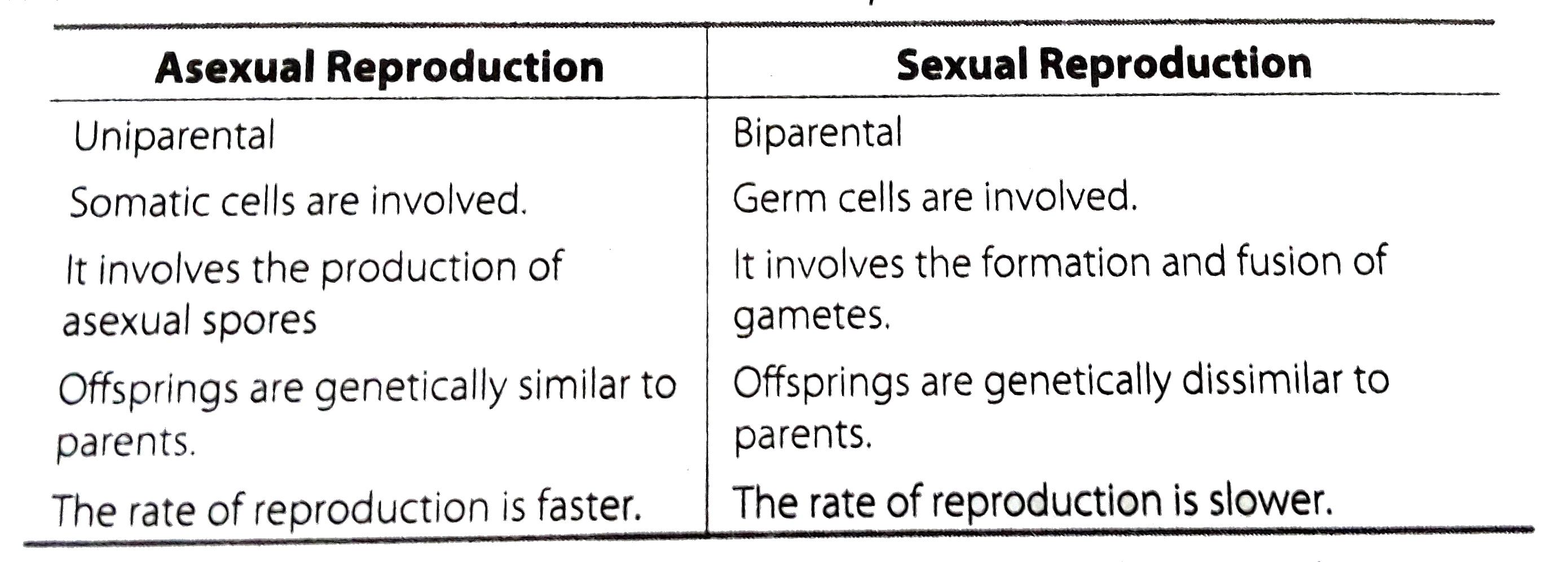
The difference between asexual and sexual reproduction are mentioned below

Asexual reproduction occurs usually in unicellular organisms, wuch as monerans and protists and in plants and certain animals.
It takes place in the following ways
(i) Binary Fission In this type of asexual reproduction, the parent organism divides into two halves, each half forming an idenpendent daughter organism.
e.g., Amoeba, Euglena, Paramecium.
(ii) Budding In this type of asexual reproduction, a daughter individual is formed from a small projection, the bud, arising from the parent body.
e.g., yeast, Hydra.
(iii) Fragmentation In this type of asexual reproduction, the parent body breaks into two or more fragment. Each body fragment develops into an organism.
e.g., sponges, Selaginella.
(iv) Gemmule In this type of asexual reproduction, internal buds, called germmules are involved. Gemmules are asexually reproduced mass of cells, that is capable of developing into a new organisms.
e.g., sponges.
(v) Sporulation In this type of asexual reproduction, dispersive structures called spores are released fromthe parent body that germinate under favourable condition form new individuals.
(a) Motile spores are called zoospores and are found in aquatic animals. e.g., Albugo, Chlamydomonas.
(b) Non-motile spores are named as sporangiospores (e.g., Rhizopus, Mucor) and conidia e.g., Penicillium.
Promotional Banner

Topper's Solved these Questions

  • PRINCIPLE OF INHERITANCE AND VARIATIONS

    NCERT EXEMPLAR|Exercise Principle Of Inheritance And Variations|53 Videos
  • REPRODUCTIVE HEALTH

    NCERT EXEMPLAR|Exercise Reproductive Health|37 Videos

Similar Questions

Explore conceptually related problems

Different between asexual and sexual reproduction

Difference Between Asexual and Sexual Reproduction

State the main difference between asexual and sexual reproduction.

Differentiate between asexual and sexual reproduction .

Distinguish between asexual and sexual reproduction.

Describe the advantages of asexual reproduction.

NCERT EXEMPLAR-REPRODUCTION IN ORGANISMS-Reproduction In Organisms
  1. Why do gametes produced in large numbers in organisms exhibit external...

    Text Solution

    |

  2. Which of the following are monoecious and dioecious organisms ? (a) ...

    Text Solution

    |

  3. Match the organisms given in column I with the vegetative propagules g...

    Text Solution

    |

  4. What do the following parts of a flower develop into after fertilisati...

    Text Solution

    |

  5. In haploid organisms that undergo sexual reproduction, name the stage ...

    Text Solution

    |

  6. The number of taxa exhibiting asexual reproduction is drastically redu...

    Text Solution

    |

  7. Honeybees produce their young ones by sexual reproduction. Inspite of ...

    Text Solution

    |

  8. With which type of reproduction do we associate the reduction division...

    Text Solution

    |

  9. Is it possible to consider vegetative propagation observed in certain ...

    Text Solution

    |

  10. Fertilisation is not an obligatory event for fruit production in certa...

    Text Solution

    |

  11. In a developing embryo, analyse the consequences if cell divisions are...

    Text Solution

    |

  12. List the changes observed in an angiosperm flower subsequent to polli...

    Text Solution

    |

  13. Suggest a possible explanation why the seeds in a pea pod are arrange...

    Text Solution

    |

  14. Draw the sketch of a zoospore and a conidium. Mention two dissimilarit...

    Text Solution

    |

  15. Justify the statement 'vegetative reproduction is also a type of asexu...

    Text Solution

    |

  16. Enumerate the differences between asexual and sexual reproduction. Des...

    Text Solution

    |

  17. Do all the gametes formed from a parent organism have the same genetic...

    Text Solution

    |

  18. Although sexual reproduction is a long drawn, energy-intensive complex...

    Text Solution

    |

  19. Differentiate between (a) oestrus and menstrual cycles, (b) ovipary an...

    Text Solution

    |

  20. Rose plants produce large, attractive bisexual flowers, but they seldo...

    Text Solution

    |

