

Home
Class 11
CHEMISTRY
The pressure volume work for an ideal ga...

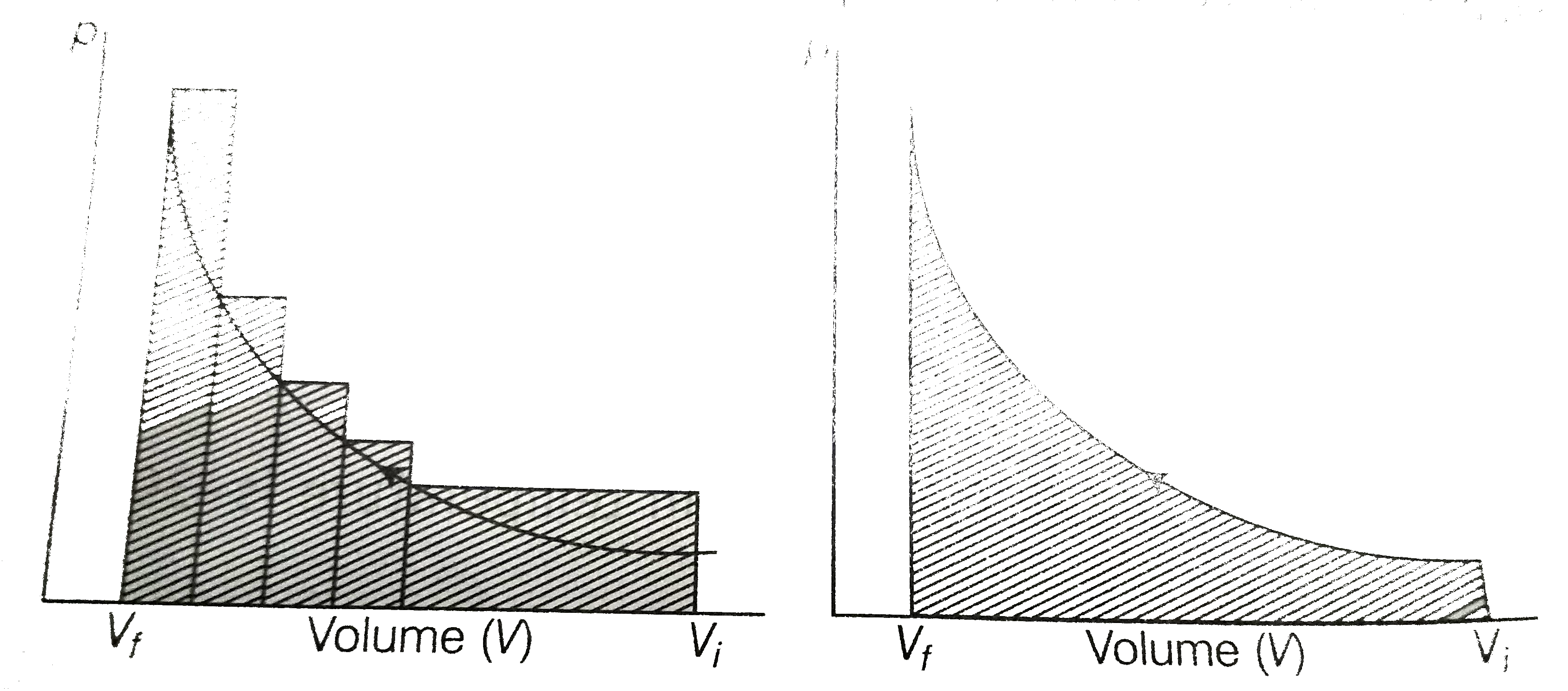
The pressure volume work for an ideal gas can be calculated by using the expression `w=-int_(V_(i))^(v_(f))Pex dV`. The work can also be calculated from the pV-plot by using the area under the curve within the specified limits. When an ideal gas is compressed (a) reversibly or (B) irreversibly from volume `V_(i)` to `V_(f)` choose the correct option.

A

W (reversible) = W (irreversible)

B

W (reversible) `lt` W (irreversible)

C

W (reversible) `=` W (irreversible)

D

W (reversible) `=` W (irreversible) `+ p_(ex) . Delta V`

Text Solution

Verified by Experts

The correct Answer is:
B

The correct option is W (reversible) `lt W` (irreversible). This is because area under curve is always more in irreversible compression as can be seen from given figure
Promotional Banner

Topper's Solved these Questions

  • THE S-BLOCK ELEMENTS

    NCERT EXEMPLAR|Exercise Long Answer Type Questions|8 Videos

Similar Questions

Explore conceptually related problems

The pressure-volume work for an ideal gas can be calculated by using the expression omega=-underset(upsilon_(1))int overset(upsilon_(1))P_(ex)dV. The work can also be calculated form the Pv, plot by using the area under the curve within the specified limits. When an ideal gas is compressed (a) reversiblity or (b) irrevesibly form volume V_(i) "to"V_(f) choose the correct option:

A gas expands under constant pressure P from volume V_(1) to V_(2) The work done by the gas is

What is the relation for work done (i) reversibly and (ii) irreversibly for the isothermal expansion of an ideal gas from volume V_(1) to V_(2) at temperature T?

Write the expression to calculate maximum work done when 1 mole of an ideal gas expands isothermally and reversibly from V_1 to V_2

NCERT EXEMPLAR-THERMODYNAMICS-Multiple choice questions
  1. delta(f) U^(Ó¨) "of formation of" CH(4)(g) at a certain temperature is...

    Text Solution

    |

  2. In an adibatic process, no transfer of heat takes place between system...

    Text Solution

    |

  3. The pressure volume work for an ideal gas can be calculated by using t...

    Text Solution

    |

  4. The entropy change can be calculated by using the expression DeltaS-(q...

    Text Solution

    |

  5. On the basic of thermochemical equations (I),(II)and (III), Find out w...

    Text Solution

    |

  6. Consider the reactions given below .On the basis of these reactions ,F...

    Text Solution

    |

  7. The enthalpy of elements in their standard atates are taken as zero .T...

    Text Solution

    |

  8. Enthalpy of sublimation of a substance is equal to :

    Text Solution

    |

  9. Which of the following is not correct ?

    Text Solution

    |

  10. Thermodynamics mainly deals with:

    Text Solution

    |

  11. In an exothermic reaction heat is evolved and system loses heat to the...

    Text Solution

    |

  12. The spontaneity means having the potential to proceed without assistan...

    Text Solution

    |

  13. For an ideal gas, the work of reversible expansion under isothermal co...

    Text Solution

    |

  14. Consider the following reaction between zinc and oxygen and choose t...

    Text Solution

    |

  15. 18.0 g of water completely vaporises at 100^(@)C and 1 bar pressure an...

    Text Solution

    |

  16. One mole of acetone requires less heat to vaporise than 1 mole of wate...

    Text Solution

    |

  17. Standard molar enthalpy of formation, Delta(f) H^(Θ) is just a special...

    Text Solution

    |

  18. The value of Delta(f) H^(Θ) for NH(3) is -91.8 kJ mol^(-1). Calculate ...

    Text Solution

    |

  19. Enthalpy is an extensive property. In general, if enthalpy of an overa...

    Text Solution

    |

  20. The enthaply of atomisation for the reaction : CH(4)(g) to C(g) + 4 H(...

    Text Solution

    |