Home
Class 11
CHEMISTRY
Use the following data to calculate Delt...

Use the following data to calculate `Delta_("lattice") H^(@)` for NaBr. `Delta_("sub")H^(@)` for sodium metal `=108.4 kJ mol^(-1)`, ionization enthalpy of sodium `=496 kJ mol^(-1)`., electron gain enthalpy of bromine `=-325 kJ mol^(-1)` bond dissociation enthalpy of bromine `=192 kJ mol^(-1) , Delta _f H^(@)` for `NaBr(s) - 360 kJ mol^(-1)`.

Text Solution

Verified by Experts
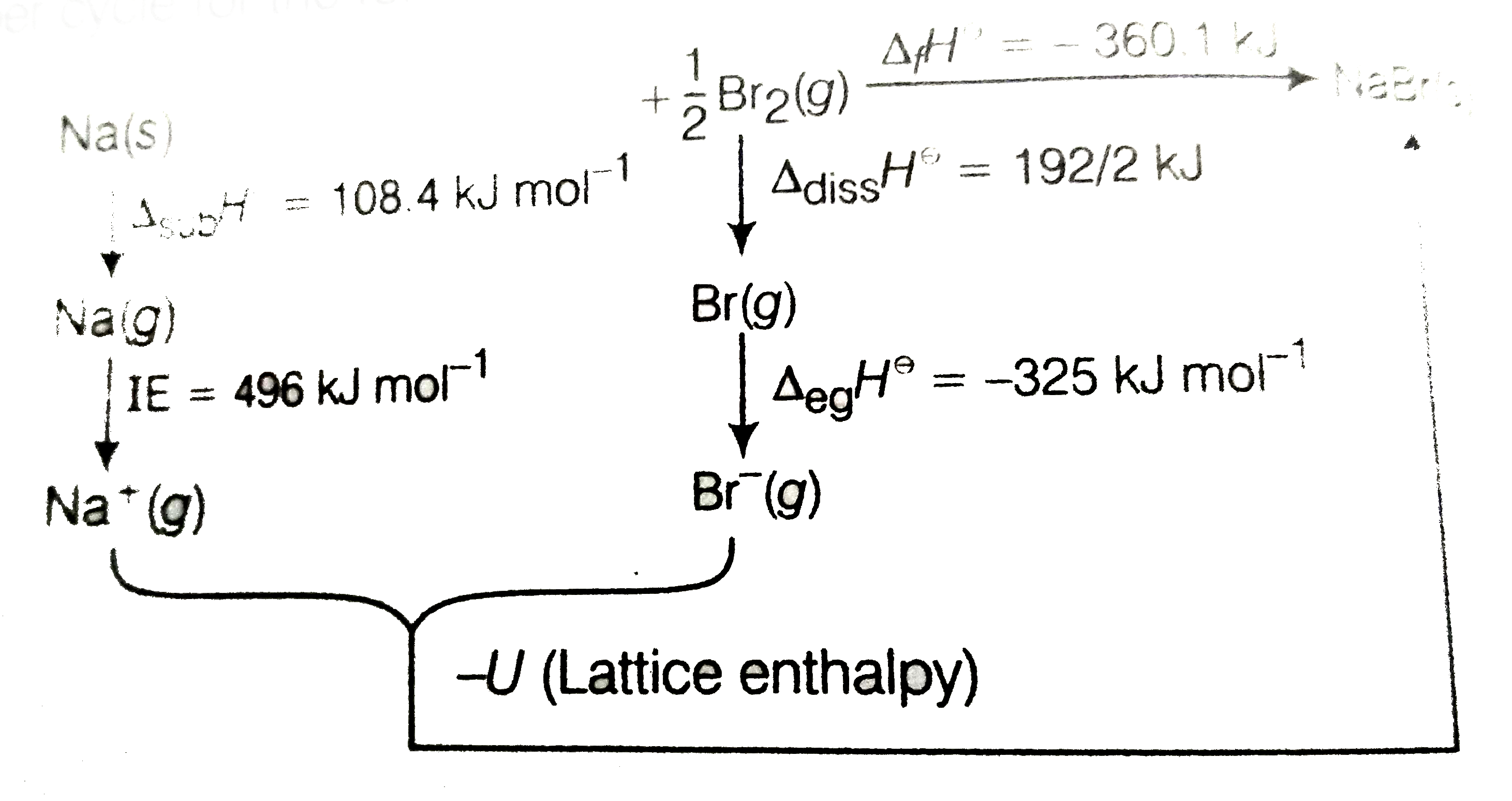
Given that, `Delta_("sub") H^(Θ)` for `Na` metal `= 108.4 kJ mol^(-1)`
IE of `Na = 496 kJ mol^(-1) " of " Br = - 325 kJ mol^(-1), Delta_("diss") H^(Θ) " of " Br = 192 kJ mol^(-1), Delta_(f) H^(Θ) " for " NaBr = - 360.1 kJ mol^(-1)`
Born-Haber cycle for the fomation of `NaBr` is as

By applying Hess's law,
`Delta_(f) H^(Θ) + IE + Delta_("diss") H^(Θ) + Delta_("eg") H^(Θ) + U`
`-360.1 = 108.4 + 496 + 96 + (-325) - U`
`U = + 735.5 kJ mol^(-1)`
Promotional Banner

Topper's Solved these Questions

  • THE S-BLOCK ELEMENTS

    NCERT EXEMPLAR|Exercise Long Answer Type Questions|8 Videos

Similar Questions

Explore conceptually related problems

Use the following data to calculate Delta_("lattice")H^(@) for NaBr. Delta_("sub")H^(@) for sodium metal = 108.4 kJ "mol"^(-1) .Ionization enthalpy of sodium = 496 kJ "mol"^(-1) Electron gain enthalpy of bromine = -325 kJ "mol"^(-1) .Bond dissociation enthalpy of bromine = 192 kJ "mol"^(-1) . Delta_(f)^(H^(@)) for NaBr (s) = -360.1 kJ "mol"^(-1) .

For Br_2(l) Enthalpy of atomisation = x kJ/mol, Bond dissociation enthalpy of bromine = y kJ/mole, then

The enthalpy of solution of sodium chloride is 4 kJ mol^(-1) and its enthalpy of hydration of ion is -784 kJ mol^(-1) . Then the lattice enthalpy of NaCl (in kJ mol^(-1) ) is

Lattice energy of NaCl(s) is -790 kJ " mol"^(-1) and enthalpy of hydration is -785 kJ " mol"^(-1) . Calculate enthalpy of solution of NaCl(s).

the bond enthalpy of H_(2)(g) is 436 kJ "mol"^(-1) and that of N_(2)(g) is 941.3 kJ"mol"^(-1) . Calculate the average bond enthalpy of ann N-H bond in ammonia, Delta_(t)^(@)(NH_(3)) =-46 kJ "mol"^(-1)

The ionization enthalpy of Na^+ formation from Nad is 495.8 kJ mol^(-1) , while the electron gain enthalpy of Bris -325.0 kJ mol^(-1) .Given the lattice enthalpy of NaBr is -728.4 kJ mol^(-1) The energy for the formation of NaBr ionic solid is (-)"______" xx 10^(-1)kJ "mol"^(-1)

NCERT EXEMPLAR-THERMODYNAMICS-Multiple choice questions
  1. Enthalpy is an extensive property. In general, if enthalpy of an overa...

    Text Solution

    |

  2. The enthaply of atomisation for the reaction : CH(4)(g) to C(g) + 4 H(...

    Text Solution

    |

  3. Use the following data to calculate Delta("lattice") H^(@) for NaBr. ...

    Text Solution

    |

  4. Given that DeltaH = 0 for mixing of two gases.Explain whether the diff...

    Text Solution

    |

  5. Heat has randomising influence on a system and temperature is the meas...

    Text Solution

    |

  6. Increase in enthalpy of the surroundings is equal to decrease in entha...

    Text Solution

    |

  7. At 298 K, K(p) for the reaction : N(2)O(4)(g) iff 2NO(2)(g) is 0.98. P...

    Text Solution

    |

  8. (a) A sample of 1.0 mol of a monoatomic ideal gas is taken through a ...

    Text Solution

    |

  9. The standard molar entropy of H(2)O(l) is 70 J K^(-1) "mol"^(-1).Wil...

    Text Solution

    |

  10. Identify the state functions and path functions out of the following: ...

    Text Solution

    |

  11. The molar enthalpy of vapourisation of acetone is less than that of wa...

    Text Solution

    |

  12. Which quantity out of Delta(r)G or Delta(r)G^(@) will be zero at equil...

    Text Solution

    |

  13. Predict the change in internal energy for an isolated system at consta...

    Text Solution

    |

  14. Although heat is a path function but heat absorbed by the system under...

    Text Solution

    |

  15. Expansion of a gas in vaccum is called free expansion.Calculate the wo...

    Text Solution

    |

  16. Heat capacity (C(p)) is an extensive property but specific heat (C) is...

    Text Solution

    |

  17. The difference between C(p) and C(v) can be derived using the empirica...

    Text Solution

    |

  18. If the combustion of 1 g of graphite produces -20.7 kJ of heat, what w...

    Text Solution

    |

  19. The net enthalpy change of a reaction is the amount of energy required...

    Text Solution

    |

  20. The enthalpy of vaporisation of C CI(4) is 30.5 kJ "mol"^(-1).Calcul...

    Text Solution

    |

