Home
Class 11
BIOLOGY
Define uniport, symport and antiport. Do...

Define uniport, symport and antiport. Do they require energy ?

Text Solution

Verified by Experts
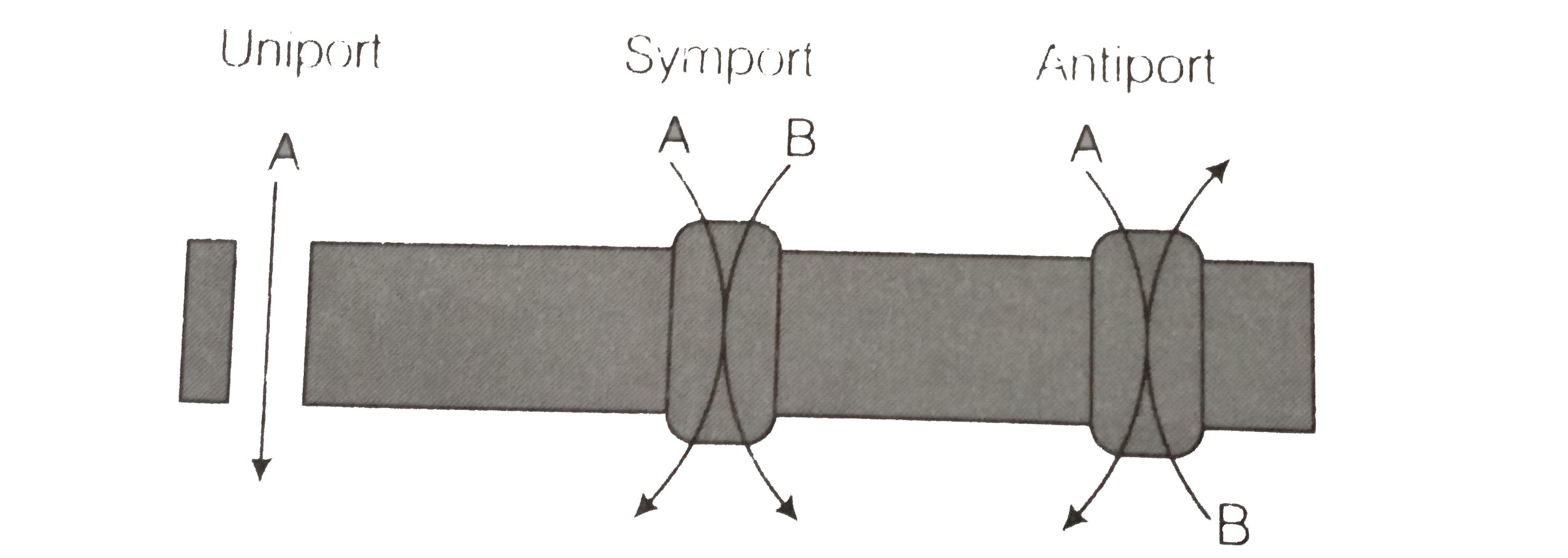
The biological mebranes have many mechanism for movement of substances to and for. Some are active and some are passive. Specific membrane proteins are also involved for special types of transport mechanism.
Uniport This is a mebrane transport system by a integral membrane protein that is involved in facilitated diffusion. These channels get open in response to a stimulus for free flow of specific molecules in a specific direction. These transport molecule with solute gradient without energy expenditure.
Symport This involves the movement of two or more different molecules or ions, across the membrane in the same direction, with no energy expenditure.
Antiport also called exchanger. This integral membrane protein is involved in secondary active transport of two or more different molecules or ions acroos the membrane in opposite direction, without affecting the tansport of other molecules.
Promotional Banner

Topper's Solved these Questions

  • TRANSPORT IN PLANTS

    NCERT EXEMPLAR|Exercise Long Answer Type Questions|7 Videos
  • TRANSPORT IN PLANTS

    NCERT EXEMPLAR|Exercise Very Short Answer Type Questions|23 Videos
  • THE LIVING WORLD

    NCERT EXEMPLAR|Exercise Long Answer Type Questions|10 Videos

Similar Questions

Explore conceptually related problems

Uniport, Symport and antiport are the types of

Symport, Uniport and Antiport

Define energy.

Define energy?

diffusion, type OF diffusing, factors affecting diffusion, simple and facilitated diffusion, uniport, symport and antiport. significance OF diffusion pressure

Work function is the energy required

Chemical reaction require energy for

Define a source of energy ?

Facilitated Diffusion|| Uniport|| Symport|| Antiport|| Active transport ||Comparison OF different transport mechanisms

NCERT EXEMPLAR-TRANSPORT IN PLANTS-Short Answer Type Questions
  1. How is it that the intracellular level of K^(+) are higher than extrac...

    Text Solution

    |

  2. Cut pieces of beetroot do not leave the colour in cold water but do so...

    Text Solution

    |

  3. In a girdled plant, when water is supplied to the leaves above the gir...

    Text Solution

    |

  4. Varous types of transport mechanisms are needed to fulfil the mineral ...

    Text Solution

    |

  5. How can plants be grown limited water supply without compromising on m...

    Text Solution

    |

  6. Will the ascent of sap be possible without the cohesion and adhesion o...

    Text Solution

    |

  7. Keep some freshly cut flowers in a solution of food colour. Wait for s...

    Text Solution

    |

  8. When a freshly collected Spirogyra filament is kept in a 10 % potassiu...

    Text Solution

    |

  9. Sugar crystals do not dissolve easily in ice cold water. Explain.

    Text Solution

    |

  10. Salt is applied to tennis lawns to kill weeds. How does salting tennis...

    Text Solution

    |

  11. What is the chemical composition of of xylem and phloem sap ?

    Text Solution

    |

  12. If you are provided with two tubes (A and B), where one is narrow and ...

    Text Solution

    |

  13. What are 'aquaporins' ? How does presence of aquaporins affect osmosis...

    Text Solution

    |

  14. ABA (Abscisic Acid) is called a stress hormone. A. How this hormone ...

    Text Solution

    |

  15. We know that plants are harmed by excess water. But plants survive und...

    Text Solution

    |

  16. Differentiate between diffusion and translocation in plants.

    Text Solution

    |

  17. How is fcilitated diffusion different from diffusion ?

    Text Solution

    |

  18. Explain the mass flow hypothesis of transport in phloem.

    Text Solution

    |

  19. Observe the diagram and answer the following. (a) Are these types...

    Text Solution

    |

  20. Define uniport, symport and antiport. Do they require energy ?

    Text Solution

    |

