Home
Class 11
BIOLOGY
The arrangement of ovules within the ova...

The arrangement of ovules within the ovary is known as placentation. What does the term placenta refer to ? Name and draw various types of placentations in the flower as seen in T.S. or V.S.

Text Solution

Verified by Experts
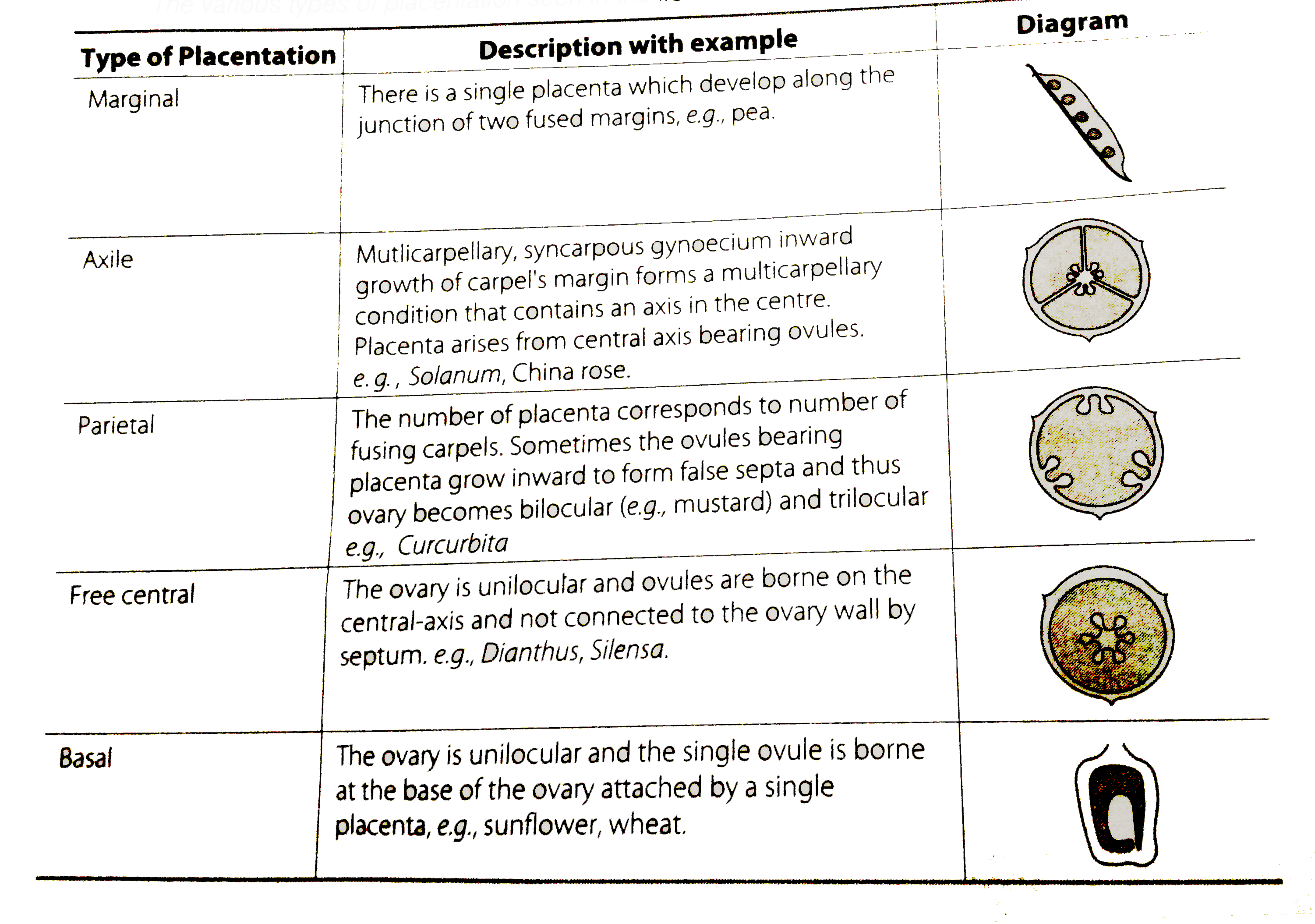
Placenta is a flattened , cushion like tissue on which one or more ovules are attached . The various types of placentation seen in the flowers are described in the following table
Promotional Banner

Topper's Solved these Questions

  • MORPHOLOGY OF FLOWERING PLANTS

    NCERT EXEMPLAR|Exercise Short Answer Type Questions|14 Videos
  • MINERAL NUTRITION

    NCERT EXEMPLAR|Exercise Long Answer Type Questions|8 Videos
  • NEURAL CONTROL AND CO-ORDINATION

    NCERT EXEMPLAR|Exercise LONG ANSWER TYPE QUESTIONS|3 Videos

Similar Questions

Explore conceptually related problems

The arrangement of ovules within the ovary is known as placentation. What does the term placenta refer to ? Draw various types of placentations in the flower as seen TS and VS

The mode of arrangement of sepals or petals in a floral bud is known as aestivation . Draw the various types of aestivation possible for a typical pentamerous flower.

Four plants (A, B, C, D) are observed. ‘A’ shows axile placentation of unitegmic ovules within the ovary. 'B' shows basal placentation of unitegmic ovule within the ovary. 'C' has legume fruit with cotyledons as chief edible parts. 'D' has pneumatophores and vivipary type of seed germination. A, B, C and D plants, respectively are

Wheb placenta forms a ridge along the ventral suture of the ovary and the ovules are borne on this ridge forming two rows, the placentation is termed as

Draw a neat labelled diagram of T.S. of ovary and describe various phases of menstural cycle.

Fill in the following blanks with suitable words : Pollen grains contain .........gametes fo a plant. (b) Ovules contain .......... gametes of a plant (c) The ovary of a flower becomes ..........after fertilisation. (d) The ovule becomes a .......... after fertilisation. (e) Flowering plants reproduce by .......... method of reproduction (f) The female organ of reproduction in the flower is the ......... (g) The male organ of reroduction in the flower is the......... (h) The name of the structue in the flower in which the male gamete is formed is.......... (i) The .......... at the base of the carple contains egg cell. (j) The term used to refer to the transfer of pollen from the stamen of one flowr to the carpel of another flower of the same species is ......... (k) The cells involved in sexual reproduction are called.......... (l) Fussion of gametes gives rist to a single cell called.......... (m) The process of fussion of gametes is called .......... (n) A multicellular animal starts its life from a ........... through sexual reproduction. (o) The union of a sperm nucelus with an egg nucleus is known as ........... and results in a ..........egg. (p) The menstrual cycle in controlled by .........

A train of length l=350m starts moving rectilinearly with constant acceleration w=3.0*10^-2 m//s^2 , t=30s after the start the locomotive headlight is switched on (event 1), and tau=60s after that event the tail signal light is switched on (event 2). Find the distance between these events in the reference frames fixed to be train and to the Earth. How and at what constant velocity V relative to the Earth must a certain reference frame K move for the two events to occur in it at the same point?

Identify the family which shows the following diagnostic features. Name two plants of the family which are used as source of food. Features : Flowers pentamerous, Gynoecium - bicarpellary, syncarpous, ovary placed obliquely, placentation axile, placenta swollen.

Study the following statements and choose the correct answer : I. Cross -pollinating flowers have exotrose anthers . II. Samara is a type of fleshy fruit. III. Marginal placentation has a monocarpellary , unilocular ovary . IV. Opposite phyllotaxy is seen in guava.

