

Home
Class 12
PHYSICS
A beam of singly ionized atoms of carbon...

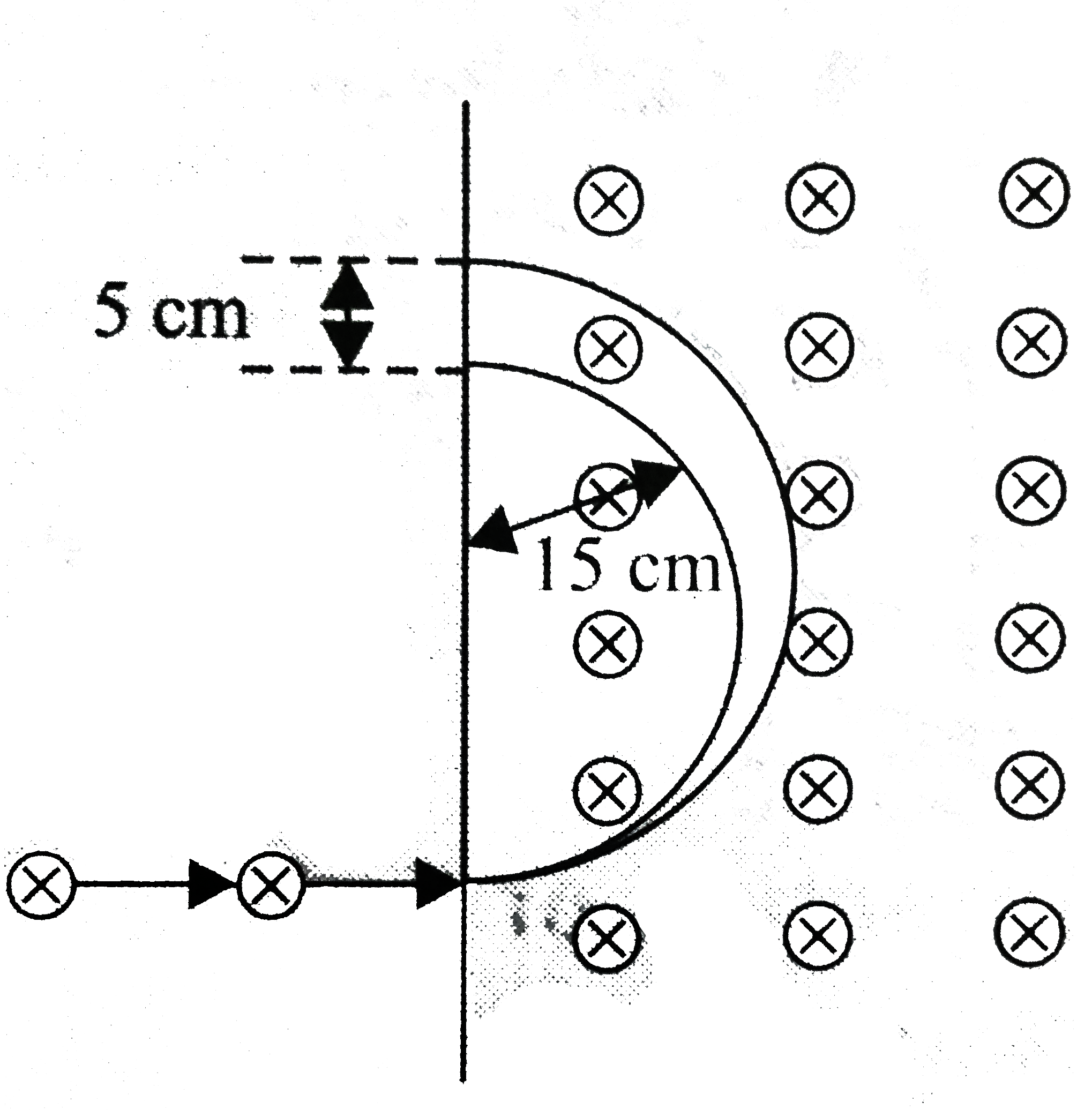
A beam of singly ionized atoms of carbon (each charge +e) all have the same speed enters a mass spectrometer, as shown in Fig. The ions strike the photographic plate in two different locations 5 cm apart. The `._12C_6` isotope traces a path of smaller radius, `15.0 cm`. What is the atomic mass number of other isotope ?
.

Promotional Banner

Similar Questions

Explore conceptually related problems

In the game of billiards, all the balls have approximately the same mass, about 0.17 kg. In the figure, the cue ball strikes another ball such that it follows the path shown. The other ball has a speed of 1.5 m/s immediately after the collision. What is the speed of the cue ball after the collision?

A narrow beam of singly charged potassium ions of kinetic energy 32keV is injected into a region of width 1.00 cm having a magnetic field of strength 0.500 T as shown in . The ions are collected at a screen 95.5cm away from the field region. If the beam contains isotopes of atomic weights 39 and 41, find the separation between the points where these isotopes strike the screen. Take the mass of a potassium ion= A (1.6 X 10^(-27) ) kg where A is the mass number.

In a helium dilution refrigerator .^(3)He and .^(4)He are mixed in a special chamber to obtain extremely low temperature. A Bainbridge mass spectrometer is used to measure the ratio of the two isotopes (a) If the spectrometer were used with 100 V cm^(-1) between the plates and a magnetic field of 0.2 T, what would be the speed of an ion that can pass through the velocity filter? (b) If the velocity-filter exit slit were 1 mm wide, could this machine resolve the two isotopes ?

In a helium dilution refrigerator .^(3)He and .^(4)He are mixed in a special chamber to obtain extremely low temperature. A Bainbridge mass spectrometer is used to measure the ratio of the two isotopes (a) If the spectrometer were used with 100 V cm^(-1) between the plates and a magnetic field of 0.2 T, what would be the speed of an ion that can pass through the velocity filter? (b) If the velocity-filter exit slit were 1 mm wide, could this machine resolve the two isotopes ?

A researcher studying the properties of ions in the upper atmosphere wishes to construct an apparatus with the following charateristics: Using an electric field, a beam of ions, each having charge q, mass m , and initial velocity vhati , is turned through an angle of 90^@ as each ion undergoes displacement Rhati + Rhatj . The ions enter a chamber as shown in figure and leave through the exit port with the same speed they had when they entered the chamber. The electric field acting on the ions is to have constant magnitude. If the field is produced by two flat plates and is uniform in direction, what value should the field have in this case?