Home
Class 12
PHYSICS
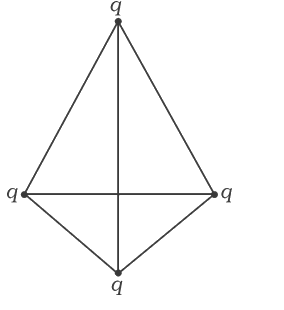
Four similar point charges q are located...

Four similar point charges q are located at the vertices of a tetrahedron with an edge a. the energy of the interaction of charges is:

A

`(6q^(2))/( 4 pi epsi_(0) a)`

B

`( 4 q^(2))/( 4 pi epsi_(0) a)`

C

`(3q^(2))/(4 pi epsi_(0)a)`

D

`(q^(2))/(4 pi epsi_(0)a)`

Text Solution

Verified by Experts

The correct Answer is:

A

`U=6 times 1/(4 pi e_0) q^2/a`
Promotional Banner

Similar Questions

Explore conceptually related problems

Four similar point charges q are located at the vertices of (C) a tetrahedron with an edge a. The energy of the interaction of Four similar point charges q are located at the vertices of (C) a tetrahedron with an edge a. The energy of the interaction of

Three charges 2q, -q, and -q are located at the vertices of an equilateral triangle. At the center of the triangle,

Eight point charges , each q , are placed on the vertices of a cube of side a . Find the potential energy of the system of charges.

The point charges are placed on the vertices of regular hexagon of side L as shown. Find the potential energy of the system of charges.

Four identical point charges q are placed at four corners of a square of side a. Find the potential energy of the charge system. .

Four identical charges q are placed at the corners of a square of side a. Find the potential energy of one of the charges due to the remaining charges. .

Four point charges q, q, q and – q are placed at the vertices of a square of side length a. The configuration is changed and the charge are positioned at the vertices of a rhombus of side length a with – q charge at the vertex where angle is 120^(@) . Find the work done by the external agent in changing the configuration.

Three identical positive charges Q are arranged at the vertices of an equilateral triangle. The side of the triangle is a. Find the intensity of the field at the vertex of a regular tetrahedron of which the triangle is the base.

When identical point charges are placed at the vertices of a cube of edge length 'a' each of them experiences a net force of magnitude F . Now these charges are placed on the vertices of another cube of edge length 'b' . What will be magnitude of the net force on any of the charges? These cubes are simply geometrical constructs and not made by any matter.
