Home
Class 12
PHYSICS
In a uniformly charges sphere of total c...

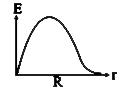
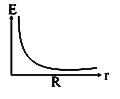
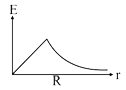
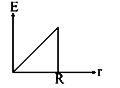
In a uniformly charges sphere of total charge Q and radius R, the electric field E is plotted as a function of distance from the centre. The graph which would corresponding to the above will be :-

A

B

C

D

Text Solution

Verified by Experts

The correct Answer is:

C

Electric field inside the uniformly charged sphere varies linearly, `E=(kQ)/R^3 .r (r lre R)`, while outside the sphere, it varies as inverse square of distance, `E=(DQ)/r^2, (r ge R)`which is correctly represented in option (C).
Promotional Banner

Similar Questions

Explore conceptually related problems

In a uniformly charged sphere of total charge Q and radius R, the electric field E is plotted as function of distance from the centre, The graph which would correspond to the above will be:

A hallow metal sphere of radius R is uniformly charged. The electric field due to the sphere at a distance r from the centre:

A solid sphere of radius R is charged uniformly. The electrostatic potential V is plotted as a function of distance r from the centre of th sphere. Which of the following best represents the resulting curve?

If the potential at the centre of a uniformly charged hollow sphere of radus R is V, then electric field at a distance r from the centre of sphere will be (rgtR) .

If the potential at the center of a uniformly charged sphere of radius R is V then electric field at a distance r from the center of sphere will be ( r lt R ) : -

The electric field due to uniformly charged sphere of radius R as a function of the distance from its centre is represented graphically by

Figure shows a uniformly charged thin non-conducting sphere of total charge Q and radius R. If point charge q is situated at point 'A' which is at a distance r lt R from centre of the sphere, then find out following : (i) Force acting on charge q. (ii) Electric field at centre of sphere. (iii) Electric field at point B.

The electrostatic potential of a uniformly charged thin spherical shell of charge Q and radius R at a distance r from the centre
