Home
Class 12
PHYSICS
A uniformly charged solid shpere fo rad...

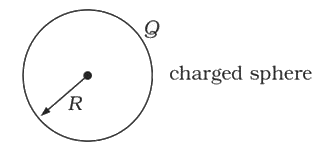
A uniformly charged solid shpere fo radius `R` has potential `V_(0)` (measured with respect to `oo`) on its surface. For this sphere the equipotentail surfaces with potentials `(3V_(0))/(2) , (5 V_(0))/(4), (3V_(0))/(4)` and `(V_(0))/(4)` have radius `R_(1), R_(2), R_(3)` and `R_(4)` respecatively. Then

A

`R_1=0 and R_2 gt (R_4 - R_3)`

B

`R_(1) ne 0 and (R_(2) - R_(1)) gt (R_(4) - R_(3))`

C

`R_1 =0 and R_2 lt(R_4 - R_3)`

D

`2R gtR_4`

Text Solution

Verified by Experts

The correct Answer is:
C

Potential at the surface of the charged sphere
`V_0=(kQ)/R`
`implies V=(KQ)/r, r ge R`
`=(kQ)/(2R^3) (3R^2-r^2)` for `r le R`
`V_(centre) =V_c=(KQ)/(2R^3) times 3R^2=(3kQ)/(2R) =(3V_0)/2 implies R_1=0`
As potential decreases for outside points. Thus, according to the question, we can write
`V_R2=(5V_0)/4=(kQ)/(2R^3) (3R^2-R_2^2)`
`(5V_0)/R=V_0/(2R^2) (3R^2-R_2^2) or 5/2=3-(R_2/R)^2 or (R_2/R)^2=3-5/2=1/2 or R_2=R/sqrt2`
SImilarly
`V_(R_3) =(kQ)/R_3=(3V_0)/4 implies (KQ)/R_3=3/4 times (KQ)/R or R_3=4/3 R`
`V_(R_4)=(KQ)/(R_4)=V_0/4 implies (kQ)/R_4=1/4 times (KQ)/R or R_4=4R`
Promotional Banner

Similar Questions

Explore conceptually related problems

Metallic sphere of radius R is charged to potential V. Then charge q is proportional to

A conducting sphere of radius r is charged to a potential V .The outward pull per unit area of its surface is given by...

A solid sphere of radius R is charged uniformly through out the volume. At what distance from its surface is the electric potential 1/4 of the potential at the centre?

A solid sphere of mass m and radius R rolls without slipping on a horizontal surface such that v_(c.m.)=v_(0) .

A hollow charged metal sphere has radius r . If the potential difference between its surface and a point at a distance 3r from the centre is V, then electric field intensity at a distance 3r is

Concentric metallic hollow spheres of radii R and 4R hold charges Q_1 and Q_2 respectively. Given that surface charge densities of the concentric spheres are equal, the potential difference V(R)- V(4R) is :

A hollow spherical conductor of radius r potential of 100 V at its outer surface. The potential inside the hollow at a distance of (r )/(2) from its centre is

