Home
Class 12
PHYSICS
Two equal point charges are fixed at x=-...

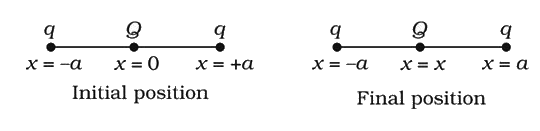
Two equal point charges are fixed at `x=-a` and `x=+a` on the x-axis. Another point charge Q is placed at the origin. The change in the electrical potential energy of Q, when it is displaced by a small distance x along the x-axis, is approximately proportional to

A

x

B

`x^(2)`

C

`x^(3)`

D

`1//x`

Text Solution

Verified by Experts

The correct Answer is:
B

`U_(i)=(2KQq)/(a)+(K.q.q)/(2a)`
and `U_(f)-KQq[(1)/(a+x)+(1)/(a-x)]+(K.q.q)/(2a)`
Here, `K=(1)/(4piepsi_(0))," "DeltaU=U_(f)-U_(i)" ""or"" "|DeltaU|=(2KQqx^2)/(a^3)`
For `xltlta" "therefore" "DeltaUpropx^(2)`
Promotional Banner

Similar Questions

Explore conceptually related problems

Two equal negative charges are fixed at points and on y-axis. A positive charge Q is released from rest at the point on the x-axis. The charge Q will:

Two point charges q each are fixed at (a,0) and (-a,0). A third charge Q is placed at origin. Electrons potential energy of the system will

Two charges, each equal to q, are kept at x=-a and x=a on the x-axis. A particle of mass m and charge q_0=q/2 is placed at the origin. If charge q_0 is given a small displacement (ylt lt a) along the y-axis, the net force acting on the particle is proportional to

Two equal positive charges Q are fixed at points (a, 0) and (-a,0) on the x-axis. An opposite charge -q at rest is relased from point (0, a) on the y-axis. The charge -q will

Two equal negative charges -q are fixed at points (0, -a) and (0,a) on y-axis. A poistive charge Q is released from rest at point (2a, 0) on the x-axis. The charge Q will

Two point charges +q and fixed at (a,0,0) and (-a,0,0) . A third point charge -q is at origin. State whether ite equlilbrium is stable, unstable or neutral if it is slightly displaced: (a) along x-axis. , (b) along y-axis.

Two point charges +q and -q are placed a distance x apart. A third charge is so placed that al the three charges are in equilibrium. Then

Two point charges (Q each are placed at (0,y) and (0-y) A point charge q of the sme polarity can move along the x-axis. Then

