Home
Class 12
PHYSICS
A cubical region of side a has its centr...

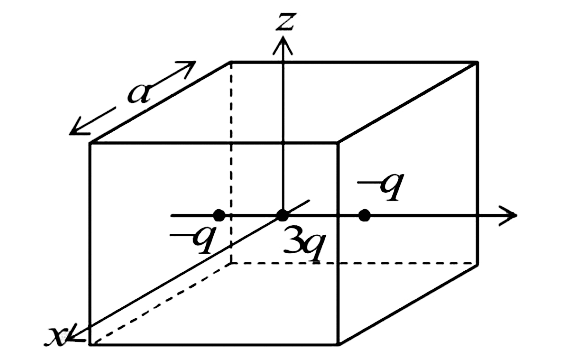
A cubical region of side a has its centre at the origin. It encloses three fixed point charges, `-q` at `(0,-a//4,0)`, `+3q` at `(0, 0, 0)` and `-q` at `(0, +a//4, 0)`. Choose the correct options(s)

A

The net electric flux crossing the plane x = + a/2 is equal to the net electric flux crossing the plane x = a/2

B

The net electric flux crossing the plane y = + a/2 is more that the net electric flux crossing the plane y = -a/2

C

The net electric flux crossing the entire region is `q// epsi_(0)`

D

The net electric flux crossing tha plane `z = +a//2` is equal to the net electric flux crossing the plane ` x= + a//2`

Text Solution

Verified by Experts

The correct Answer is:

A, C, D

Option (A) is correct due to symmetry. Option (B) is incorrect due to symmetry.
Option (C) is correct because as per Gauss’ theorem, net electric flux passing through any closed surface `=(q_("in"))/(epsi_(0))`
Here, `q_("in")=3q-q-q=qtherefore` Net electric flux `=q/_(epsi_(0))`
Option (D) is correct due to symmetry.
Promotional Banner

Similar Questions

Explore conceptually related problems

A cubical region of side a has its centre at the origin. It encloses three point charges , -q at (0, -a//4 , 0),+3q at (0,0,0) and -q at (0,+a//4 ,0) . Choose the correct option (s) (i) The net electric flux crossing the plane x = +(q)/(2) is equal to the net electric flux crossing the plane x = -(a)/(2) (ii) The net electric flux crossing the plane y = +(a)/(2) is more than the net electric flux crossing the plane y = -(a)/(2) (iii) The net electric flux crossing the entire region is (q)/(epsilon_(0)) (iv) The net electric flux crossing the plane z = +(a)/(2) is equal to the net electric flux crossing the plane x = +(a)/(2)

A regular hexagon of side a has a charge Q at each vertex. Potential at the centres of hexagon is (k= (1/4piepsilon_0) )

A point charge q_1 = -1.0 muC is held stationary at the origin. A second point charge q_2 = + 2.0 muC moves from the point (1.0 m, 0, 0) to (2.0 m, 0, 0) . How much work is done by the electric force on q_2 ?

Consider a spherical surface of radius 4 m cenred at the origin. Point charges +q and - 2q are fixed at points A( 2 m, 0,0) and B( 8 m, 0, 0), respectively. Show that every point on the shperical surface is at zero potential.

A point charge q_1 =-5.8muC is held stationary at the origin. A second point charge q_2=+4.3muC moves from the pont (0.26m 0,0) to (0.38m, 0, 0) . How much work is doen the electric force on q_2 ?

A charge of 8 mC is located at the origin. Calculate the work done in taking a small charge of -2xx10^(-9)C from a point P (0,0,3 cm) to a point Q (0,4 cm, 0) via a point R (0,6 cm, 9cm).

A charge of 8 mC is located at the origin. Calculate the work done in taking a small charge of -2xx10^(-9) from a point P(0,0,3cm) to a point Q (0,4cm,0) via a point R(0,6cm,9cm).

Two point charges q and –q are at positions (0,0,d) and (0,0, –d) respectively . What is the electric field at (a,0,0 ) ?

A charge q = -2.0 muC is placed at origin. Find the electric field at (3 m, 4 m, 0) .

A positive point charge q_(1) is placed at (a,0) and another positive point charge q_(2) is placed at (0,a) . Find the force acting on q_(1) .
