Home
Class 12
PHYSICS
An infinitely long thin non-conduction w...

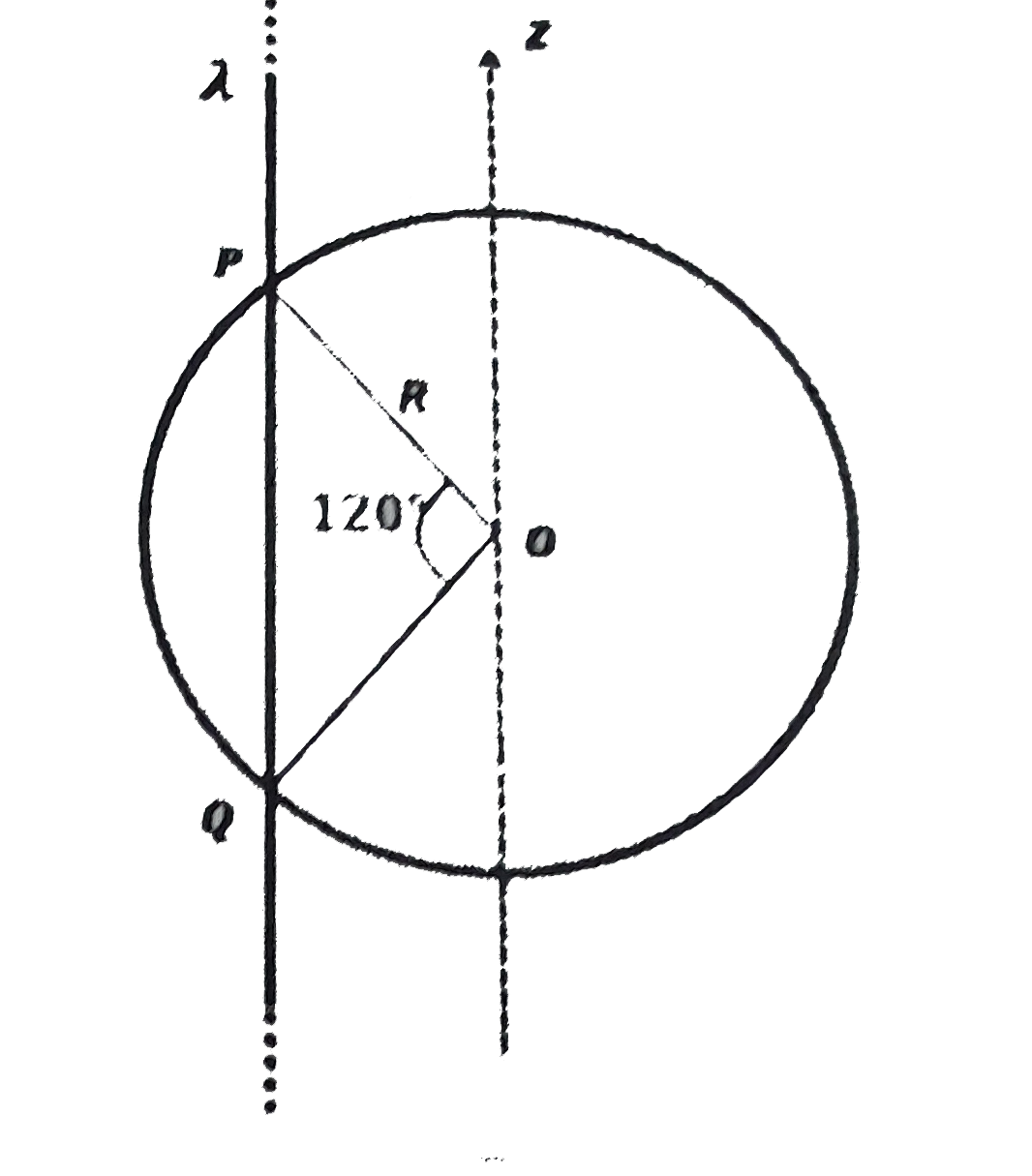
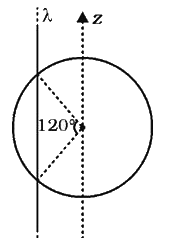
An infinitely long thin non-conduction wire is parallel to the z-axis and carries a uniform line charge density `lambda`. It pierces a thin non-conducting spherical shell of radius r in such a way that that the are PQ subtends an angle `120^(@)` at the centre O of the spherical shell, as shown in the figure. The permittivity of free space is `epsi_(0)`. which of the following statements is (are) true ?

A

The electric flux through the shell is `sqrt(3) R lambda // epsi_(0)`

B

The z -component of the electric field is zero at all the point on the surface of the shell

C

The electric flux thourgh the shell is `sqrt(2)R lambda // in_(0)`

D

The electric field is normal to the surface of the shell at all points

Text Solution

Verified by Experts

The correct Answer is:
A, B

Flux through shell is
`phi=(q_(enc))/(epsi_(0))=(lamda(2Rsin60^(@))/(in_(0))=(sqrt3lamdaR)/(in_(0))` (A is correct)
Field due to infinite charged wire is perpendicular to the wire
`thereforeE_(z)=0` at all points (B is correct)
Promotional Banner

Similar Questions

Explore conceptually related problems

A non-conducting spherical shell of radius R surrounds a point charge q (q at center). The electric flux through a cap of the shell of half angle theta is:

A point charge +q is placed at the centre of a conducting spherical shell of inner radius a and outer radius b. Find the charge appearing on the inner and outer surface of the shell.

A point charge Q is placed inside a conducting spherical shell of inner radius 3R and outer radius 5R at a distance R from the centre of the shell. The electric potential at the centre of the shell will be

A uniformly charged thin conducting spherical shell of radius R and charge q is rotated with constant angular velocity omega about a diameter. The magnetic dipole moment of the system is

A charge Q is placed at the centre of a spherical conducting shell. Choose the correct option.

Charge Induction In Metal Cavities|Combination Of Conducting Spherical Shell

A point charge is placed at a distance 2 a from the centre of a thin conducting uncharged spherical shell A of radius 'a' as shown in the figure.Then the charge on the shell will be

A point charge is placed at a distance 2 a from the centre of a thin conducting uncharged spherical shell A of radius 'a' as shown in the figure.Then the charge on the shell will be

A thin spherical conducting shell of radius R has a charge q. Another charge Q is placed at the centre of the shell. The electrostatic potential at a point P a distance R/2 from the centre of the shell is

