Home
Class 12
PHYSICS
A charged shell of radius R carries a to...

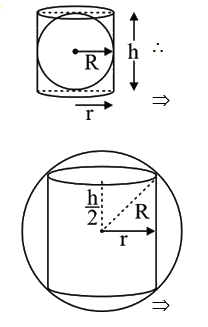
A charged shell of radius R carries a total charge Q. Given `phi` as the flux of electric field through a closed cylindrical surface of height h, radius r & with its centre same as that of the shell. Here centre of cylinder is a point on the axis of the cylinder which is equidistant from its top & bottom surfaces. which of the followintg are correct.

A

If ` h gt 2R ` and `r = 4R //5` then `phi = Q // 5 in_(0)`

B

If `h gt 2R and r = 3R// 5` then `phi = Q // 5 in_(0)`

C

If `h gt 2R and r gt R` then `phi = // in_(0)`

D

If `h lt 8 R// 5` and `r = 3R//5` then `phi = 0`

Text Solution

Verified by Experts

The correct Answer is:
B, C, D

For `hgt2R` and the sphere will completely be inside the cylinder.

`thereforeQ_("enclosed")=Q`
`rArrphi=Q/(in_(0))` (C) is correct
For `r=(3r)/5` and `h/2=(4R)/5`
`r^(2)+(h/2)^(2)=(9R^(2)+86R^(2))/(25)=R^(2)`
`rArr` For `r=(3R)/5` and `hltR/5`, the sphere will completely be outside the cylinder.
`thereforeQ_("enclosed")=0rArrphi=0` (D) is correct
For `hgt2R` and `r=(3R)/5, sintheta=r/R=3/5`
Area of curved surface of sphere enclosed by cylinder
`S=2[2pi(1-costheta)R^(2)]`
`S=4piR^(2)(1-4/5) thereforeQ_("enclosed")=Q/(4piR^(2))S=Q/5`
`rArrphi=Q/(5in_(0))therefore` (B) is correct
Similarly, for `hgt2R,r=(4R)/5 , sintheta=4/5,S=2[2pi(1-costheta)R^(2)]=4piR^(2)(1-3/5)`
`thereforeQ_("enclosed")=Q/(4piR^(2))S=(2Q)/5rArrphi=(2Q)/(5in_(0))therefore` (A) is wrong
Promotional Banner

Similar Questions

Explore conceptually related problems

Find the flux of electric field through a spherical surface of radius R due to a charge of 10^(-7) C at the centre of another equal at a point 2R away from the centre.

A spherical shell of radius R has a charge +q units. The electric field due to the shell at a point

A conducting shell of radius R carries charge -Q . A point charge +Q is placed at the centre. The electric field E varies with distance r (from the centre of the shell) as

A sphere of radius R, is charged uniformly with total charge Q. Then correct statement for electric field is (r = distance from centre): -

A charge q is placed at the centre of the open end of a cylindrical vessel . The flux of the electric field through the surface of the vessel is

Consider a cylindrical surface of radius R and length l in a uniform electric field E. Compute the electric flux if the axis of the cylinder is parallel to the field direction.

A non-conducting spherical shell of radius R surrounds a point charge q (q at center). The electric flux through a cap of the shell of half angle theta is:

A charge q is placed at the centre of a cylinder of radius R and length 2R. Then electric flux through the curved surface of the cylinder is

A charge 'Q' is placed at the centre of a hemispherical surface of radius 'R'. The flux of electric field due to charge 'Q' through the surface of hemisphere is

