Home
Class 12
PHYSICS
The nuclear charge (Ze) is non uniformll...

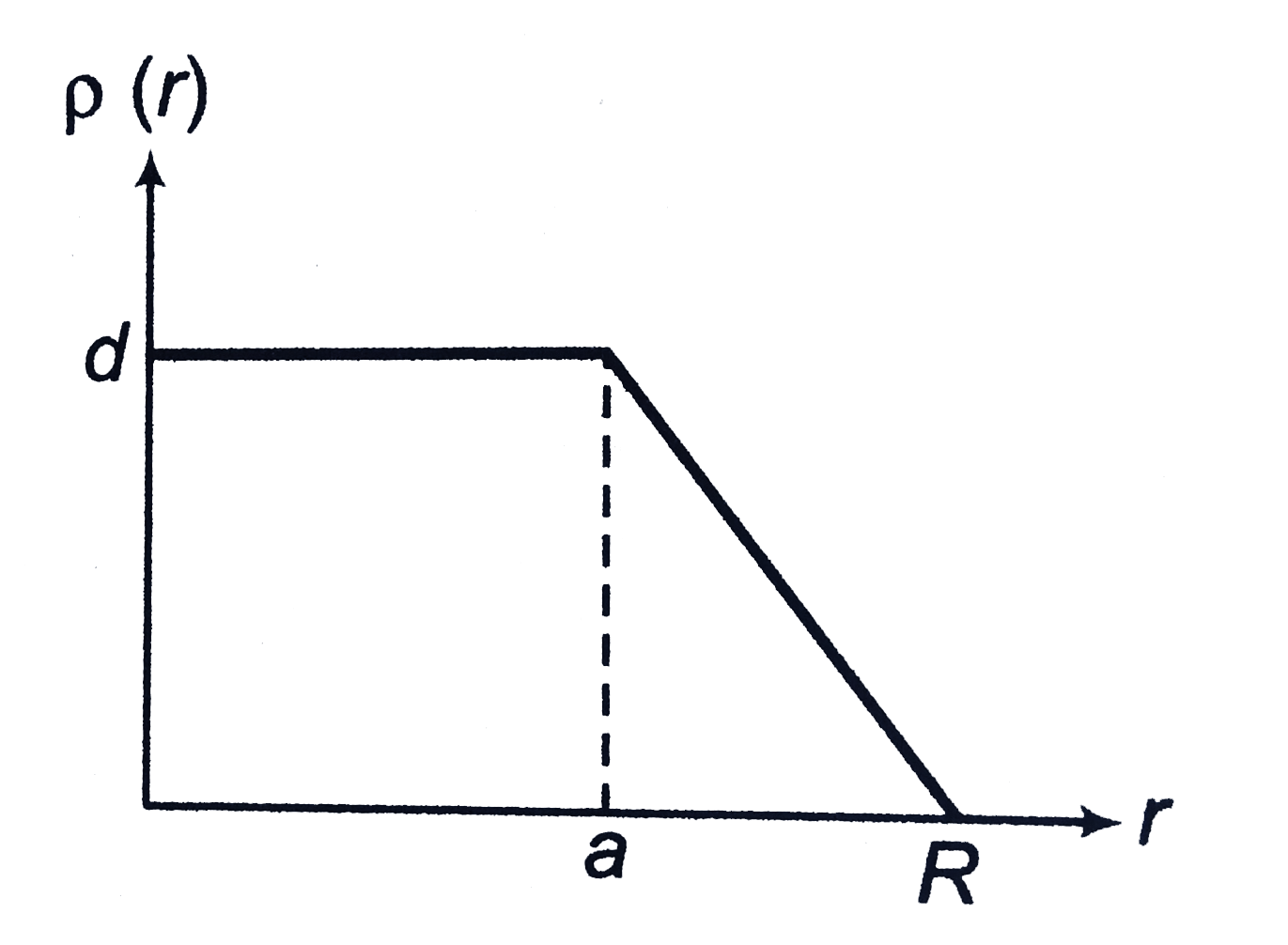
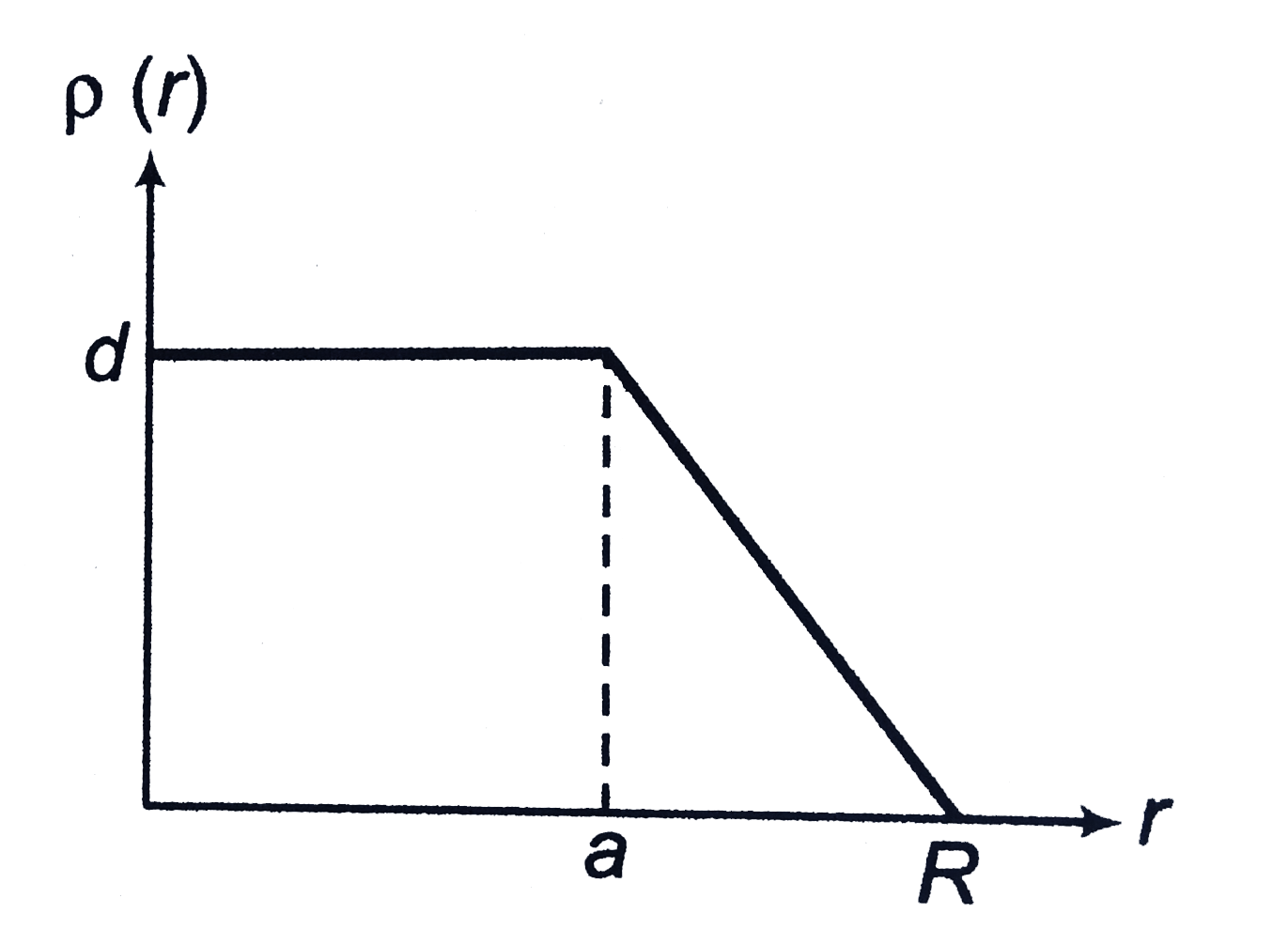
The nuclear charge (`Ze`) is non uniformlly distribute with in a nucleus of radius `r`. The charge density `rho(r)` (charge per unit volume) is dependent only on the radial distance r form the centre of the nucleus s shown in figure. The electric field is only along the radial direction.

For a=0 the value of d (maximum value of `rho` as shown in the figure) is

A

`( 3 Ze)/(4 pi R^(3))`

B

`(3Ze)/(pi R^(3))`

C

`( 4Z e)/( 3pi R^(3))`

D

`(Ze)/(3pi R^(3))`

Text Solution

Verified by Experts

The correct Answer is:
B

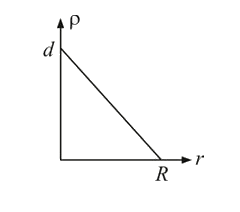
For `a=0rArrp(r)=(-d/r.r+d)`
Now, `int_(0)^(r)(4pir^(2))(d-d/Rr)dr=`net charge =ze
Solving this equation, we get `d=(3ze)/(piR^(3))`
Promotional Banner

Similar Questions

Explore conceptually related problems

The nuclear charge ( Ze ) is non uniformlly distribute with in a nucleus of radius r. The charge density rho(r) (charge per unit volume) is dependent only on the radial distance r form the centre of the nucleus s shown in figure. The electric field is only along the radial direction. The electric field at r=R is

The nuclear charge ( Ze ) is non uniformlly distribute with in a nucleus of radius r. The charge densilty rho(r) (charge per unit volume) is dependent only on the radial distance r form the centre of the nucleus s shown in figure. The electric field is only along the radial direction. The electric field within the nucleus is generaly observed to be linearly dependent on r. This implies

3 charges are placed in a circle of radius d as shown in figure. Find the electric field along x-axis at centre of circle.

A solid sphere of radius R has a volume charge density rho=rho_(0) r^(2) (where rho_(0) is a constant ans r is the distance from centre). At a distance x from its centre (for x lt R ), the electric field is directly proportional to :

Inside a uniformly charged infinitely long cylinder of radius 'R' and volume charge density 'rho' there is a spherical cavity of radius 'R//2'. A point 'P' is located at a dsintance 2 R from the axis of the cylinder as shown. Then the electric field strength at the point 'P' is

An isolated solid metal sphere of radius R is given an electric charge. The variation of the intensity of the electric field with the distance r from the centre of the sphere is best shown by

A solid of radius 'R' is uniformly charged with charge density rho in its volume. A spherical cavity of radius R/2 is made in the sphere as shown in the figure. Find the electric potential at the centre of the sphere.

