`(V_(0) = 3m // s, x = 3)`
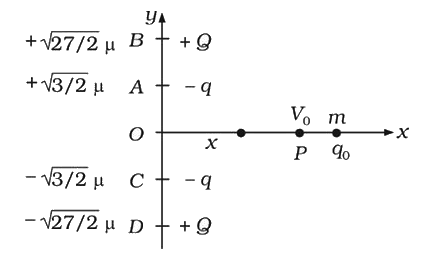
In the figure ` q = 1 mu C = 10^(-6) C , q_(0) = + 0.1 mu C = 10^(-7) C ` and ` m = 6 xx 10^(-4) Kg ` and Q ` = 8 mu C`
Let P be any point at a distance x from origin O . Then
`AP = CP = sqrt((3)/(2)+X^(2))`
` BP = DP=sqrt((27)/(2) + x^(2))`
Electric potential at point P will be, `V = (2KQ)/(BP) - (2kq)/(AP)`
Where `K = (1)/(4 pi epsi_(0)) = 9 xx 10^(9) N m//C^(2)`
`therefore " " V = 2 xx 9 xx 10^(9) [(8 xx 10^(-6))/(sqrt((27)/(2))+ x^(2)) + sqrt((3)/(2)+x^(2))] , v = 1.8 xx 10^(4) [ (8)/(sqrt((27)/(2)+x)) - (1)/(sqrt((3)/(2)+x^(2))]`
Electric field at P
`E = -(dV)/(dx) = 1.8 xx 10^(4) [ (beta) ((-1)/(2)) ((27)/(2) + x^(2))^(-3//2) (-(1)/(2)) ((3)/(2) + x^(2))^(-3//2)](2x)`
E = 0 on x-axis where x = 0 or `(8)/((27)/(2) + x^(2))^(3//2) = (1)/((3)/(2)+x^(2))^(3//2)`
`rArr ((4)^(3//2))/((27)/(2) + x^(2))^(3//2) = (1)/((3)/(2))+ x^(2))^(3//2) rArr ((27)/(2) + x^(2)) = 4((3)/(2)+ x^(2))`
This equation gives ` x = pm sqrt((5)/(2)) m`
The least value of kinetic energy of the particle at infinity should be enough to take the particle upto ` x = pm sqrt((5)/(2))` m because at ` x = + sqrt((5)/(2))m , E= 0` . `rArr` Electrostatic force on charge q is zero or `F_(e) = 0 `
For at `x gt sqrt((5)/(2))m` E is repulsive ( towards positive x - axis) & for ` x gt sqrt((5)/(m))`, E is attractive (towards negative x axis). Now form Eq (i) potential at `x = sqrt((5)/(2))m`.
`V = 1.8xx 10^(4) [(8)/(sqrt((27)/(2) + (5)/(2)))-(1)/(sqrt((3)/(2) + (5)/(2)))] , v_(0) = sqrt((2q_(0)V)/(m))`
Substituting the value
`V_(0) = sqrt((2 xx 10^(-7) xx 2.7xx 10^(4))/(6 xx 10 ^(-4))) rArr v_(0) = 3 m//s therefore `Minimum value of `v_(0)` is `3m//s`
From Eq (i) , potential orgin ( x = 0) is , ` v_(0) = 1.8xx 10^(4) [(8)/(sqrt(27)/(2)) - (1)/(sqrt((3)/(2))] = 2.4xx 10^(4)V`
Let be the kinetic energy of the particle at origin. Applying energy conservation at and at `k + q_(0) v_(0) = (1)/(2)m v_(0)^(2)`
But `(1)/(2) m v_(0)^(2) = q_(0) V` [ form Eq (i)]
` k = q_(0) (V - V_(0))` ,
` k =(10^(-7)) (2.7 xx 10^(-4) - 2.4 xx 10^(4))` , ` k = 3 xx 10^(-4) J`


