Home
Class 12
CHEMISTRY
Ease of ionization to produce carbocatio...

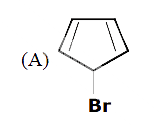
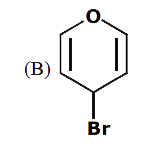
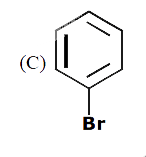
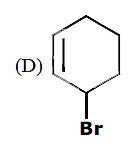
Ease of ionization to produce carbocation and bromide ion under the treatment of `Ag^(o+)` will be maximum in ?

A

B

C

D

Text Solution

AI Generated Solution

The correct Answer is:

To determine which compound has the maximum ease of ionization to produce a carbocation and bromide ion under the treatment of `Ag^(o+)`, we need to analyze the stability of the carbocations formed from the given compounds. The more stable the carbocation, the easier the ionization will be. ### Step-by-Step Solution: 1. **Identify the Compounds**: We need to analyze the stability of carbocations formed from the given options. The question implies that we have several aromatic compounds with bromine substituents. 2. **Understanding Carbocation Stability**: Carbocations are stabilized by resonance and the presence of electron-donating groups. Aromatic compounds tend to stabilize carbocations due to their resonance structures. 3. **Analyze Each Option**: - **Option 1**: A 5-membered ring with bromine. - After ionization, a positive charge is formed on a carbon in the ring. This structure is anti-aromatic (4 π electrons), making it unstable. Therefore, ionization is not easy. - **Option 2**: A 6-membered ring with an oxygen heteroatom and bromine. - Upon ionization, a positive charge is formed. The structure can be stabilized by resonance involving the oxygen atom. This compound has 6 π electrons (aromatic), making it stable. Thus, ionization is easier. - **Option 3**: Bromobenzene. - When treated with `Ag^(o+)`, the positive charge on the benzene ring makes it unstable. The instability of the carbocation means that ionization is not easy. - **Option 4**: A 6-membered ring with a double bond and bromine. - Similar to option 2, this compound can stabilize the carbocation through resonance. However, the presence of a double bond may affect the stability compared to option 2. 4. **Conclusion**: Among the options analyzed, **Option 2** is the most stable due to its aromatic nature and the ability of the oxygen to stabilize the positive charge through resonance. Therefore, the ease of ionization to produce a carbocation and bromide ion under the treatment of `Ag^(o+)` will be maximum in **Option 2**. ### Final Answer: The ease of ionization to produce carbocation and bromide ion under the treatment of `Ag^(o+)` will be maximum in **Option 2**.
Promotional Banner

Topper's Solved these Questions

  • AROMATIC COMPOUND

    MOTION|Exercise Exercise - 2 (Level-I)|47 Videos
  • AROMATIC COMPOUND

    MOTION|Exercise Exercise - 2 (Level-II)|29 Videos
  • ALKYI HALIDE

    MOTION|Exercise Exercise - 4 | Level-II|8 Videos
  • ATOMIC STRUCTURE

    MOTION|Exercise EXERCISE-4 (LEVEL-II)|18 Videos

Similar Questions

Explore conceptually related problems

Ease of ionization to produce carbocation and bromide ion under the statement of \(Ag ^{+}\) will be maximum in which of the following compounds?

n-propyl bromide on treatment with ethanolic potassium hydroxide produces

Bromine is commercially produced by the oxidation of bromide ions in natural brine with

When ethyl bromide is treated with moist Ag_(2)O main product is//are.

The equilibrium constant at 278K for Cu(s)+2Ag^(o+)(aq) hArr Cu^(2+)(aq)+2Ag(s) is 2.0xx10^(15) . In a solution in which copper has displaced, some silver ions from the solution, the concentration of Cu^(2+) ions from the solution, the concentration of Cu^(2+) ions is 1.8xx10^(-2) mol L^(-1) and the concentration of Ag^(o+) ions is 3.0xx10^(-9) mol L^(-1) . Is the system at equilibrium?
