Home
Class 12
CHEMISTRY
CHF(2) Br overset(OH^(-))(rarr) (A) [Int...

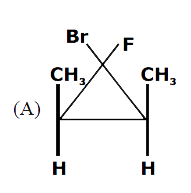
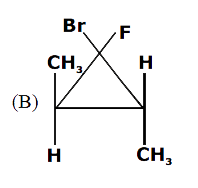
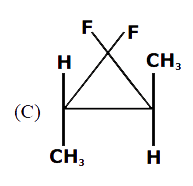
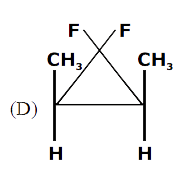
`CHF_(2) Br overset(OH^(-))(rarr) (A)` [Intermediate] `overset("Trans -2-butene")(rarr) (B)`

A

B

C

D

Text Solution

AI Generated Solution

The correct Answer is:

To solve the question regarding the reaction of CHF₂Br with OH⁻ and then with trans-2-butene, we will break down the process step by step. ### Step 1: Reaction of CHF₂Br with OH⁻ The first step involves the reaction of CHF₂Br with a hydroxide ion (OH⁻). The hydroxide ion acts as a base and abstracts a proton (H⁺) from the CHF₂Br molecule. **Chemical Equation:** \[ \text{CHF}_2\text{Br} + \text{OH}^- \rightarrow \text{CF}_2\text{Br}^- + \text{H}_2\text{O} \] ### Step 2: Formation of Carbene After the proton abstraction, we have CF₂Br⁻. The bromine (Br) atom is a good leaving group and will leave, resulting in the formation of a carbene intermediate, specifically a singlet carbene (CF₂). **Chemical Equation:** \[ \text{CF}_2\text{Br}^- \rightarrow \text{CF}_2 + \text{Br}^- \] ### Step 3: Reaction with Trans-2-butene Now, the singlet carbene (CF₂) will react with trans-2-butene. The double bond in trans-2-butene can react with the carbene. The carbene will insert itself into the double bond of trans-2-butene. **Chemical Structure of Trans-2-butene:** \[ \text{CH}_3\text{CH}=\text{CH}\text{CH}_3 \] ### Step 4: Insertion of the Carbene When the carbene (CF₂) inserts into the double bond of trans-2-butene, it will form a new carbon-carbon bond. The stereochemistry of the double bond will remain unchanged because the insertion does not lead to a change in the relative positions of the substituents. **Resulting Product Structure:** The resulting product will have the two fluorine atoms attached to one of the carbon atoms that were involved in the double bond of trans-2-butene. ### Final Product The final product can be represented as follows: \[ \text{CH}_3\text{C}(\text{F}_2)\text{C}(\text{H})\text{CH}_3 \] ### Summary of the Reaction The overall reaction can be summarized as: 1. CHF₂Br reacts with OH⁻ to form CF₂Br⁻. 2. CF₂Br⁻ loses Br⁻ to form the singlet carbene CF₂. 3. CF₂ reacts with trans-2-butene to form the final product.
Promotional Banner

Topper's Solved these Questions

  • AROMATIC COMPOUND

    MOTION|Exercise Exercise - 2 (Level-II)|29 Videos
  • AROMATIC COMPOUND

    MOTION|Exercise Exercise - 3|17 Videos
  • AROMATIC COMPOUND

    MOTION|Exercise Exercise - 4 | Level-II|16 Videos
  • ALKYI HALIDE

    MOTION|Exercise Exercise - 4 | Level-II|8 Videos
  • ATOMIC STRUCTURE

    MOTION|Exercise EXERCISE-4 (LEVEL-II)|18 Videos

Similar Questions

Explore conceptually related problems

2DCDO overset(OH^(-))rarr [X] and [Y] are

In the following sequence of reactions, CH_(3)CH_(2)CH_(2)Br overset("KOH"(Alc))(rarr) " (A) " overset("HBr")(rarr) " (B) " overset("KOH"(aq))(rarr) (C ) The product (C) is

Identify 'Product' in the reaction : CH_(3)COCl overset(KCN) (rarr) Intermediate overset(H_(2)O)(rarr) Product

2CH_(3)CHO overset(OH^(-))rarr X rarr Y overset(H_(2)-Pd//C)rarr Z, Z is

CHCl_(3)+MeCOMe overset(OH^(-))rarr A overset("excess KOH")rarr B overset(NaOH - CaO)rarr C overset("KOBr")rarr D

overset(Br_(2)//"heat")(rarr) P, P is

MOTION-AROMATIC COMPOUND-Exercise - 2 (Level-I)
  1. The orbital picture of a triplet carbene can be drawn as

    Text Solution

    |

  2. It is believed that chloroform and hydroxide ion react to produce an e...

    Text Solution

    |

  3. CHF(2) Br overset(OH^(-))(rarr) (A) [Intermediate] overset("Trans -2-b...

    Text Solution

    |

  4. Ph-underset(14)overset(O)overset("||")(C)-CHN(2) underset(H(2)O)overse...

    Text Solution

    |

  5. Which of the following will not give carbylamine reaction

    Text Solution

    |

  6. (A) Product (A) will be

    Text Solution

    |

  7. overset(I)overset("|")(PhCHBr) overset(PhC equiv CPh)underset("EtOK")(...

    Text Solution

    |

  8. Complete the following reaction

    Text Solution

    |

  9. Intermediate produced during reimer tiemann’s formlylation will be

    Text Solution

    |

  10. Which of the following compound doesn’t gives Hoffmann’s carbyl amine ...

    Text Solution

    |

  11. CH(3) – NH(2) + CHCl(3) + KOH rarr major product will be :

    Text Solution

    |

  12. What is the product of the following reaction ?

    Text Solution

    |

  13. It involves conversion of a carboxylic acid amide into an amine with a...

    Text Solution

    |

  14. It involves conversion of a carboxylic acid amide into an amine with a...

    Text Solution

    |

  15. The given is mechanism of Beckmann rearrangment. Reagent cannot b...

    Text Solution

    |

  16. The given is mechanism of Beckmann rearrangment. Rate determining...

    Text Solution

    |

  17. The given is mechanism of Beckmann rearrangment. Product (X) i...

    Text Solution

    |

  18. Text Solution

    |

  19. Product (A) will be

    Text Solution

    |

  20. Give the major organic product of the following re- action :

    Text Solution

    |
