Home
Class 12
CHEMISTRY
Which of most reactive towards nucleophi...

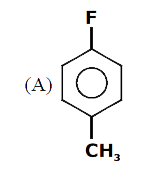
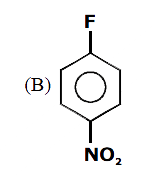
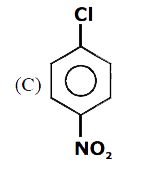
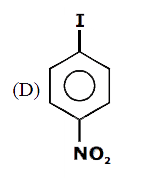
Which of most reactive towards nucleophilic aromatic substitution.

A

B

C

D

Text Solution

AI Generated Solution

The correct Answer is:

To determine which compound is most reactive towards nucleophilic aromatic substitution, we need to analyze the effect of substituents on the aromatic ring and how they influence the electron density. Here’s a step-by-step solution: ### Step 1: Understand Nucleophilic Aromatic Substitution Nucleophilic aromatic substitution involves the addition of a nucleophile to an aromatic ring, followed by the departure of a leaving group. The reactivity of the aromatic compound depends on the electron density of the ring and the nature of the substituents. **Hint:** Remember that nucleophiles are electron-rich species and will attack areas of low electron density on the aromatic ring. ### Step 2: Identify the Substituents Let’s consider the four options provided. Typically, these options will include different substituents such as halogens (like fluorine, chlorine), alkyl groups (like methyl), and electron-withdrawing groups (like nitro). **Hint:** Focus on how each substituent affects the electron density of the aromatic ring. ### Step 3: Analyze Electron-Withdrawing and Electron-Donating Effects - **Electron-Withdrawing Groups (EWGs)** like nitro (-NO2) decrease the electron density on the aromatic ring, making it more susceptible to nucleophilic attack. - **Electron-Donating Groups (EDGs)** like alkyl groups (e.g., -CH3) increase the electron density, making the ring less reactive towards nucleophiles. **Hint:** Identify which substituents are EWGs and which are EDGs in your options. ### Step 4: Determine the Most Reactive Compound 1. **For a compound with a halogen (like fluorine):** The bond between carbon and fluorine is highly polar due to fluorine's high electronegativity, making it a good leaving group. However, the presence of electron-donating groups can reduce reactivity. 2. **For compounds with nitro groups:** The nitro group is a strong electron-withdrawing group, which significantly decreases electron density on the ring, enhancing reactivity towards nucleophiles. **Hint:** Compare the electron density of the aromatic rings in each option to see which one is most affected by EWGs. ### Step 5: Conclusion After analyzing the effects of substituents: - The compound with the nitro group (-NO2) will be more reactive towards nucleophilic aromatic substitution compared to those with electron-donating groups or less polar leaving groups. - Among the options, the compound with the nitro group and a good leaving group (like iodine) will be the most reactive. **Final Answer:** The compound with the nitro group is the most reactive towards nucleophilic aromatic substitution.
Promotional Banner

Topper's Solved these Questions

  • AROMATIC COMPOUND

    MOTION|Exercise Exercise - 3|17 Videos
  • AROMATIC COMPOUND

    MOTION|Exercise Exercise - 4 | Level-I|13 Videos
  • AROMATIC COMPOUND

    MOTION|Exercise Exercise - 2 (Level-I)|47 Videos
  • ALKYI HALIDE

    MOTION|Exercise Exercise - 4 | Level-II|8 Videos
  • ATOMIC STRUCTURE

    MOTION|Exercise EXERCISE-4 (LEVEL-II)|18 Videos

Similar Questions

Explore conceptually related problems

Which of the following 2-halo nitrobenzene is most reactive towards nucleophilic aromatic substitution ?

Which of the following is the most reactive towards eklectrophilic aromatic substitution?

Which of the following is most reactive towards electrophillic aromatic substitution for halogen ?

Which of the following compound is most reactive in the nucleophilic aromatic substitution reaction with NaOH ?

Which is least reactive towards nucleophilic substitution (S_(N^(2)))

MOTION-AROMATIC COMPOUND-Exercise - 2 (Level-II)
  1. Which of the following structures correspond to the product expected, ...

    Text Solution

    |

  2. Conjugation of electron withdrawing groups, e.g., -CHO, -overset(O)ove...

    Text Solution

    |

  3. Which of most reactive towards nucleophilic aromatic substitution.

    Text Solution

    |

  4. Nitro benzene reacts with Me-overset(O)overset("||")(C)-Cl in presence...

    Text Solution

    |

  5. Which of the following is ortho-para directing group

    Text Solution

    |

  6. The structure of the compound that gives a tribromo derivative on trea...

    Text Solution

    |

  7. Amongst the following, moderately activating groups is

    Text Solution

    |

  8. Which of the following is ortho para directing

    Text Solution

    |

  9. Of the species PhSH, Ph underset(O)underset("||")(S)R, ph underset(O)u...

    Text Solution

    |

  10. Which of the following group(s) activate the benzene ring towards elec...

    Text Solution

    |

  11. Statement-1 : Rate of nitration is C(6)H(6) cong C(6) D(6) cong C(6)T(...

    Text Solution

    |

  12. Product (A) will be

    Text Solution

    |

  13. Product (A) is

    Text Solution

    |

  14. Which aromatic compound is obtained when noctane undergoes catalytic h...

    Text Solution

    |

  15. Benzoic acid may be prepared by the oxidation of:

    Text Solution

    |

  16. Isopropylbenzene can be prepared by :

    Text Solution

    |

  17. In which of the following reaction t-butylbenzene is formed:

    Text Solution

    |

  18. Product is

    Text Solution

    |

  19. Which of the following reactions of bezene proves the presence of thre...

    Text Solution

    |

  20. Electrophile NO(2)^(o+) attacks the following in which cases NO(2)^(o...

    Text Solution

    |
