Home
Class 12
CHEMISTRY
Which of the following group(s) activate...

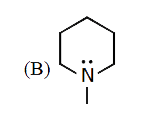
Which of the following group(s) activate the benzene ring towards electrophilic substitution reaction.

A

`-Cl`

B

C

`-O-overset(O)overset("||")(C)-CH_(3)`

D

`-C equiv overset(..)N`

Text Solution

AI Generated Solution

The correct Answer is:

To determine which groups activate the benzene ring towards electrophilic substitution reactions, we need to analyze the nature of the substituents attached to the benzene ring. Here’s a step-by-step solution: ### Step 1: Understand the Activation and Deactivation of the Benzene Ring - **Activation**: Groups that donate electron density to the benzene ring increase its reactivity towards electrophiles. These groups are known as activating groups. - **Deactivation**: Groups that withdraw electron density from the benzene ring decrease its reactivity towards electrophiles. These groups are known as deactivating groups. ### Step 2: Identify Electron Donating and Withdrawing Groups - **Electron Donating Groups**: These groups typically have lone pairs of electrons that can be delocalized into the benzene ring. Examples include -OH, -NH2, -OCH3, etc. - **Electron Withdrawing Groups**: These groups pull electron density away from the benzene ring. Examples include -NO2, -CN, -COOH, -Cl, etc. ### Step 3: Analyze Each Option 1. **Chlorine (Cl)**: - Chlorine has a high electronegativity and exhibits a -I (inductive) effect, which withdraws electrons. Thus, it deactivates the ring despite having lone pairs that can participate in resonance. - **Conclusion**: Deactivates the ring. 2. **Nitrogen (N)**: - If nitrogen is part of an amine group (-NH2) or similar, it can donate its lone pair to the ring, increasing electron density and activating the ring. - **Conclusion**: Activates the ring. 3. **OCO-CS3 (Acetoxy group)**: - The oxygen has lone pairs that can participate in resonance with the benzene ring, increasing electron density. Although the carbonyl group can withdraw electrons, the overall effect is still activation due to resonance. - **Conclusion**: Activates the ring. 4. **Cyanide (CN)**: - The cyanide group is a strong electron-withdrawing group due to its -I and -M effects, which significantly reduce the electron density on the benzene ring. - **Conclusion**: Deactivates the ring. ### Final Conclusion Based on the analysis: - **Activating Groups**: Nitrogen (N) and OCO-CS3 (Acetoxy group). - **Deactivating Groups**: Chlorine (Cl) and Cyanide (CN). ### Answer: The groups that activate the benzene ring towards electrophilic substitution reactions are: - Option 2 (Nitrogen) - Option 3 (OCO-CS3) ---
Promotional Banner

Topper's Solved these Questions

  • AROMATIC COMPOUND

    MOTION|Exercise Exercise - 3|17 Videos
  • AROMATIC COMPOUND

    MOTION|Exercise Exercise - 4 | Level-I|13 Videos
  • AROMATIC COMPOUND

    MOTION|Exercise Exercise - 2 (Level-I)|47 Videos
  • ALKYI HALIDE

    MOTION|Exercise Exercise - 4 | Level-II|8 Videos
  • ATOMIC STRUCTURE

    MOTION|Exercise EXERCISE-4 (LEVEL-II)|18 Videos

Similar Questions

Explore conceptually related problems

Which of the following froups groups deactivates the benzene ring towards electrophilic substitution ?

Which of the following substituents deactivates the benzene ring towards electrophilic substitution?

All the common m-directig group make the benzene ring towards electrophilic substitution reactions

Explain the fact that in aryl ethers, (i) the alkoxy group activates the benzene ring towards electrophilic substitution and (ii) it directs the incoming substituents to ortho and para positions in benzene ring.

Which of the following compounds react slower than benzene in electrophilic substitution?

MOTION-AROMATIC COMPOUND-Exercise - 2 (Level-II)
  1. Amongst the following, moderately activating groups is

    Text Solution

    |

  2. Which of the following is ortho para directing

    Text Solution

    |

  3. Of the species PhSH, Ph underset(O)underset("||")(S)R, ph underset(O)u...

    Text Solution

    |

  4. Which of the following group(s) activate the benzene ring towards elec...

    Text Solution

    |

  5. Statement-1 : Rate of nitration is C(6)H(6) cong C(6) D(6) cong C(6)T(...

    Text Solution

    |

  6. Product (A) will be

    Text Solution

    |

  7. Product (A) is

    Text Solution

    |

  8. Which aromatic compound is obtained when noctane undergoes catalytic h...

    Text Solution

    |

  9. Benzoic acid may be prepared by the oxidation of:

    Text Solution

    |

  10. Isopropylbenzene can be prepared by :

    Text Solution

    |

  11. In which of the following reaction t-butylbenzene is formed:

    Text Solution

    |

  12. Product is

    Text Solution

    |

  13. Which of the following reactions of bezene proves the presence of thre...

    Text Solution

    |

  14. Electrophile NO(2)^(o+) attacks the following in which cases NO(2)^(o...

    Text Solution

    |

  15. The reaction of replacement of a hydrogen atom in benzene by alkyl gro...

    Text Solution

    |

  16. Which of the following statements is correct:

    Text Solution

    |

  17. Which of the following gives Friedel Crafts reac- tion?

    Text Solution

    |

  18. Which of the following can be used in Friedel Crafts reaction when ben...

    Text Solution

    |

  19. The good method for converting benzene into n- propyl benzene is:

    Text Solution

    |

  20. Which of the following will undergo nitration slower than benzene ?

    Text Solution

    |
