Home
Class 12
CHEMISTRY
HO-CH(2)-CH(2)-CH =O underset(underset((...

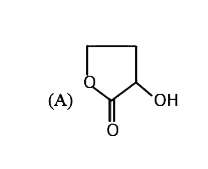
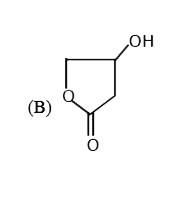
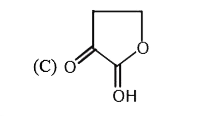
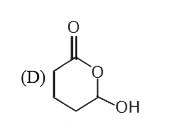
HO-`CH_(2)-CH_(2)`-CH =O `underset(underset((4)Delta)underset((3)H_(2)O^(oplus))((2)H^(oplus)))overset((1)KCN)(rarr)`(A), Product (A) is ,

A

B

C

D

Text Solution

AI Generated Solution

The correct Answer is:

To solve the given question, we need to analyze the reaction step by step. The starting material is HO-CH₂-CH₂-CH=O, which is an aldehyde with a hydroxyl group. The reaction involves KCN (potassium cyanide) and H₂O (water) in the presence of H⁺ ions. ### Step-by-Step Solution: 1. **Identify the Starting Material**: The starting compound is HO-CH₂-CH₂-CH=O. This is a 3-hydroxypropionaldehyde. 2. **Nucleophilic Attack by KCN**: The cyanide ion (CN⁻) from KCN acts as a nucleophile and attacks the carbonyl carbon of the aldehyde (C=O) group. This results in the formation of a tetrahedral intermediate. **Hint**: Remember that nucleophiles attack electrophilic centers, such as carbonyl carbons. 3. **Protonation of the Intermediate**: In the presence of H⁺ ions, one of the hydroxyl groups can be protonated, leading to the formation of an oxonium ion. This intermediate can then undergo hydrolysis. **Hint**: Protonation increases the electrophilicity of the carbonyl carbon, making it more reactive. 4. **Hydrolysis**: Water (H₂O) attacks the carbonyl carbon of the oxonium ion, leading to the formation of a new hydroxyl group and the conversion of the carbonyl to a hydroxyl. **Hint**: Hydrolysis is a reaction where water is used to break bonds, often resulting in the formation of hydroxyl groups. 5. **Formation of a 5-Membered Ring**: The lone pair on the oxygen can attack the carbonyl carbon, forming a 5-membered cyclic intermediate. This step is crucial as it stabilizes the structure. **Hint**: Cyclic structures often form in reactions involving nucleophiles and electrophiles due to the stability of ring formations. 6. **Deprotonation**: The nitrogen in the intermediate can accept a proton, leading to the formation of an amine group. This step is essential for the final product. **Hint**: Deprotonation is a common step in organic reactions that helps stabilize charged intermediates. 7. **Formation of the Final Product**: The leaving group (NH₃) departs, and we are left with a double bond between carbon and oxygen (C=O) along with a hydroxyl group (OH) on the adjacent carbon. **Hint**: The leaving group is often a good nucleophile or a stable molecule that can depart without destabilizing the product. 8. **Final Structure**: The final product A is a compound with a carbonyl group (C=O) and a hydroxyl group (OH) adjacent to it, which corresponds to the structure of a 5-membered ring compound. ### Conclusion: The product A formed from the reaction is a 5-membered cyclic compound with a hydroxyl group and a carbonyl group. ### Final Product: The final product A is **5-hydroxy-2-oxopentanenitrile**.
Promotional Banner

Topper's Solved these Questions

  • CARBONL COMPOUNDS

    MOTION|Exercise EXERCISE -2 (LEVEL-II)|18 Videos
  • CARBONL COMPOUNDS

    MOTION|Exercise EXERCISE - 3|10 Videos
  • CARBONL COMPOUNDS

    MOTION|Exercise EXERCISE -1|40 Videos
  • BIOMOLECULES & POLYMERS

    MOTION|Exercise EXERCISE - 4 (LEVEL II)|17 Videos
  • CARBOXYLIC ACID

    MOTION|Exercise Exercise - 4 (LEVEL - 2 )|22 Videos

Similar Questions

Explore conceptually related problems

Ch_(3)-CH_(2)-C -=CH overset( R)underset(H_(3)O^(oplus))to Butanone, R is

H_(3)C-CH_(2)-underset(O)underset(||)(C)-CH_(3)underset(D_(2)O)overset(NaBH_(4))to Product ?

Ph-CH_(2)-overset(O)overset(||)(C)-OHoverset((1) NaOH, CaO, Delta)underset((2) H^(oplus))(to) (A) Product (A) is:

CH_(3)-overset(CH_(3))overset(|)underset(CH_(3))underset(|)C-CH_(2)-OH overset(conc. H_(2)SO_(4))underset(Delta)rarrP The product "P" is

CH_(3)-underset(Br)underset(|)CH-CH_(2)-overset(O)overset(||)C-CH_(3)underset(Delta)overset(N_(2)H_(4),overset(Ө)OH)rarr product :

CH_(3)-(CH_(2))_(3)-OH overset(CH_(3)-underset(O)underset(||)overset(O)overset(||)(S)-Cl)underset(ET_(3)N)(rarr)(A) overset(14)overset(KCN)(rarr)(B) overset(H_(3)O^(o+))(rarr)(C) Product (C) is :
