Text Solution
Verified by Experts
The correct Answer is:



Topper's Solved these Questions
Similar Questions
Explore conceptually related problems
MOTION-CARBOXYLIC ACID-Exercise - 4 (LEVEL - 2 )
- Which of the following reactants on reaction with conc. NaOH followed ...
Text Solution
|
- Match the compounds in Column I with their characteristic test(s)/reac...
Text Solution
|
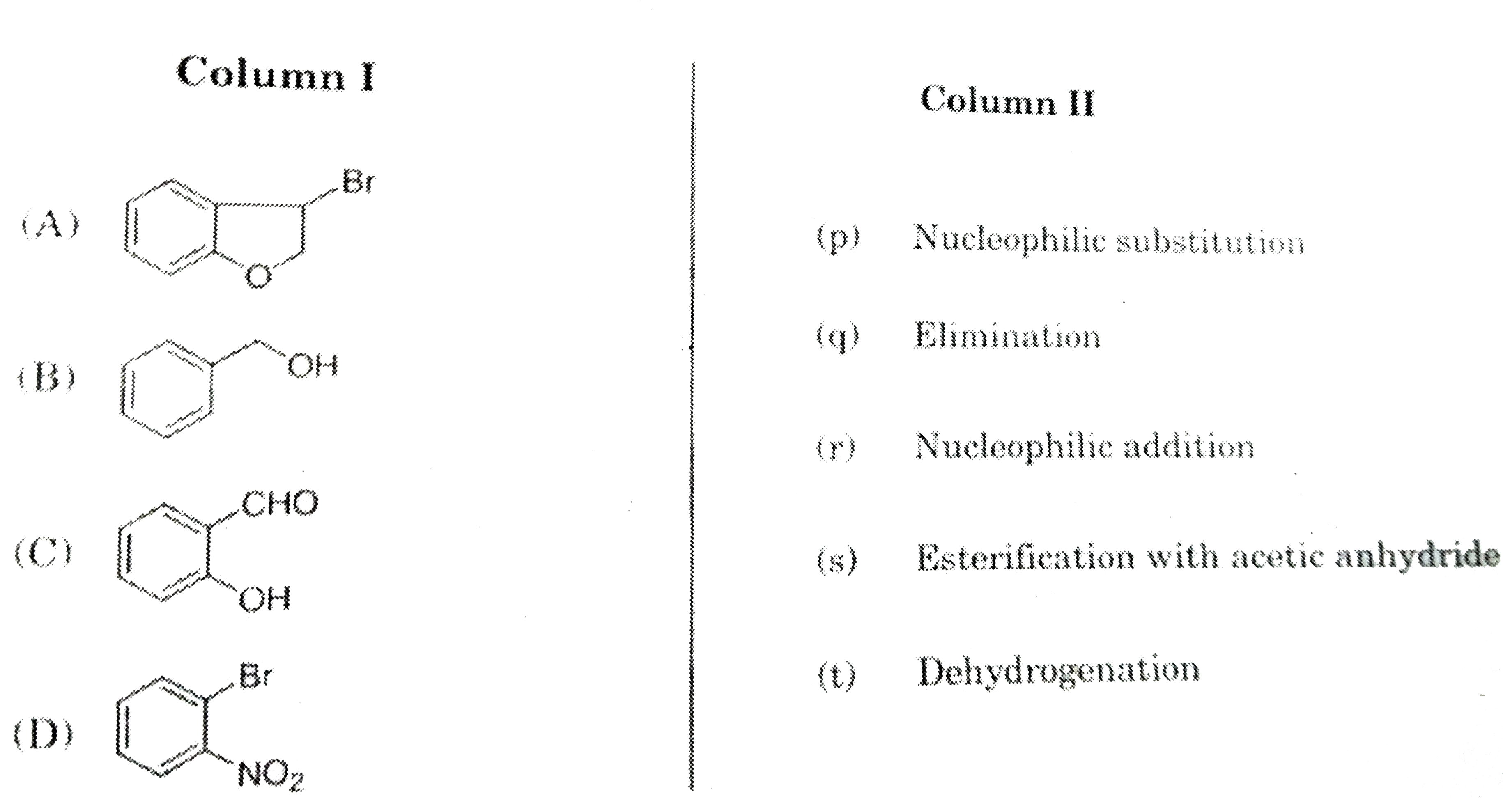
- Match each of the compounds given in Column I with the reaction(s), th...
Text Solution
|
- The major product of the following reaction is
Text Solution
|
- Among the following compounds, the most acidic is
Text Solution
|
- The carboxyl functional group (-COOH) is present in :
Text Solution
|
- The compound that undergoes decarboxylation most readily under mild c...
Text Solution
|
- After completion of the reaction (I and II), the organic compound(s) i...
Text Solution
|
- P and Q are isomers of dicarboxylic acid C(4)H(4)O(4). Bothdecolorize ...
Text Solution
|
- P and Q are isomer of dicraboxylic acid C(4)H(4)O(4) Both decolourixe ...
Text Solution
|
- In the reaction shown, below, the major product(s) formed is/are :
Text Solution
|
- Consider all possible isomeric ketones, including stereoisomers, of MW...
Text Solution
|
- The product(s) of the following reaction sequence is(are):
Text Solution
|
- Compound p and R upon ozonolysis produce Q and S, respectively . Th...
Text Solution
|
- Columns 1,2 and 3 contain starting materials, reaction conditions, and...
Text Solution
|
- Columns 1,2 and 3 contain starting materials, reaction conditions, and...
Text Solution
|
- Columns 1,2 and 3 contain starting materials, reaction conditions, and...
Text Solution
|
- Aniline reacts with mixed acid (cone. HNO(3) and cone. H(2)SO(4)) at 2...
Text Solution
|
- Treatment of benzene with CO/HCl in the presence of anhydrous "AlCl"(3...
Text Solution
|
- Treatment of benzene with CO/HCl in the presence of anhydrous "AlCl"(3...
Text Solution
|