

Home
Class 11
PHYSICS
A weightless rod of length l carries two...

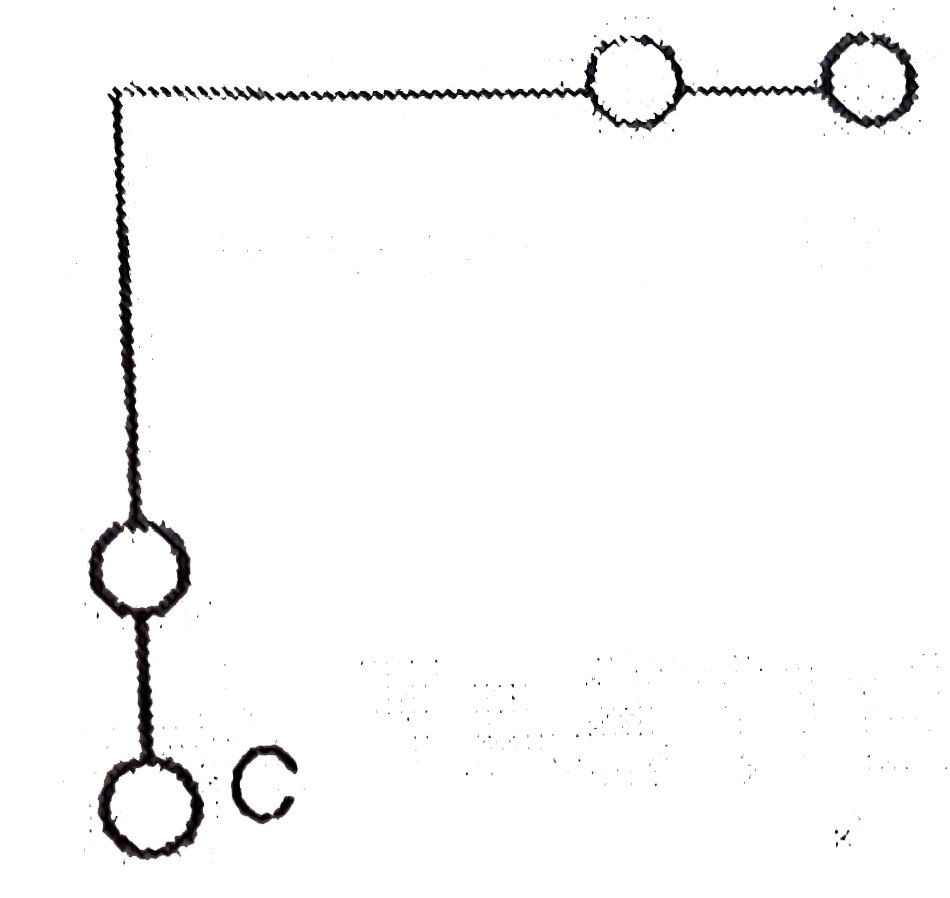
A weightless rod of length l carries two equal masses m one fixed at the end and other in the middle ofhte rod. The rod can revolve in a vertical plane about A. Then, horizontal velocity which must be imparted to end C of rod to deflect it to horizontal position is

Promotional Banner

Similar Questions

Explore conceptually related problems

A weightless rod of length 2l carries two equal masses 'm', one tied at lower end A and the other at the middle of the rod at B . The rod can rotate in vertical plane about a fixed horizontal axis passing thriugh C . The rod of is released from rest in horizontal possion. The speed of the mass B at the instant rod become vertical is:

A weightless rod of length 2l carries two equal masses 'm', one tied at lower end A and the other at the middle of the rod at B . The rod can rotate in vertical plane about a fixed horizontal axis passing thriugh C . The rod of is released from rest in horizontal possion. The speed of the mass B at the instant rod become vertical is:

A weightless rod of length 2l carries two equal masses 'm' , one secured at lower end A and the other at the middle of the rod at B . The rod can rotate in vertical plane about a fixed horizontal axis passing through C . What horizontal velocity must be imparted to the mass at A so that it just completes the vertical circle.

A weightless rigid rod AB of length / connects two equal masses m one particle is fixed at the end B and the other at the middle ofthe rod as shown in the figure-5.131. The rod can rotate in the vertical plane freely around the hinge point/4. Choose the correct option(s)

A light rod of length l is pivoted at the upper end. Two masses (each m), are attached to the rod, one at the middle and the other at the free end. What horizontal velocity must be imparted to the lower end mass, so that the rod may just take up the horizontal position ?

A light rod of length l is pivoted at the upper end. Two masses (each m), are attached to the rod, one at the middle and the other at the free end. What horizontal velocity must be imparted to the lower end mass, so that the rod may just take up the horizontal position ?

A homogenous rod XY of length L and mass 'M' is pivoted at the centre 'C' such that it can rotate freely in vertical plane. Initially the rod is in the horizontal position.