
Home
Class 12
PHYSICS
Two same length rods of brass and steel ...

Two same length rods of brass and steel of equal cross-sectional area are joined end to end as shown in figure and supported between two rigid vertical walls. Initially the rods are unstrained. If the temperature of system is raised by `Deltat`. Find the displacement of the junction of two rods. Given that the coefficient of linear expansion and young's modulus of brass and steel are `apha_(b).alpha_(s)(alpha_(b)gtalpha_(s)),Y_(b)` and `Y_(s)` respectively.

Text Solution

Verified by Experts
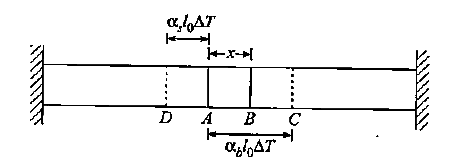
Here the initial lengths of the two rods are `l_(0)` and as `alpha_(b)gtalpha_(s)` , we can directly state that the junction of the two rods is displacedf toward right. Due to this brass rod is some what expanded but less as compared to free expansion and steel is overall compressed due to the stress developed between the two rods.
Figure shows the final situation of rods at higher temperature `Deltat`. in figure A is the initial position of junction and B is its final position.

If only brass rod is present, expansion in it due to increase in temperature by `DeltaT` is
`Deltal_(b)=alpha_(b)l_(0)DeltaT`
Which is equal to AC in figure. But finally the rod is expanded by x, thus the elastic compression in the rod due to stress between the two rods is BC, which is given as
`BC=alpha_(b)l_(0)DeltaT-x`
Thus elastic strain in brass rod is
`("Strain")_("brass")=(alpha_(b)l_(0)Deltat-x)/(l_(0))`[ As `alpha_(b)l_(0)DeltaT` is small]
Similary if steel rod alone is there, it would have been expanded by
`Deltal_(s)=alpha_(s)l_(0)DeltaT`
Which is equal to AD in figure . But finally steel rod is compressed by x, thus the elastic compression in steel rod due to stress between the two rods is BD, which is given as
`BD=alpha_(s)=l_(0)DeltaT+x`
Thus elastic strain in steel rod is
`("Strain)_("steel")=(alpha_(s)l_(0)DeltaT-x)/(l_(0))` [As `alpha_(s)l_(0)DeltaT` is small]
As thetwo rods are in contact, stress develoed in the two rod must be equal thus we have
`("Stress")_("brass")=("Stress")_("steel")`
or `Y_(b)xx("Strain")_("brass")=Y_(S)xx("Strain")_("steel")`
or `Y_(b)[(alpha_(b)l_(b)DeltaT-x)/(l_(@)0]=Y_(s)[(alpha_(s)l_(@)DeltaT+x)/(l_(0))]`
or `x=((Y_(b)alpha_(b)-Y_(s)alpha_(s))l_(@)DeltaT)/((Y_(b)+Y_(s)))`
Promotional Banner

Topper's Solved these Questions

  • HEAT AND THERMAL EXPANSION

    PHYSICS GALAXY - ASHISH ARORA|Exercise PRACTICE EXERCISE|40 Videos
  • HEAT AND THERMAL EXPANSION

    PHYSICS GALAXY - ASHISH ARORA|Exercise DISCUSSION QUESTION|24 Videos
  • GEOMETRICAL OPTICS

    PHYSICS GALAXY - ASHISH ARORA|Exercise Unsolved Numerical Problems|107 Videos
  • HEAT TRANSFER

    PHYSICS GALAXY - ASHISH ARORA|Exercise Unsolved Numerical Problems for Preparation of NSEP,INPhO&IPhO|66 Videos

Similar Questions

Explore conceptually related problems

Two rods of equal cross sections area are joined end the end as shown in figure. These are supported between two rigid vertical walls. Initially the rods are unstrained . If temperature of system is increased by DeltaT then junction will not shift if -

Two rods of equal cross sections area are joined end the end as shown in figure. These are supported between two rigid vertical walls. Initially the rods are unstrained . If temperature of system is increased by DeltaT then thermal stress developed in first rod-

Two rods of equal cross sections area are joined end the end as shown in figure. These are supported between two rigid vertical walls. Initially the rods are unstrained . If temperature of system is increased by DeltaT then shifting in junction if junction if Y_(1)alpha_(1) gt Y_(2)alpha_(2) is given by -

Two Aluminium rods and a steel rod of equal cross-sectional area and equal length l_(0) are joined rigidly side by side as shown in figure. Initially the rods are at 0^(@)C . Find the length of the rod at the temperature theta if young's modulus of elasticity of the aluminium and steel are Y_(a) and Y_(s) respectively and coefficient of linear expansion of aluminum and steel are alpha_(a) and alpha_(s) respectively. |{:("Aluminium"),("Steel"),("Aluminium"):}|

Two rods of different materials and identical cross sectional area, are joined face to face at one end their free ends are fixed to the rigid walls. If the temperature of the surroundings is increased by 30^(@)C , the magnitude of the displacement of the joint of the rod is (length of rods l_(1) = l_(2) = 1 unit , ratio of their young's moduli, Y_(1)//Y_(2) = 2 , coefficients of linear expansion are alpha_(1) and alpha_(2) )

Two rods of copper and brass having the same length and cross - section are joined end to end. The free end of the copper is at 0^(@)C and of brass is at 80^(@)C in steady-state. If thermal conductivity of copper is 4 times of that of brass find the temp. at junction of two rods

Figure shows a steel rod of cross sectional ara 2 xx 10^(-6)m^(2) is fixed between two vertical walls. Initially at 20^(@)C there is no force between the ends of the rod and the walls. Find the force which the rod will exert on walls at 100^(@) C . Given that the coefficient of linear expansion of steel is 1.2 xx 10^(-5).^(@)C^(-1) and Young's modulus is 2xx10^(11)N//m^(2)

Three rods A, B and C of the same length and cross- sectional area are joined in series as shown. The temperature at the junction of A and B , in equilibriu, is

PHYSICS GALAXY - ASHISH ARORA-HEAT AND THERMAL EXPANSION-UNSOLVED NUMRICAL PROBLEMS FOR PREPARATION OF NSEP, INPhO & IPhO
  1. Two same length rods of brass and steel of equal cross-sectional area ...

    Text Solution

    |

  2. In a vertical U-tube containing a luquid, the two arms are maintained ...

    Text Solution

    |

  3. How many kilograms of copper will experience the same temperature rise...

    Text Solution

    |

  4. If coal gives off 7000 kcal/ kg when it is burnt, how much coal will b...

    Text Solution

    |

  5. How much water would have to evaporate from the skin per minute to mak...

    Text Solution

    |

  6. During exercise, a person may give offf 180 kcal of heat in 30 min by ...

    Text Solution

    |

  7. A 55.0 kg ice skater moving at 8.5 m/s glides to a stop. Assuming the ...

    Text Solution

    |

  8. The design of some physical instrument requires that there be a consta...

    Text Solution

    |

  9. A steel rod 25 cm long has a cross -sectiional area of 0.8cm^(2). What...

    Text Solution

    |

  10. How should 1 kg of water at 5^@C be divided into two parts so that if ...

    Text Solution

    |

  11. A steel wire of cross sectional area 5xx10^(-7)m^(2) is tied between t...

    Text Solution

    |

  12. A bar measured with a vernier caliper is found to be 180 mm long. The ...

    Text Solution

    |

  13. The brass scale of a mercury barometer has been graduated at 0^(@)C. A...

    Text Solution

    |

  14. A piece of metal weighs 46 g in air and 30 g in lipuid of density 1.24...

    Text Solution

    |

  15. Calculate the percentage increase in the moment of inertia of a ring o...

    Text Solution

    |

  16. A gas heated geyser consumes V(00=1.8cm^(3) of methane (CH(4)) in an h...

    Text Solution

    |

  17. A mixture of 250 g of water and 200 g of ice at 0^@C is kept in a calo...

    Text Solution

    |

  18. An earthware vessel loses 1 g of water per second due ot evaporation. ...

    Text Solution

    |

  19. A steel rule is calibrated at 22^(@)C against a standard so that the d...

    Text Solution

    |

  20. An iron cube floats in a bowl of liquid mercury at 0^(@)C a. if the te...

    Text Solution

    |

  21. A precise steel tape measure has been calibrated at 20^(@)C. At 40^(@)...

    Text Solution

    |

